Will a Militarized Police Force Facing Occupy Wall Street Lead to Another Kent State Massacre?

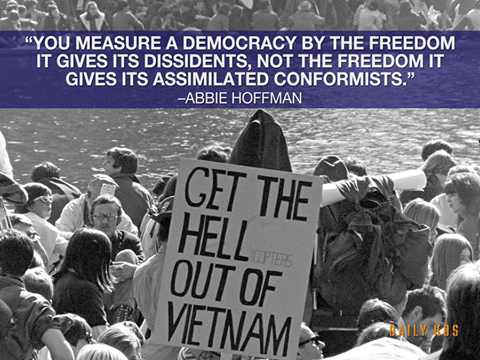
[May 3d] is an ugly anniversary in American history: 42 years ago, National Guardsman opened fire on anti-Vietnam protesters at Ohio’s Kent State University, killing four students. Ten days later, Mississippi police fired on civil rights protesters taking refuge in a women’s dormitory at Jackson State University and killed two more students.

Four decades later, as police across the country deploy paramilitary tactics developed for fighting foreign terrorists on Occupy and some May Day protests, and as campus police ratchet up responses to tuition hike protests, we must ask, is this where things inevitably are headed—toward deadly confrontations between overly armed police and angered protesters, or just as likely, innocent bystanders caught in a crossfire?

[...]

The Kent and Jackson State anniversaries underscore many questions. When and where will a fatal police overreaction take place? Who will be the victim? What will be the reaction, including from politicians who helped to unduly militarize the police? 

This scenario is not an accident waiting to happen. Police use undue force all the time, where the consequence is the armed police shooter kills an unarmed victim. It has happened many times in 2012, according to statistics compiled by the government, just not yet at an Occupy or student protest.

Read more . . .

Noam Chomsky: U.S. and Europe ‘committing suicide in different ways’ (VIDEO)

In an interview with GritTV’s Laura Flanders, author and MIT professor Noam Chomsky discussed the potentially bleak future facing both the United States and the European Union. Both, he said, are facing historic crises and are going about trying to resolve them in exactly the wrong ways.

According to Chomsky, we are currently living in a period of “pretty close to global stagnation” but that the world’s great powers are reacting to the lack of growth in exactly the wrong manner. “The United States and Europe are committing suicide in different ways, but both doing it.”

[...]

It’s also a mistake, he said, to treat the Republican Party as a genuine political party rather than the “lock-step” policy arm of the superrich. Of course, the wealthy can’t sell the idea of a plutocracy to the population outright, so they mobilize the socially conservative base by stoking the so-called “culture wars.”

Chomsky has a new book, Occupy, about the Occupy Wall Street movement, what it says about society and humanity’s way forward through this time of economic and social stagnation. He calls OWS “the first major public response to 30 years of class war” and believes that the movement’s greatest success has been the introduction of the inequalities of everyday life into the public dialogue.

The nearly half-hour discussion ranges over a number of topics, but keeps coming back again and again to the importance of individual engagement in society and the political system, and the power of Occupy as a force for social and political change.

Watch the full interview here . . .

Noam Chomsky: May Day

Zuccotti Park Press, a project of Adelante Alliance, a Brooklyn-based immigrant advocacy group, is releasing Occupy, a new book by Noam Chomsky, on May Day.

People seem to know about May Day everywhere except where it began, here in the United States of America. That’s because those in power have done everything they can to erase its real meaning. For example, Ronald Reagan designated what he called “Law Day” — a day of jingoist fanaticism, like an extra twist of the knife in the labor movement. Today, there is a renewed awareness, energized by the Occupy movement’s organizing, around May Day, and its relevance for reform and perhaps eventual revolution.

Read more . . .

Wallace Shawn reads Howard Zinn

Actor Wallace Shawn reads the speech of historian Howard Zinn given at Johns Hopkins University on Civil Disobedience, November 1970. Part of a reading from Voices of a People’s History of the United States (Howard Zinn and Anthony Arnove) May 2, 2007 in New York, NY. 

Anarchism Is Not What You Think It Is—And There’s a Whole Lot We Can Learn from It

On February 8, 1921 twenty thousand people, braving temperatures so low that musical instruments froze, marched in a funeral procession in the town of Dimitrov, a suburb of Moscow. They came to pay their respects to a man, Petr Kropotkin, and his philosophy, anarchism.

Some 90 years later few know of Kropotkin. And the word anarchism has been so stripped of substance that it has come to be equated with chaos and nihilism.  This is regrettable, for both the man and the philosophy that he did so much to develop have much to teach us in 2012. . . .

The precipitating event that led Kropotkin to embrace anarchism was the publication of Charles Darwin’s Origin of the Species in 1859. . . .

He spent the rest of his life promoting that concept and the theory of social structure known as anarchism. To Americans anarchism is synonymous with a lack of order. But to Kropotkin anarchist societies don’t lack order but the order emerges from rules designed by those who feel their impact, rules that encourage humanly scaled production systems and maximize individual freedom and social cohesion.

Read more . . .