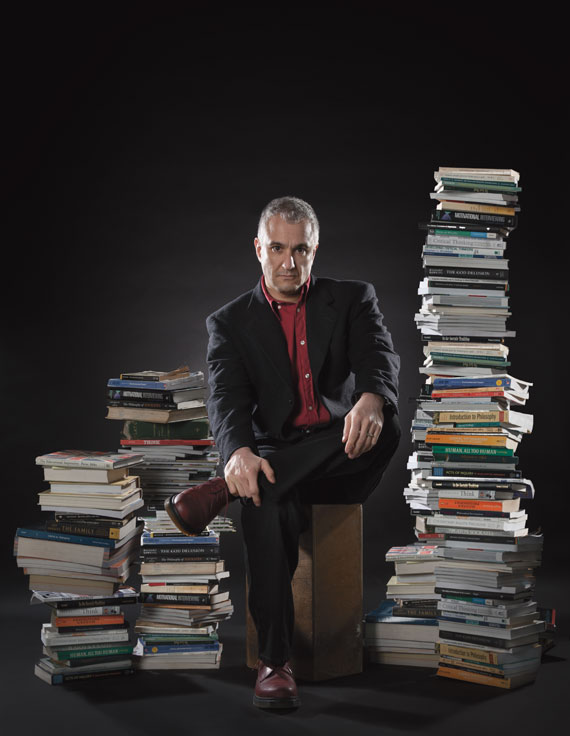
DR. PETER BOGHOSSIAN is a full-time faculty member in Portland State University’s philosophy department who is well known around campus for directly challenging his student’s faith-based beliefs. He’s also had his fair share of criticism for such recent public lectures as “Jesus, the Easter Bunny, and Other Delusions: Just Say No!” and “Faith as a Cognitive Sickness,” which drew hundreds of attendees.
MERCURY: You often speak out against faith, calling it a delusion and a cognitive sickness. How come?
PETER BOGHOSSIAN: Because enough is enough. A lot of people are sick and tired of being held hostage to the delusions of others, and I’m one of those people. I think that people are hungry for a frank, honest discussion about things—particularly about faith. To profess things you don’t know for certain, and then claim the reason for your justification is faith? That doesn’t contribute to the conversation. That’s the end of the conversation. . . .
. . . That is outside the bounds of reason. The only thing you can say is “go to the children’s table.” Those are the sorts of things that come up when we as a society don’t value critical rationality. . . .
. . . A colleague told me one of my talks offended him. I said, “Your offense means nothing to me.” Nor should it. If you want to provide reasons and evidence then you can sit at the adult table and we can talk about that. But just “I’m offended” carries no legitimacy. . . I think maybe part of the solution to making these cultural changes is to treat faith-based claims like racist claims. To stigmatize those claims. “That’s not cool, we don’t let that into the discussion.” It’s not about a right to believe—believe whatever you want. It’s about the truth or falsity of a belief and about a process that will lead you to the truth or not. Clutch your Bible? Sit at the children’s table.
. . . Not pretending to know things that you don’t know is a virtue.
Always Question Authority
One of the beginnings of human emancipation is the ability to laugh at authority. ~ Hitchens
 Always Question Authority
Oh yes, he sounds my sort of man.
I agree with every word! These people are dangerous at the fundamental level and at their normal just plain boring and irritating!
faith as defined below can not be taken away from “rational thought”.
otherwise how would one get to work each day and function properly…?
faith in waking up> faith in car starting> faith in foot path holding up your weight> faith in your coffee being hot> faith that physics itself will still work as it has for the past trillion years (or did it?)> Faith that what ever power put all this galactic stuff together wont just decide today is the day to start all over again, so one can get back home again and rationalize out how with out faith in anything one could hope to go to sleep peacefully???
faith
1. confidence or trust in a person or thing: faith in another’s ability.
2. belief that is not based on proof: He had faith that the hypothesis would be substantiated by fact.
3. belief in God or in the doctrines or teachings of religion: the firm faith of the Pilgrims.
4. belief in anything, as a code of ethics, standards of merit, etc.: to be of the same faith with someone concerning honesty.
5. a system of religious belief: the Christian faith; the Jewish faith.
6. the obligation of loyalty or fidelity to a person, promise, engagement, etc.: Failure to appear would be breaking faith.
7. the observance of this obligation; fidelity to one’s promise, oath, allegiance, etc.: He was the only one who proved his faith during our recent troubles.
8. Christian Theology . the trust in God and in His promises as made through Christ and the Scriptures by which humans are justified or saved.
You’re confusing trust that is based on probabilities (which, in turn, are based on observation) with trust that is based on supernatural beliefs. If you’re claiming these are the same, then you would have to show how Christian theology, for example, is objectively true whereas the belief in ghosts (which is part of ancestor worship as practiced in Asia), Hinduism, and Taoism are not. Good luck with that.