The Story of Broke (2011) -Teaser Two
Reply
Wow, what a loss that would be, a protest free of hypocrisy, hate, and bigotry.
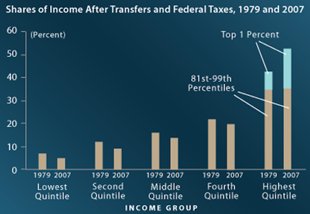
As the chart at right shows, between 1979 and 2007, the share of after-tax income going to each of the bottom four income quintiles–the bottom 80 percent–has dropped. The only quintile that has increased its share is the top 20 percent. And the top 1 percent has more than doubled its share
. . . The Occupy Wall Street movement has made inequality [emphasis added] a key focus of its protests, and has used the slogan, “We are the 99 percent.”
Read more . . .
Watch from time-hack 13:50 – 20:15
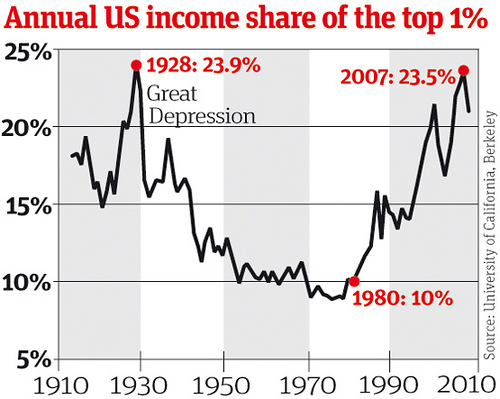
If you want to get some idea of why the 99 per cent movement has attracted so much support in the US, just take a look at this graph. Over the last thirty years, the share of income taken by the top 1 per cent of Americans has risen from 10 per cent to 23.5 per cent . . . As you’ll notice, from the 1950s onwards, income distribution in the US remained broadly stable until the Thatcher-Reagan revolution. The neoliberal policies pursued by the Reagan administration – tax cuts for the wealthy (the top rate of tax was reduced from 50 per cent to 28 per cent), deregulation and privatisation, led to a dramatic rise in inequality.
Read more . . .
Sean Faircloth, Director of Strategy and Policy for the US branch of the Richard Dawkins Foundation for Reason and Science, discusses his new book, Attack of the Theocrats: How the Religious Right Harms Us All—and What We Can Do About It, which examines the crumbling of the United States’ most cherished founding principle—the wall of separation between church and state—and offers a specific and sensible plan for rebuilding the church-state wall. The book also names The Fundamentalist Fifty, current members of Congress who have made some of the most extreme theocratic statements. If they weren’t so scary, they’d be funny.
Watch video here . . .
 Avram Noam Chomsky, Ph.D., (born December 7, 1928)
American Linguist, Philosopher, Cognitive Scientist, Professor (Emeritus)
Department of Linguistics & Philosophy at MIT, Author, and Activist
The reality is that under capitalist conditions–meaning maximization of short-term gain–you’re ultimately going to destroy the environment: the only question is when.
Noam Chomsky, Understanding Power: The Indispensable Chomsky,(The New York Press, 2002), 58.
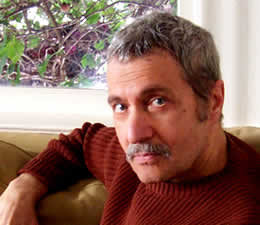 Michael Parenti, Ph.D., (born 1933) Political Scientist,
Political Scientist, Historian, Author, Lecturer, and Culture Critic
Wealth is pursued without moral restraint. The very rich try to crush anyone who resists their endless, heartless, unprincipled accumulation. Like any addiction, money is pursued in that obsessive, amoral, singleminded way, revealing a total disregard for what is right or wrong, just or unjust, an indifference to other considerations and other people’s interests–and even one’s own interests should they go beyond feeding the addiction.
Thus it is necessary and desirable to have laws to protect the environment, workers’ lives, and consumer health because big business has a total indifference to such things, and–to the extent that they cut into profits–an outright hostility toward regulations on behalf of the public interest. We sometimes forget how profoundly immoral is cooperate power.
Michael Parenti, Blackshirts & Redshirts, (City Light Books, 1997), 154.