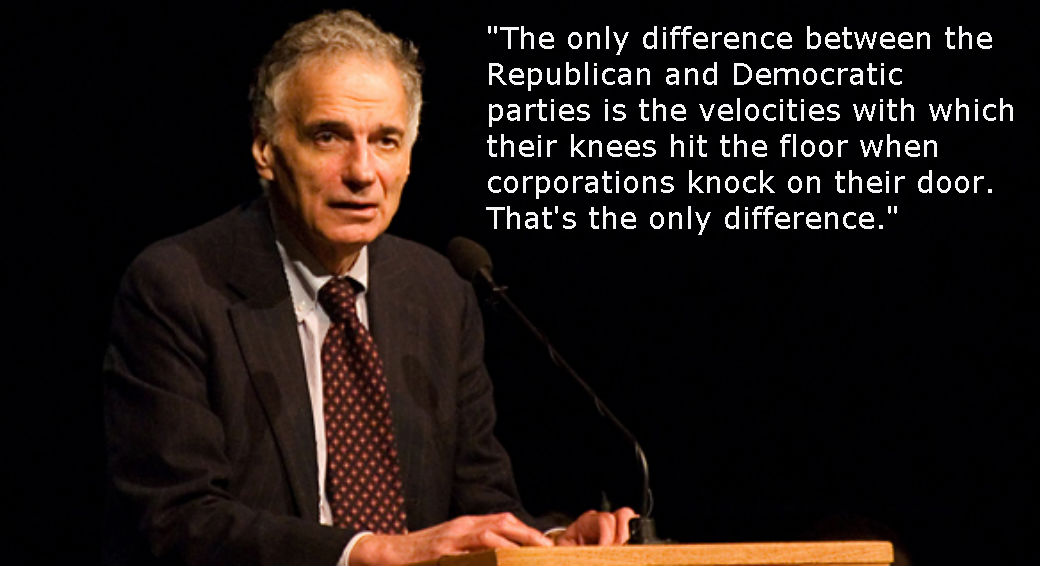
The Only Difference Between A Republican and A Democrat
1
Since only millionaires and morons vote for Republicans, and the majority are not millionaires, what does that make the majority, if not all, of the Republicans?
Well, let’s look at the syllogism and see:
If not A, then B
Premise A = majority of Republicans are millionaires
Premise B = majority of Republicans, if not all, are morons
Conclusion = Since a majority of Republicans are not millionaires, then the majority, if not all, of Republicans are morons.
QED [MSH] M-O-U-S-E
 Source: new deal 2.0
 Cesar Chavez was a civil rights activist, labor leader, and co-founder of what would become the United Farm Workers.
Source: MoveOn.org
The super-rich might not be so outraged by accusations that they haven’t earned their money fairly if they didn’t know it was true. . .
Many of today’s super-rich, particularly in the financial sector, have achieved their wealth in ways that are fundamentally anti-capitalist. As a consequence, people are justifiably wondering whether we have an economy that operates on the principles of capitalism or of oligarchy. . .
Are the rich and successful the creators of wealth and jobs for all of us, or are they the predators and moochers (Ayn Rand’s term in Atlas Shrugged), the reverse Robin Hoods who succeed by finding ways to redistribute wealth upwards?
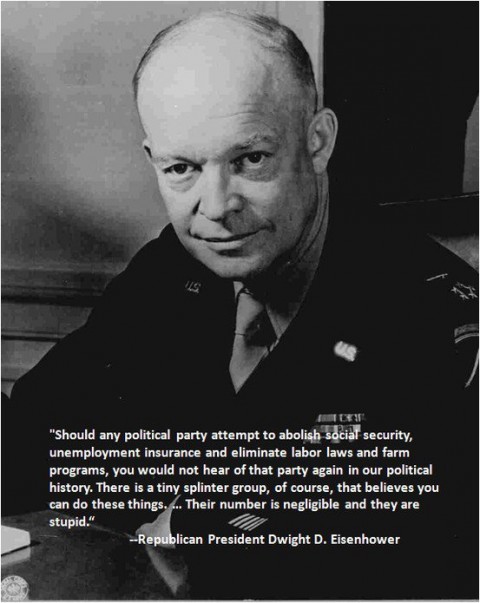 Found at MoveOn.org on 12.21.2011
Labour unions are under fire across the US, but do they have enough vitality to fight back?
For decades, labour unions in the US have been on the decline. While they are widely credited with boosting safety standards and worker pay, many have received blame for wanting too much in times of a struggling economy.
Unemployment is at nine per cent and people are clamouring for jobs, unionised or not. And their greatest political ally, the Democratic party, has taken its support for granted, weakening its pull on the strings of power in Washington, DC.
A new battle has emerged in 2011 as Republican governors have taken on public sector unions, in some cases stripping them of rights that have been in place for 50 years. It is part of a trend that is happening in key swing states and may weaken democratic voting strength in next year’s presidential election.
But organised labour has fought back hard. In Wisconsin, unions occupied the state capitol as 100,000 protesters took to the streets. In Ohio, voters overturned a law that was intended to greatly reduce the right that unions have in that state to bargain collectively.
Now as Occupy Wall Street galvanises Americans to take action against financial institutions and big corporations, labour unions have a new ally. But can organised labour harness the anger that everyday Americans are emitting or will this opportunity pass it by? Do labour unions still have the strength to organise or has their power waned to the point that they will no longer be a major player in American politics?
. . . “Big government” isn’t the problem. The problem is big money is taking over government.
Government is doing less of the things most of us want it to do — providing good public schools and affordable access to college, improving our roads and bridges and water systems, and maintaining safety nets to catch average people who fall — and more of the things big corporations, Wall Street, and the wealthy want it to do.
. . . A smaller government that’s still dominated by money would continue to do the bidding of Wall Street, the pharmaceutical industry, oil companies, big agribusiness, big insurance, military contractors, and rich individuals.

 Always Question Authority