***MUST WATCH***MUST WATCH ***MUST WATCH***MUST WATCH***
Thom Hartmann: Norwegians Heckle Fear with Singing not Bombs
1

***MUST WATCH***MUST WATCH ***MUST WATCH***MUST WATCH***
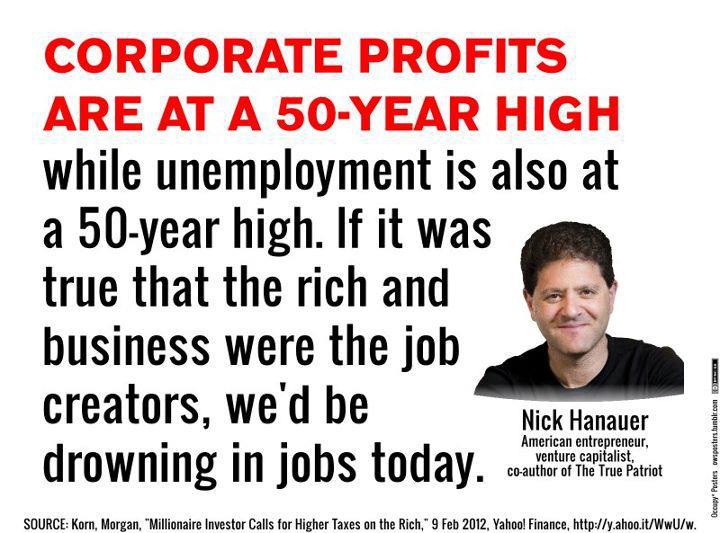
With the nation’s unemployment rate still above eight percent, millions of Americans are looking for work, and the country’s biggest corporations are hiring. According to a new report from the Wall Street Journal, however, many of those corporations are adding jobs overseas at a faster pace than they are at home. Even worse, others are cutting their domestic workforces while adding jobs in other countries at a rapid pace.
 Source: Daily Kos by BrianMcFadden for Comics
 Source: MoveOn.org
Across the United States more than 2,700 companies are collecting state income taxes from hundreds of thousands of workers – and are keeping the money with the states’ approval, says an eye-opening report published on Thursday.
The report from Good Jobs First, a nonprofit taxpayer watchdog organization funded by Ford, Surdna and other major foundations, identifies 16 states that let companies divert some or all of the state income taxes deducted from workers’ paychecks. None of the states requires notifying the workers, whose withholdings are treated as taxes they paid.
[…]
CORPORATE SOCIALISM
Deals cut with the states over the past two decades diverted $5.5 billion from public purposes to private gain, the report says. Close to $700 million more was diverted last year, Good Jobs First estimates.
[…]
These deals typify corporate socialism, in which business gains are privatized and costs socialized. They also mean government picks winners and losers, interfering with competitive markets. Leaders in both parties embrace these giveaways because they draw campaign donations from corporate interests and votes from people who do not understand that they are subsidizing huge companies.
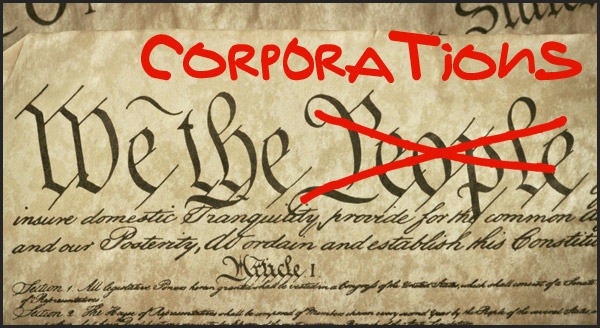
Historically, corporations were understood to be responsible to a complex web of constituencies, including employees, communities, society at large, suppliers, and shareholders. But in the era of deregulation, the interests of shareholders began to trump all the others. . . .
The Myth of Profit Maximizing
“It is literally – literally – malfeasance for a corporation not to do everything it legally can to maximize its profits. That’s a corporation’s duty to its shareholders.”
Since this sentiment is so familiar, it may come as a surprise that it is factually incorrect: In reality, there is nothing in any U.S. statute, federal or state, that requires corporations to maximize their profits. More surprising still is that, in this instance, the untruth was not uttered as propaganda by a corporate lobbyist but presented as a fact of life [A MUST READ, only seven pages] by one of the leading lights of the Democratic Party’s progressive wing, Sen. Al Franken. Considering its source, Franken’s statement says less about the nature of a U.S. business corporation’s legal obligations – about which it simply misses the boat – than it does about the point to which laissez-faire ideology has wormed its way into the American mind.
[…]
A Shift in Accountability
Even after eight years of Reagan and amid the burgeoning of free-market ideology, the Business Roundtable remained reluctant to place shareholders first, affirming in 1990 that “corporations are chartered to serve both their shareholders and society as a whole” and adding creditors to the 1981 list of constituencies, which it otherwise retained intact. It was only in 1997, in a new statement whose title substituted “Corporate Governance” for “Corporate Responsibility,” that it renounced attempts to balance the interests of corporate constituents and, having reversed its view, argued that taking care of shareholders was the best way to take care of the remaining stakeholders, rather than the other way around:
“In the Business Roundtable’s view, the paramount duty of management and of boards of directors is to the corporation’s stockholders; the interests of other stakeholders are relevant as a derivative of the duty to stockholders. The notion that the board must somehow balance the interests of stockholders against the interests of other stakeholders fundamentally misconstrues the role of directors.”
This doctrine, known as “shareholder primacy,” now reigns in the corporate world today, and it has so increased the power of those whom it has benefited that it will not be easy to dislodge. Those who propagate it believe, or would have us believe, that it is based in law; in fact, it is supported by no more than ideology.


 Always Question Authority