A few days ago, Betsy, a trained librarian who lives in Brooklyn, came to the protest for the first time and found a short stack of books lying on the ground where everyone was camped out. She decided to go to one of the organizational meetings for the protests and ask if anyone else thought it would be a good idea to start a proper library. People did.
Read more . . .
Category Archives: Literature
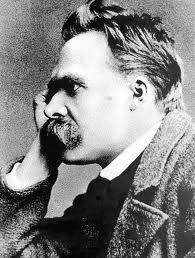
Friedrich Wilhelm Nietzsche (October 15, 1844 – August 25, 1900)
German Philosopher, Classical Philologist, Poet, and Composer, Atheist
It is impossible, as is commonly said, for us to ‘feel’ for others; we feel only for ourselves. The proposition sounds hard, but is not if it is correctly understood. One loves neither father, nor mother, nor wife, nor child, one loves the pleasant sensations they produce in us.
Essay: “Modern American Poetry” / Madison S. Hughes
By Madison S. Hughes (12.16.2009)
While enrolled as a student in a graduate Poetry class, I was pleasantly surprised to find many peculiar, and fascinating aspects to modern American poetry. To begin with, I had a huge misconception of American poets as a whole. I was under the impression that American poets would not be anywhere near the caliber of their European counterparts. What I found was that not only were they, dare I say, probably some of the best poets in all of history, but additionally, the historical time frame of which they were part concerning class, race and politics was absolutely fascinating. My goal in this paper is to dispel some of the misconceptions others may have concerning American poets, and share some of the fascinating history of their time. Continue reading
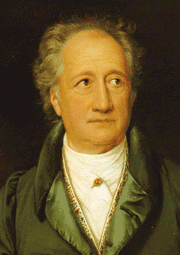
Johann Wolfgang von Goethe, FFRF: Freethought of the Day
On this date in 1749, Germany’s most famous poet, Johann Wolfgang von Goethe,was born in Frankfurt am Main, to a comfortable bourgeois family. He began studying law at Leipzig University at the age of 16, and practiced law briefly before devoting most of his life to writing poetry, plays and novels. In 1773, Goethe wrote the powerful poem “Prometheus” [quoted below], which urged human beings to believe in themselves, and not in the gods. His first novel was The Sorrows of Young Werther (1774), a semi-autobiographical tragedy about a doomed love affair. A line from that novel: “We are so constituted that we believe the most incredible things: and, once they are engraved upon the memory, woe to him who would endeavor to erase them.” In his 1797 Hermann and Dorothea, Goethe observed: “The happy do not believe in miracles.” Goethe typified the Sturm und Drang romantic movement, celebrating the individual. The Grand Duke of Weimar appointed him an administrator in 1775, where, according to historians, Goethe turned Weimar into “the Athens of Germany.” In supervising the arts and sciences, Goethe discovered the human intermaxilary bone, also known as the Goethe bone (1784), among other discoveries. After a sojourn in Italy from 1786 to 1788, Goethe returned to his art, writing for a journal edited by freethinker Friedrich von Schiller and starting his own. Inspired by Christopher Marlowe‘s play “Faust,” Goethe wrote part 1 of his most famous play, published in 1808. Part 2 was published in 1832. From Part 1, Scene 9: “The church alone beyond all question/ Has for ill-gotten gains the right digestion.” Although Goethe’s beliefs ebbed and flowed, he was uniformly anti-Christian and, at most, a pantheist. D. 1832.
Homer & the Gospel of Mark: Is Mark’s Gospel Based on Homer’s Odyssey?
. . . [O]ne recent line of research has involved tracing much in Mark to the influence of the Greek epics of Homer. Dennis MacDonald is the primary proponent of this view, and his argument has been that the gospel of Mark was written as a conscious and deliberate imitation of the stories in the Homeric epics. The goal was to give readers a familiar context to discover the superiority of Christ and Christianity over pagan gods and beliefs . . . MacDonald argues that Mark’s tales about Jesus are explicit imitations of Homeric tales about characters like Odysseus, Circe, Polyphemus, Aeolus, Achilles, and Agamemnon and his wife, Clytemnestra. Read more . . .