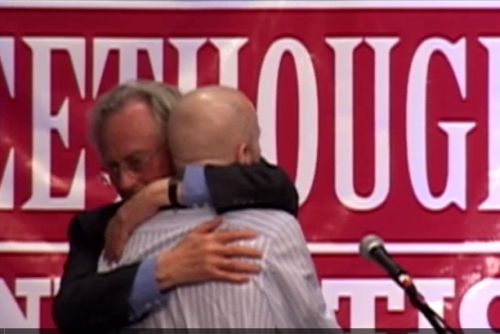
In “The tyranny of the discontinuous mind”, Dawkins wonders why we cling to absolutes of yes and no, black and white, rich and poor; pretending not to see the millions of grey areas in life. These absolutes, he argues, distort reality:
Dawkins goes on to consider a variety of these absolutes — where a blindness to intermediates may constrict or condemn us — beginning with the arguments proposed by anti-abortionists:
There are those who cannot distinguish a 16-cell embryo from a baby. They call abortion murder and feel righteously justified in committing real murder against a doctor – a thinking, feeling, sentient adult, with a loving family to mourn him . . .
It is amusing to tease such absolutists by confronting them with a pair of identical twins (they split after fertilisation, of course) and asking which twin got the soul, which twin is the non-person, the zombie. A puerile taunt? Maybe. But it hits home because the belief that it destroys is puerile, and ignorant.
Posted by New Statesman – 19 December 2011 17:47
Category Archives: Science
Fighting Faith
The Thinking Atheist’s Tribute to Christopher Hitchens
Sam Harris: In Memory of Christopher Hitchens
Hitch
The moment it was announced that Christopher Hitchens was sick with cancer, eulogies began spilling into print and from the podium. No one wanted to deny the possibility that he would recover, of course, but neither could we let the admiration we felt for him go unexpressed. It is a cliché to say that he was one of a kind and none can fill his shoes—but Hitch was and none can. In his case not even the most effusive tributes ring hollow. There was simply no one like him.
One of the joys of living in a world filled with stupidity and hypocrisy was to see Hitch respond. That pleasure is now denied us. The problems that drew his attention remain—and so does the record of his brilliance, courage, erudition, and good humor in the face of outrage. But his absence will leave an enormous void in the years to come. Hitch lived an extraordinarily large life. (Read his memoir, Hitch-22, and marvel.) It was too short, to be sure—and one can only imagine what another two decades might have brought out of him—but Hitch produced more fine work, read more books, met more interesting people, and won more arguments than most of us could in several centuries.
I first met Hitch at a dinner at the end of April 2007, just before the release of his remarkable book god is not Great. After a long evening, my wife and I left him standing on the sidewalk in front of his hotel. His book tour was just beginning, and he was scheduled to debate on a panel the next morning. It was well after midnight, but it was evident from his demeanor that his clock had a few hours left to run. I had heard the stories about his ability to burn the candle at both ends, but staggering there alongside him in the glare of a street lamp, I made a mental note of what struck me as a fact of nature—tomorrow’s panel would be a disaster.
I rolled out of bed the following morning, feeling quite wrecked, to see Hitch holding forth on C-SPAN’s Book TV, dressed in the same suit he had been wearing the night before. Needless to say, he was effortlessly lucid and witty—and taking no prisoners. There should be a name for the peculiar cocktail of emotion I then enjoyed: one part astonishment, one part relief, two parts envy; stir. It would not be the last time I drank it in his honor.
Since that first dinner, I have felt immensely lucky to count Hitch as a friend and colleague—and very unlucky indeed not to have met him sooner. Before he became ill, I had expected to have many more years in which to take his company for granted. But our last meeting was in February of this year, in Los Angeles, where we shared the stage with two rabbis. His illness was grave enough at that point to make the subject of our debate—Is there an afterlife?—seem a touch morbid. It also made traveling difficult for him. I was amazed that he had made the trip at all.
The evening before the event, we met for dinner, and I was aware that it might be our last meal together. I was also startled to realize that it was our first meal alone. I remember thinking what a shame it was—for me—that our lives had not better coincided. I had much to learn from him.I have been privileged to witness the gratitude that so many people feel for Hitch’s life and work—for, wherever I speak, I meet his fans. On my last book tour, those who attended my lectures could not contain their delight at the mere mention of his name—and many of them came up to get their books signed primarily to request that I pass along their best wishes to him. It was wonderful to see how much Hitch was loved and admired—and to be able to share this with him before the end.
I will miss you, brother.
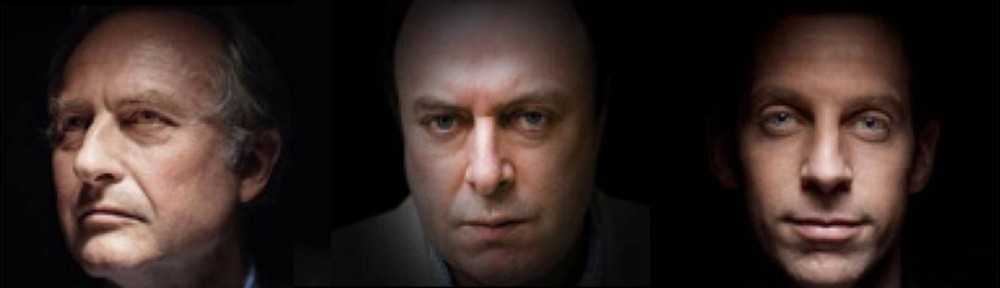
Quote: Richard Dawkins on the Death of Christopher Hitchens
Richard Dawkins Bids Farewell to Christopher Hitchens
Farewell, great voice. Great voice of reason, of humanity, of humour. Great voice against can’t, against hypocrisy, against obscurantism and pretension, against all tyrants including God. Farewell, great warrior. You were in a foxhole, Hitch, and you did not flinch. Farewell, great example to us all.
~ Richard Dawkins
Quote: Christopher Hitchens
Christopher Eric Hitchens (13 April 1949 – 15 December 2011)
English-American, Literary Critic, Journalist, Author,
Essayist, Polemicist, and Outspoken Anti-theist
The gods we have made are exactly the gods you would expect to be made from a species about a half a chromosome away from being chimpanzee.
Christian Bookstore Stops Selling Bible Because Proceeds Support Cancer Research, Cite Link To Planned Parenthood
The Susan G. Komen Foundation explicitly states that “Komen funding is used exclusively to provide breast cancer programs” and that “under no circumstances are Komen funds used to fund abortions or other non-breast services.” The goal is to help provide breast health education and breast screenings to thousands of low-income, uninsured, and under-served women through nearly 2,000 local organizations, of which only 19 of which are Planned Parenthood programs.
“Though we have assurances that Komen’s funds are used only for breast cancer screening and awareness, it is not in keeping with LifeWay’s core values to have even an indirect relationship with Planned Parenthood.”
The Faux Rage About a False War on Christmas
The divide in our society is not between rich and poor, or Catholic and Protestant, or Christian and Muslim, but between those have faith and those who have reason. . . Those who accept the idea of god tend to divide the world into believers and atheists. Yet that is incorrect. Atheist means “without god” and one cannot be without something that does not exist. . . But a more reasonable and neutral description of the two world views would be theists and rationalists (or humanists, take your pick). . . his hubris and conceit of human superiority as the only creature close to god is not benign, leading to catastrophic consequences for humanity. The species-centric arrogance of religion cultivates a dangerous attitude about our relationship with the environment and the resources that sustain us. Humanists tend to view sustainability as a moral imperative while theists often view environmental concerns as liberal interference with god’s will.
New Statesman Interview Preview: Richard Dawkins Interviews Christopher Hitchens
Fascism and the Catholic Church
RD The people who did Hitler’s dirty work were almost all religious.
CH I’m afraid the SS’s relationship with the Catholic Church is something the Church still has to deal with and does not deny.
RD Can you talk a bit about that – the relationship of Nazism with the Catholic Church?
CH The way I put it is this: if you’re writing about the history of the 1930s and the rise of totalitarianism, you can take out the word “fascist,” if you want, for Italy, Portugal, Spain, Czechoslovakia and Austria and replace it with “extreme-right Catholic party.”
Almost all of those regimes were in place with the help of the Vatican and with understandings from the Holy See. It’s not denied. These understandings quite often persisted after the Second World War was over and extended to comparable regimes in Argentina and elsewhere.