
On the show this week, Chris Hedges discusses the debacle in Afghanistan with Danny Sjursen, a graduate of West Point Military Academy, former US Army Major and author. He is a combat veteran who served in Iraq and later as an Army Captain in Afghanistan I command of B Troop in Kandahar Province from February 2011 to January 2012.
The debacle in Afghanistan is one more signpost of the end of the American empire. The two decades of combat, the one trillion dollars we wasted, the 100,000 troops deployed to subdue Afghanistan, the high-tech gadgets, artificial intelligence, cyberwarfare, Reaper drones armed with Hellfire missiles and GBU-30 bombs and the Global Hawk drones with high-resolution cameras. Then there is the Special Operations Command composed of elite rangers, SEALs and air commandos, black sites, torture, electronic surveillance, satellites, attack aircraft, mercenary armies, infusions of millions of dollars to buy off and bribe the local elites and train an Afghan army of 350,000 that has never exhibited the will to fight, failed to defeat a guerrilla army of 75,000 that funded itself through opium production and extortion in one of the poorest countries on earth.
Like any empire in terminal decay, no one will be held accountable for the debacle or for the other debacles in Iraq, Syria, Libya, Somalia, Yemen or anywhere else. Not the generals. Not the politicians. Not the CIA and intelligence agencies. Not the diplomats. Not the obsequious courtiers in the press who serve as cheerleaders for war. Not the compliant academics and area specialists. Not the defense industry. Empires at the end are collective suicide machines. The military becomes in late empire unmanageable, unaccountable, and endlessly self-perpetuating, no matter how many fiascos, blunders and defeats it visits upon the carcass of the nation, or how much money it plunders, impoverishing the citizenry and leaving governing institutions and the physical infrastructure decayed.
Danny Sjursen is the co-host of the podcast Fortress on a Hill, director of the Eisenhower Media Network and a senior fellow at the Center for International Policy. He is also the author of the new book A True History of the United States: Indigenous Genocide, Racialized Slavery, Hyper-Capitalism, Militarist Imperialism and Other Overlooked Aspects of American Exceptionalism.

 Bolivia’s President Evo Morales was overthrown in a military coup on November 10. He is now in Mexico. Before he left office, Morales had been involved in a long project to bring economic and social democracy to his long-exploited country. It is important to recall that Bolivia has suffered a series of coups, often conducted by the military and the oligarchy on behalf of transnational mining companies. Initially, these were tin firms, but tin is no longer the main target in Bolivia. The main target is its massive deposits of lithium, crucial for the electric car.
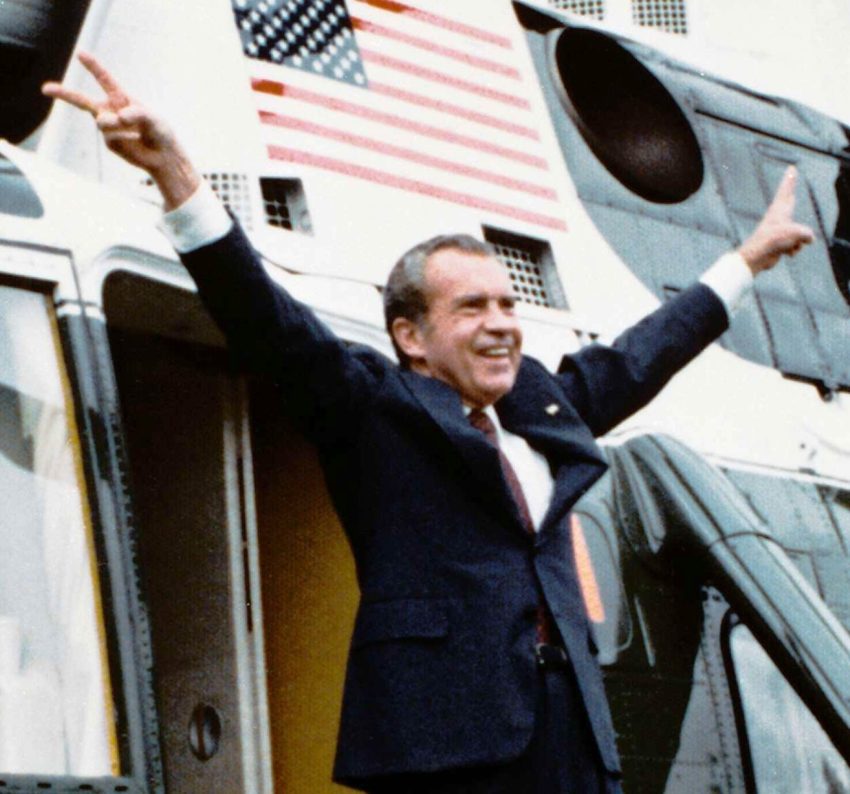 He was corrupt. He was petty, angry and resentful. He was also one of the most astute politicians in the annals of the American presidency. Time after time he overcame obstacles and defeats to rise again. His genius, ultimately, was this: He envisioned a new coalition and knew how to channel white resentment over the civil rights and antiwar movements into political triumph. This was his gift, and his legacy. Americans today inhabit the partisan universe that Richard Milhous Nixon crafted. Republican leaders to this very day speak Nixon’s language and employ Nixon’s tactics of fear and anger to win massive white majorities in election upon election. Indeed, though Nixon eventually resigned in disgrace before he could be impeached, the last half-century has been rather kind to the Republican Party. Only three Democrats have been elected president in that period, and Republicans have reigned over the White House for a majority of the post-Nixon era.
 Always Question Authority