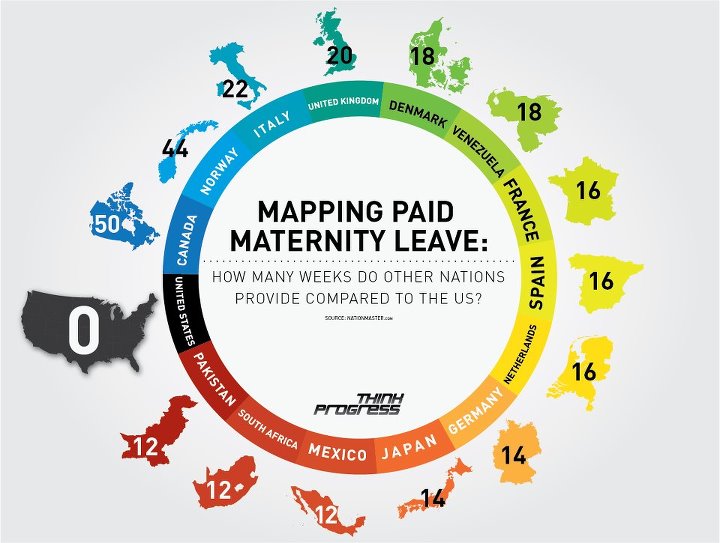
CHRISTIANITY: Zero Weeks Maternity Leave from the most Religious Nation in the Industrialized World
1
 Source: The Peoples Boycott’s Page
Reality Check! President Obama has finally spoken truth to the long-standing myth that executive business experience brings added value to the Presidency. Do not for one New York second believe that he, or any other political puppet of the corporate state, is not on the former sides of the conditionals in the post title. He also blew a whole in the myth of military experience being a significant factor in execution of Commander-in-chief duties (puns intended). Do not for one New York second believe that he, or any other political puppet of the corporate state, is not on the sides of the military industrial complex either. Need we discuss the industrial police state . . . neither did I. [MSH]
Moyers & Company, a current affairs program featuring Bill Moyers and airing on PBS stations nationwide, had a segment on Sunday evening with RoseAnn DeMoro, executive director of National Nurses United, the largest union and professional association of registered nurses in the country, with 170,000 members.
The interview focuses on the union’s call for a Robin Hood Tax, a sales tax on Wall Street speculation that could raise up to $350 billion a year in revenue.
“The money generated,” says Moyers in the program note, “could be used for social programs and job creation – ultimately to people who, without a doubt, need it more than the banks do. Though the power and influence of Big Banking is intimidating, DeMoro and her organization have an inspiring history of defeating some of the toughest opponents in government and politics.”
The nurses see the enduring effects of economic hardship on patients and communities across the nation, says DeMoro. The revenue from the Robin Hood Tax is the first step to healing distressed communities and setting the United States on the road to a real recovery. More than 40 countries, including many of the fastest-growing economies, already have such a tax, and it may well be adopted European Union-wide this year.
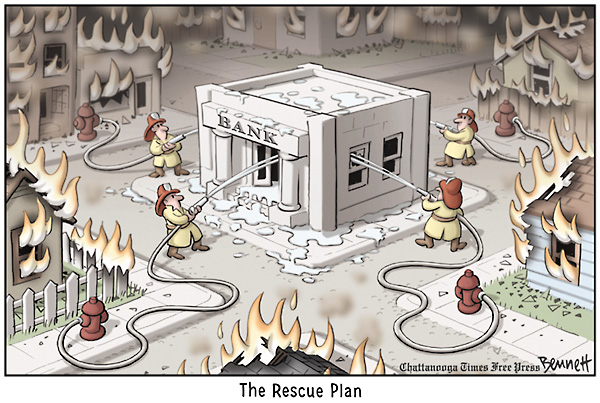
For the last half-century, capitalism has been a taboo subject in the United States. . . . Politicians repeated, robot-style, that the “U.S. is the greatest country in the world” and that “capitalism is the greatest economic system in the world.” Those few who have dared to raise questions or criticisms about capitalism have been either ignored or told to go live in North Korea, China or Cuba as if that were the only alternative to pro-capitalism cheerleading.
[…]
Questioning and criticizing capitalism have been taboo, treated by federal authorities, immigration officials, police and most of the public alike as akin to treason. Fear-driven silence has substituted for the necessary, healthy criticism without which all institutions, systems, and traditions harden into dogmas, deteriorate into social rigidities, or worse. Protected from criticism and debate, capitalism in the United States could and has indulged all its darker impulses and tendencies. No public exposure, criticism and movement for change could arise or stand in its way as the system and its effects became ever more unequal, unjust, inefficient and oppressive. Long before the Occupy movement arose to reveal and oppose what U.S. capitalism had become, that capitalism had divided the 1 percent from the 99 percent.
[…]
Across the pages that follow, what emerges is the central importance of how capitalism very particularly organizes production: masses of working people generate corporate profits that others take and use. Tiny boards of directors, selected by and responsible to tiny groups of major shareholders, gather and control corporate profits, thereby shaping and dominating society. That tiny minority (boards and major shareholders) of those associated with and dependent upon corporations make all the basic decisions—how, what, and where to produce and what to do with the profits. The vast majority of workers within and residents surrounding those capitalist corporations must live with the results of corporate decisions. Yet they are systematically excluded from participating in making those decisions. Nothing more glaringly contradicts democracy than how capitalism organizes the corporate enterprises where working people produce the goods and services without which modern life for everyone would be impossible.
From: Occupy the Economy: Challenging Capitalism By Richard Wolff


 Always Question Authority