Sam Harris Simply Destroys Catholicism
4
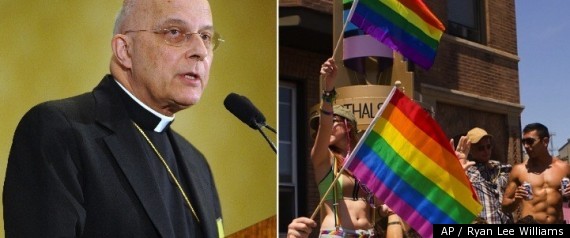
“I go with the pastor,” George told Fox. “He’s telling us that he won’t be able to have services on Sunday if that’s the case. You don’t want the gay liberation movement to morph into something like the Ku Klux Klan, demonstrating in the streets against Catholicism.”
When the Fox host pointed out that George’s comparison was “a little strong,” the cardinal stood by his statement.
“It is, but you take a look at the rhetoric,” he continued. “The rhetoric of the Klu Klux Klan, the rhetoric of some of the gay liberation people. Who is the enemy? Who is the enemy? The Catholic Church.”
. . . today’s Tea Party is less an ideological movement than the latest incarnation of an angry white minority – predominantly Southern, and mainly rural – that has repeatedly attacked American democracy in order to get its way.
. . . This isn’t to say all Tea Partiers are white, Southern or rural Republicans – only that these characteristics define the epicenter of Tea Party Land.
America has had a long history of white Southern radicals who will stop at nothing to get their way – seceding from the Union in 1861, refusing to obey Civil Rights legislation in the 1960s, shutting the government in 1995, and risking the full faith and credit of the United States in 2010.
Labour unions are under fire across the US, but do they have enough vitality to fight back?
For decades, labour unions in the US have been on the decline. While they are widely credited with boosting safety standards and worker pay, many have received blame for wanting too much in times of a struggling economy.
Unemployment is at nine per cent and people are clamouring for jobs, unionised or not. And their greatest political ally, the Democratic party, has taken its support for granted, weakening its pull on the strings of power in Washington, DC.
A new battle has emerged in 2011 as Republican governors have taken on public sector unions, in some cases stripping them of rights that have been in place for 50 years. It is part of a trend that is happening in key swing states and may weaken democratic voting strength in next year’s presidential election.
But organised labour has fought back hard. In Wisconsin, unions occupied the state capitol as 100,000 protesters took to the streets. In Ohio, voters overturned a law that was intended to greatly reduce the right that unions have in that state to bargain collectively.
Now as Occupy Wall Street galvanises Americans to take action against financial institutions and big corporations, labour unions have a new ally. But can organised labour harness the anger that everyday Americans are emitting or will this opportunity pass it by? Do labour unions still have the strength to organise or has their power waned to the point that they will no longer be a major player in American politics?
[T]he people at Politifact are terrified of being considered partisan if they acknowledge the clear fact that there’s a lot more lying on one side of the political divide than on the other. So they’ve bent over backwards to appear “balanced” — and in the process made themselves useless and irrelevant.
In “The tyranny of the discontinuous mind”, Dawkins wonders why we cling to absolutes of yes and no, black and white, rich and poor; pretending not to see the millions of grey areas in life. These absolutes, he argues, distort reality:
Dawkins goes on to consider a variety of these absolutes — where a blindness to intermediates may constrict or condemn us — beginning with the arguments proposed by anti-abortionists:
There are those who cannot distinguish a 16-cell embryo from a baby. They call abortion murder and feel righteously justified in committing real murder against a doctor – a thinking, feeling, sentient adult, with a loving family to mourn him . . .
It is amusing to tease such absolutists by confronting them with a pair of identical twins (they split after fertilisation, of course) and asking which twin got the soul, which twin is the non-person, the zombie. A puerile taunt? Maybe. But it hits home because the belief that it destroys is puerile, and ignorant.
Posted by New Statesman – 19 December 2011 17:47
America’s anti-obesity plan: Just say no
Meanwhile, in the United States, obesity has become like global warming: Actual evidence has little relevance in political debates, because what’s at stake is ideology. The anti-tax and anti-regulation fervor of America’s conservative movement makes taxing and regulating unhealthy food all but impossible here. But the issue goes deeper than that.
It turns out that the obesity problem is a profound challenge to the fundamental tenet of American conservatism. If progressivism’s most basic belief is that we are in this together–that our fates are interconnected–conservatism cherishes “rugged individualism” above all else. This is why evangelical Christianity and political conservatism are so compatible: Both focus on individual human will.
Hitch
The moment it was announced that Christopher Hitchens was sick with cancer, eulogies began spilling into print and from the podium. No one wanted to deny the possibility that he would recover, of course, but neither could we let the admiration we felt for him go unexpressed. It is a cliché to say that he was one of a kind and none can fill his shoes—but Hitch was and none can. In his case not even the most effusive tributes ring hollow. There was simply no one like him.
One of the joys of living in a world filled with stupidity and hypocrisy was to see Hitch respond. That pleasure is now denied us. The problems that drew his attention remain—and so does the record of his brilliance, courage, erudition, and good humor in the face of outrage. But his absence will leave an enormous void in the years to come. Hitch lived an extraordinarily large life. (Read his memoir, Hitch-22, and marvel.) It was too short, to be sure—and one can only imagine what another two decades might have brought out of him—but Hitch produced more fine work, read more books, met more interesting people, and won more arguments than most of us could in several centuries.
I first met Hitch at a dinner at the end of April 2007, just before the release of his remarkable book god is not Great. After a long evening, my wife and I left him standing on the sidewalk in front of his hotel. His book tour was just beginning, and he was scheduled to debate on a panel the next morning. It was well after midnight, but it was evident from his demeanor that his clock had a few hours left to run. I had heard the stories about his ability to burn the candle at both ends, but staggering there alongside him in the glare of a street lamp, I made a mental note of what struck me as a fact of nature—tomorrow’s panel would be a disaster.
I rolled out of bed the following morning, feeling quite wrecked, to see Hitch holding forth on C-SPAN’s Book TV, dressed in the same suit he had been wearing the night before. Needless to say, he was effortlessly lucid and witty—and taking no prisoners. There should be a name for the peculiar cocktail of emotion I then enjoyed: one part astonishment, one part relief, two parts envy; stir. It would not be the last time I drank it in his honor.
Since that first dinner, I have felt immensely lucky to count Hitch as a friend and colleague—and very unlucky indeed not to have met him sooner. Before he became ill, I had expected to have many more years in which to take his company for granted. But our last meeting was in February of this year, in Los Angeles, where we shared the stage with two rabbis. His illness was grave enough at that point to make the subject of our debate—Is there an afterlife?—seem a touch morbid. It also made traveling difficult for him. I was amazed that he had made the trip at all.
The evening before the event, we met for dinner, and I was aware that it might be our last meal together. I was also startled to realize that it was our first meal alone. I remember thinking what a shame it was—for me—that our lives had not better coincided. I had much to learn from him.I have been privileged to witness the gratitude that so many people feel for Hitch’s life and work—for, wherever I speak, I meet his fans. On my last book tour, those who attended my lectures could not contain their delight at the mere mention of his name—and many of them came up to get their books signed primarily to request that I pass along their best wishes to him. It was wonderful to see how much Hitch was loved and admired—and to be able to share this with him before the end.
I will miss you, brother.
I think he was one of the greatest orators of all time. He was a polymath, a wit, immensely knowledgeable, and a valiant fighter against all tyrants including imaginary supernatural ones.
His was truly a transatlantic voice, serviceable for skewering an international rogue’s gallery of politicians. His shots were fiercely partisan, precisely angled like a billiard shot, but the anger was controlled, even detached. When his anger overflowed on people or ideas he loathed (he was a good hater), he distilled it until it came out as gelid disdain. He took pride in always having the facts to back up his opinions, which never gave the impression of being shallow or glibly arrived at. . .
I take it as res ipsa loqitur (look at him—channeling Hitchensesque erudition) that he was soundly educated. But he wore his erudition lightly and used it practically, a storehouse to draw upon. He seemed to have read everything and remembered most of it.
Sarcasm and invective were prominent weapons in his armamentarium, of course, kept well oiled, ready to fire off against fools on both left and right. He was not particularly humorous, though some found him funny; irony was his most congenial mode.
We are proud to have been present at the creation of “our” Christopher Hitchens, one of the longest-running columnists in the magazine’s history. As a demonstration of his achievements in our pages, here is a degustation of his articles and columns from 1978 through 2006.





 Always Question Authority