Earlier this year, Andrew Zak Williams asked public figures why they believe in God. Now it’s the turn of the atheists – from A C Grayling to P Z Myers – to explain why they don’t.
Faith no more
Reply
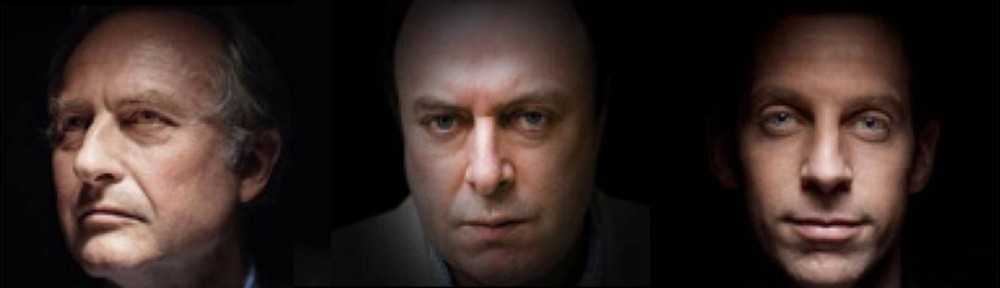
 Image found here on 12.22.2011
In A Nutshell…
The mind virus of religious belief preys on fear, warps instinctive attributes and skews morality. It contradicts responsible behavior, reason and compassion. It retards free will and causes a lack of ability to differentiate between rational and irrational choices. It allows the religionist to exist in a perfectly rational way in many other aspects of their existence in society while the infected area of the mind is stuck in a cyclical delusion. . .
Conversion Immersion…
Just as a physical virus does, Fundamental Christianity protects itself by sequestering the infected host against outside attack. Thus, the “world” is discredited. Any evidence that is contrary to doctrine is willfully ignored and taught as persecution. In the real world, this stunting of intelligence causes a decline in mental health due to the allowance of instruction only through approved church doctrine. . .
Reason Is The Enemy…
The viral use of fear is particularly effective on believers who were already ignorant and superstitious prior to their conversion, but the virus of fundamental religion has propagated and adapted well only until very recently. . . The virus of fundamental Christianity is getting most of the press and although it is often marketed as the true religion of love and tolerance, inwardly it is a destructive force that causes division, promotes willful ignorance and retards intellectual growth. . .
An Atheist’s “Great Hope”
The rise of atheism on planet Earth has already caused fundamental religious belief problems maintaining itself in our post-modern world. Religious apologetics have stagnated. Like a virus that is running toward the end of its course, the meme of fundamentalism is losing its ability to replicate.
 Posted on December 21, 2011 by Bengie
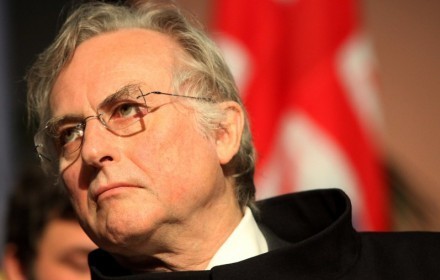
In “The tyranny of the discontinuous mind”, Dawkins wonders why we cling to absolutes of yes and no, black and white, rich and poor; pretending not to see the millions of grey areas in life. These absolutes, he argues, distort reality:
Dawkins goes on to consider a variety of these absolutes — where a blindness to intermediates may constrict or condemn us — beginning with the arguments proposed by anti-abortionists:
There are those who cannot distinguish a 16-cell embryo from a baby. They call abortion murder and feel righteously justified in committing real murder against a doctor – a thinking, feeling, sentient adult, with a loving family to mourn him . . .
It is amusing to tease such absolutists by confronting them with a pair of identical twins (they split after fertilisation, of course) and asking which twin got the soul, which twin is the non-person, the zombie. A puerile taunt? Maybe. But it hits home because the belief that it destroys is puerile, and ignorant.
Posted by New Statesman – 19 December 2011 17:47
Hitchling [hitch-ling] noun – a child void of religious indoctrination who is encouraged to read broadly and to seek the truth unapologetically
Found at SocraticMama on 12.18.2011
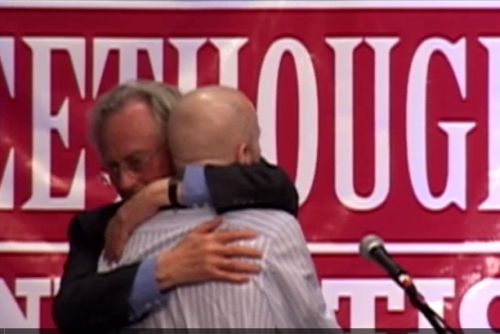
I think he was one of the greatest orators of all time. He was a polymath, a wit, immensely knowledgeable, and a valiant fighter against all tyrants including imaginary supernatural ones.
~ Richard Dawkins
Fascism and the Catholic Church
RD The people who did Hitler’s dirty work were almost all religious.
CH I’m afraid the SS’s relationship with the Catholic Church is something the Church still has to deal with and does not deny.
RD Can you talk a bit about that – the relationship of Nazism with the Catholic Church?
CH The way I put it is this: if you’re writing about the history of the 1930s and the rise of totalitarianism, you can take out the word “fascist,” if you want, for Italy, Portugal, Spain, Czechoslovakia and Austria and replace it with “extreme-right Catholic party.”
Almost all of those regimes were in place with the help of the Vatican and with understandings from the Holy See. It’s not denied. These understandings quite often persisted after the Second World War was over and extended to comparable regimes in Argentina and elsewhere.




 Always Question Authority