
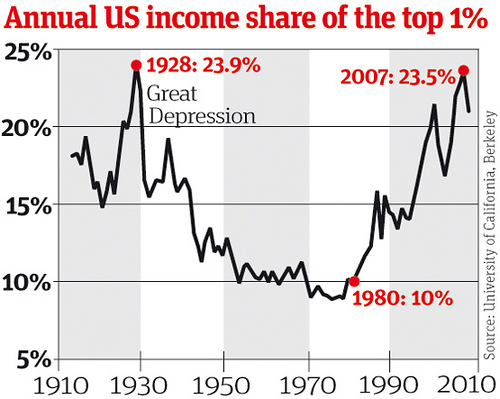
How Inequality Has Soared in the US

If you want to get some idea of why the 99 per cent movement has attracted so much support in the US, just take a look at this graph. Over the last thirty years, the share of income taken by the top 1 per cent of Americans has risen from 10 per cent to 23.5 per cent . . . As you’ll notice, from the 1950s onwards, income distribution in the US remained broadly stable until the Thatcher-Reagan revolution. The neoliberal policies pursued by the Reagan administration – tax cuts for the wealthy (the top rate of tax was reduced from 50 per cent to 28 per cent), deregulation and privatisation, led to a dramatic rise in inequality.
Read more . . . 
Pulpit Perversion Sunday: The Religious Right’s Partisan Scheme To Politicize Churches

The [Alliance Defense Fund] sponsored observance has one goal: to pave the way for Religious Right leaders to forge fundamentalist churches into a disciplined voting bloc . . .

American clergy are perfectly free to address any religious, moral and political issues they wish. The only limitation is that they cannot use their tax-exempt resources to endorse or oppose political candidates . . .

“For some religious conservatives, this policy isn’t just unwise; it’s unconstitutional,” the newspaper continued. “But tax exemption isn’t a constitutional right. It’s the creation of Congress, which has the right to attach conditions to that benefit. Put another way, churches may have a 1st Amendment right to comment on elections, but they don’t have the right to a tax exemption.”
Read more . . . 

The Anti-Wall Street Protesters’ Best Friend: Ray Kelly

Is Police Commissioner Raymond Kelly a closet supporter of Occupy Wall Street, the anti-establishment protest group that has been camped out in the financial district for the past week and a half? That’s what it’s looking like . . .

Over the past couple of days, the protesters, who are occupying Zuccotti Park, between Broadway and Trinity Place, have garnered headlines as far afield as London, Athens, and Jerusalem, as well the support of Michael Moore, Susan Sarandon, Cornel West, and Noam Chomsky . . .

On its regularly updated Web site, OccupyWallStreet.org, the group describes itself as “a leaderless resistance movement with people of many colors, genders and political persuasions,” likens itself to anti-government protesters in Egypt, Spain, and other places, and adds, “We plan to use the revolutionary Arab Spring tactic of mass occupation to restore democracy in America.”
Read more . . . 

The Occupy Wall Street Library

A few days ago, Betsy, a trained librarian who lives in Brooklyn, came to the protest for the first time and found a short stack of books lying on the ground where everyone was camped out. She decided to go to one of the organizational meetings for the protests and ask if anyone else thought it would be a good idea to start a proper library. People did.
Read more . . . 

Essay: “A Call to Revoke the Religious Tax Exemption”

By Madison S. Hughes (02.25.2011)

Abstract

It is time; nay it is long past time, to revoke the religious tax exemption. Granted, this proposition may instantly be viewed as yet another untouchable “third-rail” of politics; however, there are numerous economic arguments to be made against continuing this exemption. Past arguments against the religious tax exemption have largely fallen on deaf ears. Changing conditions, especially economic conditions, can place old arguments in a new light. The current government-funding crisis—at all governmental levels—is sufficiently dire, and it is long past time for a call to revoke the religious tax exemption. This paper will demonstrate that the religious tax exemption is responsible for considerable revenue loss, and has a negative impact on: school funding, public library funding, revenue generation, the U.S. Federal Budget Deficit, fairness, and equity. Additionally, the tax exemption: is not transparent, lends to corruption, does not hold persons or religious organizations accountable for corruption, and, therefore warrants a call to revoke the religious tax exemption.

Keywords: church, religious organizations, revocation of religious tax exemption Continue reading

Essay: “The Faith-Based Initiative: Flawed in Concept, Constitutionally Threatening, and Ineffective”

By Madison S. Hughes (11.07.2010)

Abstract

The Faith-Based Initiative (FBI) is a poverty-stricken solution to boosting the nation’s capacity in social services. The idea resonates especially in the current economic climate. Regardless of the economic conditions, the FBI is not a solution to the problem of providing necessary social services. At the same time, the substitution of religious institutions for putatively secular functions represents a clear and present violation to the Establishment Clause regarding the separation of Church and State. This paper will argue that while the objective of providing social services should be a paramount concern, the FBI fails to deliver on this objective on two counts. First, it remains a threat to our most vulnerable citizens because they represent a vehicle to impose specific religious creeds from their social service provider. As such, this initiative, while politically expedient, poses a substantial constitutional infringement, and is unacceptable as public policy. Secondly, to date the FBI has not produced a measurable gain in social service capacity. Continue reading