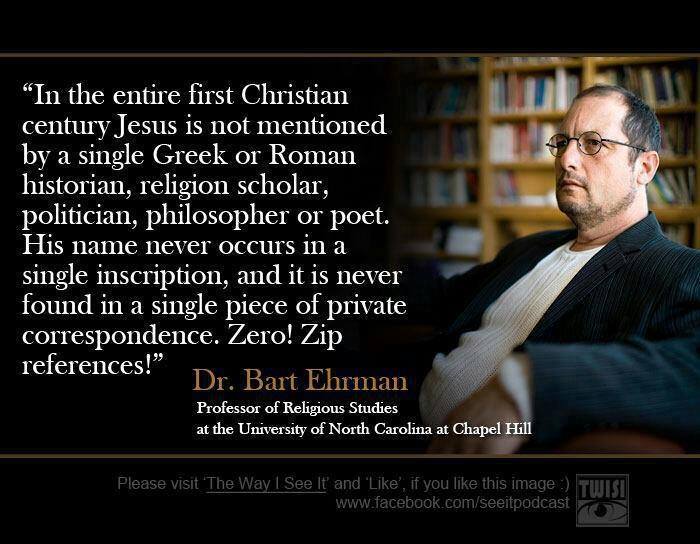
 h/t: Friendly Atheist
CHRISTIAN HISTORY: “Jesus Has No References” / Dr Bart Ehrman
Reply

h/t: Friendly Atheist
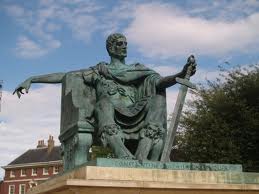
Emperor Constantine
Christianity is a copycat religion created by Emperor Constantine (for political purposes) based upon a myth (The Persian savior god Mithra, crucified 600 B.C. ? 400 B.C.?), which was based on other similar myths, all the way back to Chrishna of India (a mythical god that some claim was “crucified” around 1200 B.C.). There were 16 mythical crucifixions before Christ. The belief in the crucifixion of Gods was prevalent in various oriental or heathen countries long prior to the reported crucifixion of Christ. Of the 16 crucifixions, most were born of a virgin and about half of them on December 25th.
There were too many religions in Rome in 325 A.D. A Council was called in an endeavor to amalgamate the many religions of the Roman Empire into one. Christianity plagiarized older myths and legends historicized to suit the Roman Catholic Church while combining the numerous religions existing at the time (Krishna, Horus, Mithraism, Osirian, Isis, and many other mystery religions). For unity and to stop all the conflicts between the numerous religions…
Christianity was INVENTED.
During most of my years as a liberal Protestant minister, I never saw a contradiction between my Christian faith and the fact of evolution. Like many progressive Christians, I did not understand evolution as a challenge to the doctrine of divine creation ex nihilo; evolution was merely the mechanism that God used for creating life on our planet.
[…]
My indifference towards evolution changed dramatically when I ran across Richard Dawkins’ analogy of natural selection as “climbing Mount Improbable.” In that memorable and vivid metaphor, Dawkins illustrates the truly incremental and gradual nature of the evolutionary process. Opponents of evolution have contended that, while change within species can occur, the leap from one species to a new species is just too improbably great to have happened by purely natural processes. Outside assistance must have been involved. Dawkins addresses that claim by acknowledging that, yes, the leap from one species to the next seems improbably difficult—like scaling the cliff of a mountain to reach the peak. However, if one approaches the peak not from the formidable cliff but instead moves slowly along the slope on the other side of the mountain, reaching the peak of “Mount Improbable” becomes quite possible, although it might take a very long time.
[…]
Which core doctrines of Christianity does evolution challenge? Well, basically all of them. The doctrine of original sin is a prime example. If my rudimentary grasp of the science is accurate, then Darwin’s theory tells us that because new species only emerge extremely gradually, there really is no “first” prototype or model of any species at all—no “first” dog or “first” giraffe and certainly no “first” homo sapiens created instantaneously. The transition from predecessor hominid species was almost imperceptible. So, if there was no “first” human, there was clearly no original couple through whom the contagion of “sin” could be transmitted to the entire human race. The history of our species does not contain a “fall” into sin from a mythical, pristine sinless paradise that never existed.

Atheists have to live with the knowledge that there is no salvation, no redemption, no second chances. Lives can go terribly wrong in ways that can never be put right. Can you really tell the parents who lost their child to a suicide after years of depression that they should stop worrying and enjoy life? Doesn’t the appropriate response to 4,000 children dying everyday as a direct result of poor sanitation involve despair at the relentless misery of the world as well as some effort to improve things? Sometimes life is shit and that’s all there is to it. Not much bright about that fact.
Stressing the jolly side of atheism not only glosses over its harsher truths, it also disguises its unique selling point. The reason to be an atheist is not that it makes us feel better or gives us a more rewarding life. The reason to be an atheist is simply that there is no God and we would prefer to live in full recognition of that, accepting the consequences, even if it makes us less happy. The more brutal facts of life are harsher for us than they are for those who have a story to tell in which it all works out right in the end and even the most horrible suffering is part of a mystifying divine plan. If we don’t freely admit this, then we’ve betrayed the commitment to the naked truth that atheism has traditionally embraced. . .
And so we [atheists] don’t just get on and enjoy life, we embark on our own intellectual pilgrimages [emphasis added], trying to make some progress in a universe on which no meaning has been writ. The journey can be wonderful but it can also be arduous and it may end horribly. But there is no other way, and anyone who urges you to follow a path that they promise leads to a bright future [i.e., salvation] is either gravely mistaken or a charlatan [emphasis added].
Emperor Constantine
Christianity is a copycat religion created by Emperor Constantine (for political purposes) based upon a myth (The Persian savior god Mithra, crucified 600 B.C. ? 400 B.C.?), which was based on other similar myths, all the way back to Chrishna of India (a mythical god that some claim was “crucified” around 1200 B.C.). There were 16 mythical crucifixions before Christ. The belief in the crucifixion of Gods was prevalent in various oriental or heathen countries long prior to the reported crucifixion of Christ. Of the 16 crucifixions, most were born of a virgin and about half of them on December 25th.
There were too many religions in Rome in 325 A.D. A Council was called in an endeavor to amalgamate the many religions of the Roman Empire into one. Christianity plagiarized older myths and legends historicized to suit the Roman Catholic Church while combining the numerous religions existing at the time (Krishna, Horus, Mithraism, Osirian, Isis, and many other mystery religions). For unity and to stop all the conflicts between the numerous religions…
Christianity was INVENTED.

 Always Question Authority