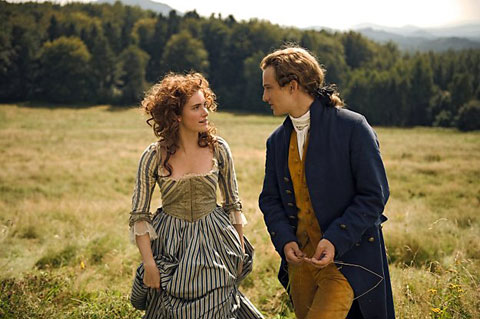
Young Goethe in Love: In fact, just another love story

Johann Wolfgang von Goethe (1749 – 1832), poet, novelist, dramatist, philosopher, naturalist and physicist, was a towering figure in German and world culture. . . 

In the film’s production notes, [German filmmaker Philipp] Stölzl writes: “Goethe is Germany’s most famous and important poet and philosopher, yet there has never been a relevant feature film about this extraordinary personality. There’s a reason for this, too: Goethe could do everything and was everything! He was handsome, came from a wealthy family, wrote successful novels, theater plays and poems, was an accomplished horseback rider and fencer, invented roller skates and discovered the pharyngeal bone, and he was a natural scientist, privy councilor, traveler, artist, minister, lawyer, and much, much more—all in all, a universal genius and thus a completely non-dramatic character for a feature film.”

Read more . . . 

Quote: Al Stefanelli

Al Stefanelli
Author, Journalist, Outspoken Atheist,
Blog, “A Voice Of Reason In An Unreasonable World”

Reason is to examine a statement, ponder the validity of it, consider the source of it, question the authority of it, search for the truth behind it and make an intelligent assessment of it.

Christopher Hitchens: Forced Merriment: The True Spirit of Christmas

One of my many reasons for not being a Christian is my objection to compulsory love. How much less appealing is the notion of obligatory generosity. To feel pressed to give a present is also to feel oneself passively exerting the equivalent unwelcome pressure upon other people. . . 

But the Christmas cycle imposes a deadening routine and predictability. This is why the accidental genius of Charles Dickens is to have made, of Ebenezer Scrooge, the only character in the story who has any personality to him—and the one whose stoic attempt at a futile resistance is invoked under the breath more than most people care to admit. . .

It also offends—by being so much in my face, without my having requested it and in spite of polite entreaties to desist—another celebrated precept about the right to be let alone. A manger on your lawn makes me yawn. A reindeer that strays from your lawn to mine is a nuisance at any time of year. Angels and menorahs on the White House lawn are an infraction of the Establishment Clause, which is as much designed to prevent religion from being corrupted by the state as it is to protect the public square from clerical encroachment.

The “wall of separation” has to be patrolled in small things as well as big ones. 

Read more . . .  

The Reason for the Season — and It’s Not Jesus

Dec[ember] 25 is not [Jesus’ — or Joshua’s for those people who like to be historically correct] birthday. Biblical scholars have debunked the blind belief that Jesus was born on Dec. 25 time and time again. Instead, through scientific, historical and astrological calculations, they’ve pinpointed September of the year 3 B.C. as a more accurate date. . .

Many people are familiar with the Winter Solstice, and for those who are not, it’s when the sun reaches its lowest point in the sky on Dec. 21, actually appearing to stop moving for three days, then rising again on Dec. 25. With just a cursory examination, one can understand that the “Birth of the Son” is actually the “Return of the Sun.”

Read more . . .