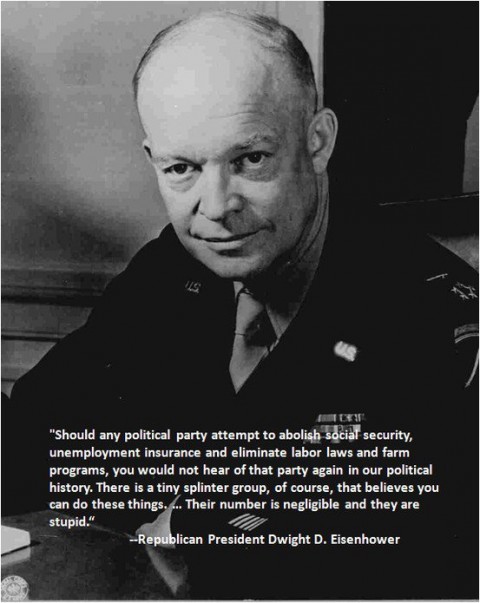
 Found at MoveOn.org on 12.21.2011
Did Eisenhower Predict The End Of The GOP?
2

Found at MoveOn.org on 12.21.2011
Labour unions are under fire across the US, but do they have enough vitality to fight back?
For decades, labour unions in the US have been on the decline. While they are widely credited with boosting safety standards and worker pay, many have received blame for wanting too much in times of a struggling economy.
Unemployment is at nine per cent and people are clamouring for jobs, unionised or not. And their greatest political ally, the Democratic party, has taken its support for granted, weakening its pull on the strings of power in Washington, DC.
A new battle has emerged in 2011 as Republican governors have taken on public sector unions, in some cases stripping them of rights that have been in place for 50 years. It is part of a trend that is happening in key swing states and may weaken democratic voting strength in next year’s presidential election.
But organised labour has fought back hard. In Wisconsin, unions occupied the state capitol as 100,000 protesters took to the streets. In Ohio, voters overturned a law that was intended to greatly reduce the right that unions have in that state to bargain collectively.
Now as Occupy Wall Street galvanises Americans to take action against financial institutions and big corporations, labour unions have a new ally. But can organised labour harness the anger that everyday Americans are emitting or will this opportunity pass it by? Do labour unions still have the strength to organise or has their power waned to the point that they will no longer be a major player in American politics?
 Posted on December 21, 2011 by Bengie
[T]he people at Politifact are terrified of being considered partisan if they acknowledge the clear fact that there’s a lot more lying on one side of the political divide than on the other. So they’ve bent over backwards to appear “balanced” — and in the process made themselves useless and irrelevant.
. . . Children, I’ll argue, have a human right not to have their minds crippled by exposure to other people’s bad ideas—no matter who these other people are. Parents, correspondingly, have no god-given licence to enculturate their children in whatever ways they personally choose: no right to limit the horizons of their children’s knowledge, to bring them up in an atmosphere of dogma and superstition, or to insist they follow the straight and narrow paths of their own faith.
In short, children have a right not to have their minds addled by nonsense. And we as a society have a duty to protect them from it. So we should no more allow parents to teach their children to believe, for example, in the literal truth of the Bible, or that the planets rule their lives, than we should allow parents to knock their children’s teeth out or lock them in a dungeon.
That’s the negative side of what I want to say. But there will be a positive side as well. If children have a right to be protected from false ideas, they have too a right to be succoured by the truth. And we as a society have a duty to provide it. Therefore we should feel as much obliged to pass on to our children the best scientific and philosophical understanding of the natural world—to teach, for example, the truths of evolution and cosmology, or the methods of rational analysis—as we already feel obliged to feed and shelter them.
In “The tyranny of the discontinuous mind”, Dawkins wonders why we cling to absolutes of yes and no, black and white, rich and poor; pretending not to see the millions of grey areas in life. These absolutes, he argues, distort reality:
Dawkins goes on to consider a variety of these absolutes — where a blindness to intermediates may constrict or condemn us — beginning with the arguments proposed by anti-abortionists:
There are those who cannot distinguish a 16-cell embryo from a baby. They call abortion murder and feel righteously justified in committing real murder against a doctor – a thinking, feeling, sentient adult, with a loving family to mourn him . . .
It is amusing to tease such absolutists by confronting them with a pair of identical twins (they split after fertilisation, of course) and asking which twin got the soul, which twin is the non-person, the zombie. A puerile taunt? Maybe. But it hits home because the belief that it destroys is puerile, and ignorant.
Posted by New Statesman – 19 December 2011 17:47
. . . “Big government” isn’t the problem. The problem is big money is taking over government.
Government is doing less of the things most of us want it to do — providing good public schools and affordable access to college, improving our roads and bridges and water systems, and maintaining safety nets to catch average people who fall — and more of the things big corporations, Wall Street, and the wealthy want it to do.
. . . A smaller government that’s still dominated by money would continue to do the bidding of Wall Street, the pharmaceutical industry, oil companies, big agribusiness, big insurance, military contractors, and rich individuals.




 Always Question Authority