The Thinking Atheist’s Tribute to Christopher Hitchens
Reply
Hitch
The moment it was announced that Christopher Hitchens was sick with cancer, eulogies began spilling into print and from the podium. No one wanted to deny the possibility that he would recover, of course, but neither could we let the admiration we felt for him go unexpressed. It is a cliché to say that he was one of a kind and none can fill his shoes—but Hitch was and none can. In his case not even the most effusive tributes ring hollow. There was simply no one like him.
One of the joys of living in a world filled with stupidity and hypocrisy was to see Hitch respond. That pleasure is now denied us. The problems that drew his attention remain—and so does the record of his brilliance, courage, erudition, and good humor in the face of outrage. But his absence will leave an enormous void in the years to come. Hitch lived an extraordinarily large life. (Read his memoir, Hitch-22, and marvel.) It was too short, to be sure—and one can only imagine what another two decades might have brought out of him—but Hitch produced more fine work, read more books, met more interesting people, and won more arguments than most of us could in several centuries.
I first met Hitch at a dinner at the end of April 2007, just before the release of his remarkable book god is not Great. After a long evening, my wife and I left him standing on the sidewalk in front of his hotel. His book tour was just beginning, and he was scheduled to debate on a panel the next morning. It was well after midnight, but it was evident from his demeanor that his clock had a few hours left to run. I had heard the stories about his ability to burn the candle at both ends, but staggering there alongside him in the glare of a street lamp, I made a mental note of what struck me as a fact of nature—tomorrow’s panel would be a disaster.
I rolled out of bed the following morning, feeling quite wrecked, to see Hitch holding forth on C-SPAN’s Book TV, dressed in the same suit he had been wearing the night before. Needless to say, he was effortlessly lucid and witty—and taking no prisoners. There should be a name for the peculiar cocktail of emotion I then enjoyed: one part astonishment, one part relief, two parts envy; stir. It would not be the last time I drank it in his honor.
Since that first dinner, I have felt immensely lucky to count Hitch as a friend and colleague—and very unlucky indeed not to have met him sooner. Before he became ill, I had expected to have many more years in which to take his company for granted. But our last meeting was in February of this year, in Los Angeles, where we shared the stage with two rabbis. His illness was grave enough at that point to make the subject of our debate—Is there an afterlife?—seem a touch morbid. It also made traveling difficult for him. I was amazed that he had made the trip at all.
The evening before the event, we met for dinner, and I was aware that it might be our last meal together. I was also startled to realize that it was our first meal alone. I remember thinking what a shame it was—for me—that our lives had not better coincided. I had much to learn from him.I have been privileged to witness the gratitude that so many people feel for Hitch’s life and work—for, wherever I speak, I meet his fans. On my last book tour, those who attended my lectures could not contain their delight at the mere mention of his name—and many of them came up to get their books signed primarily to request that I pass along their best wishes to him. It was wonderful to see how much Hitch was loved and admired—and to be able to share this with him before the end.
I will miss you, brother.
His was truly a transatlantic voice, serviceable for skewering an international rogue’s gallery of politicians. His shots were fiercely partisan, precisely angled like a billiard shot, but the anger was controlled, even detached. When his anger overflowed on people or ideas he loathed (he was a good hater), he distilled it until it came out as gelid disdain. He took pride in always having the facts to back up his opinions, which never gave the impression of being shallow or glibly arrived at. . .
I take it as res ipsa loqitur (look at him—channeling Hitchensesque erudition) that he was soundly educated. But he wore his erudition lightly and used it practically, a storehouse to draw upon. He seemed to have read everything and remembered most of it.
Sarcasm and invective were prominent weapons in his armamentarium, of course, kept well oiled, ready to fire off against fools on both left and right. He was not particularly humorous, though some found him funny; irony was his most congenial mode.
We are proud to have been present at the creation of “our” Christopher Hitchens, one of the longest-running columnists in the magazine’s history. As a demonstration of his achievements in our pages, here is a degustation of his articles and columns from 1978 through 2006.
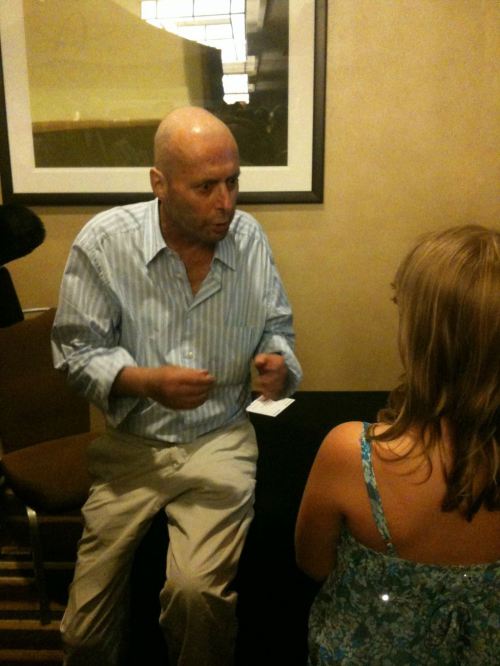
When Christopher Hitchens got the Dawkins Award in Houston, I posted the following report from Chron.com: Though [Hitchens] was asked a variety of questions from the audience, none appeared to elicit more interest than the one asked by eight-year-old Mason Crumpacker, who wanted to know what books she should read. In response, Hitchens first asked where her mother was and the girl indicated that she was siting beside her. He then asked to see them once the presentation was over so that he could give her a list.
As the event drew to a close, Mason and her mom, Anne Crumpacker of Dallas, followed him out. Surrounded by attendees wanting a glance of the famed author, Hitchens sat on a table just outside of the ballroom and spent about 15 minutes recommending books to Mason.
We are the 99 percent. We are getting kicked out of our homes. We are forced to choose between groceries and rent. We are denied quality medical care. We are suffering from environmental pollution. We are working long hours for little pay and no rights, if we’re working at all. We are getting nothing while the other 1 percent is getting everything. We are the 99 percent.
Brought to you by the people who occupy wall street. Why will YOU occupy?
OccupyWallSt.org
Occupytogether.org
 Titus Lucretius Carus (ca. 99 BCE – ca. 55 BCE)
Roman Poet and Philosopher
Therefore this terror and darkness of the mind
Not by the sun’s rays, nor the bright shafts of day,
Must be dispersed, as is most necessary,
But by the face of nature and her laws.We start then from her first great principle
That nothing ever by divine power comes from nothing.
For sure fear holds so much the minds of men
Because they see many things happen in earth and sky
Of which they can by no means see the causes,
And think them to be done by power divine.
So when we have seen that nothing can be created
From nothing, we shall at once discern more clearly
The object of our search, both the source from which each thing
Can be created, and the manner in which
Things come into being without the aid of gods.
 This is a picture of the Liberal revolutionary movement
Occupy Wall Street Library.
Has anyone ever seen a picture of a Conservative reactionary movement
Tea Party Protest Library?
I didn’t think so. Why is that?
 Clinton Richard Dawkins, Ph.D., (born 26 March 1941)
Ethologist, Evolutionary Biologist, Author, and Outspoken Atheist
The mere fact that you can ask a question in the English language doesn’t make it a question that deserves an answer.
Is Police Commissioner Raymond Kelly a closet supporter of Occupy Wall Street, the anti-establishment protest group that has been camped out in the financial district for the past week and a half? That’s what it’s looking like . . .
Over the past couple of days, the protesters, who are occupying Zuccotti Park, between Broadway and Trinity Place, have garnered headlines as far afield as London, Athens, and Jerusalem, as well the support of Michael Moore, Susan Sarandon, Cornel West, and Noam Chomsky . . .
On its regularly updated Web site, OccupyWallStreet.org, the group describes itself as “a leaderless resistance movement with people of many colors, genders and political persuasions,” likens itself to anti-government protesters in Egypt, Spain, and other places, and adds, “We plan to use the revolutionary Arab Spring tactic of mass occupation to restore democracy in America.”
Read more . . .


 Always Question Authority