Quote: Isaac Asimov

Isaac Asimov born Eyzik Yudovitš Asimov (c. January 2, 1920 – April 6, 1992)
American author, professor of biochemistry at Boston University, one of the most prolific writers of all time, having written or edited more than 500 books and an estimated 90,000 letters and postcards, a humanist, a rationalist and an atheist

There is a cult of ignorance in the United States, and there has always been. The strain of anti-intellectualism has been a constant thread winding its way through our political and cultural life, nurtured by the false notion that democracy means that “my ignorance is just as good as your knowledge.”

Quote: Neil deGrasse Tyson

Neil deGrasse Tyson, MPhil, PhD (born October 5, 1958)
American astrophysicist, science communicator and author

The good thing about science is that it’s true whether or not you believe in it.

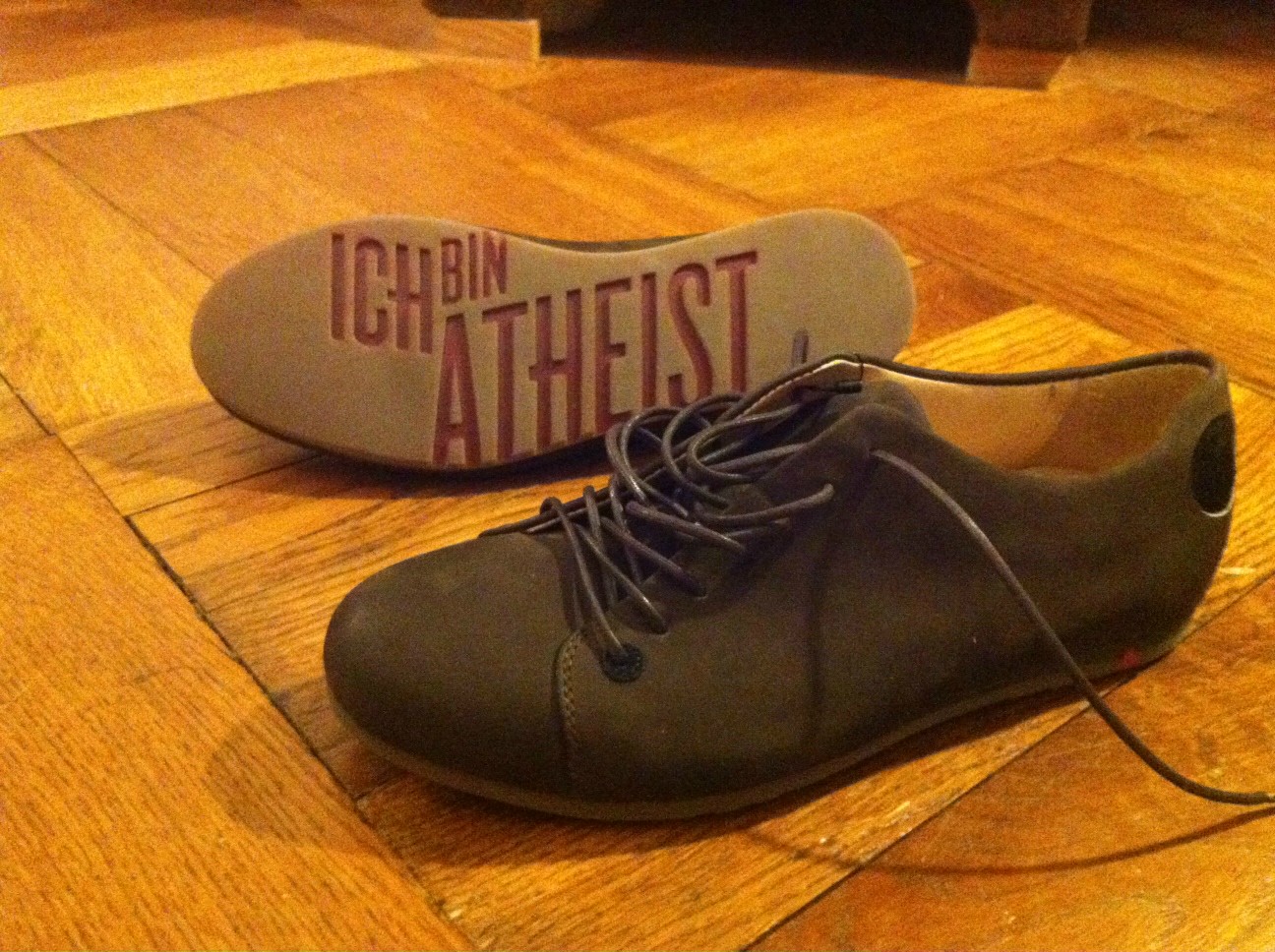
Atheist Shoes (VIDEO)

Now, I realise that some of you haven’t the foggiest what an Atheist shoe is. And, admittedly, an atheist shoes sounds like a peculiar idea. But we think a shoe is a lovely, understated way for atheists to out themselves and to be less shy about their godlessness. And we also think our Bauhaus-inspired, 1930s-infatuated shoes will be a welcome antidote to the samey junk pumped out by the big sneaker corporations – not only do we feel our designs are prettier, but we know that the care, craftsmanship and quality of materials going into our shoes are superior to those invested by N**e, *onver*e and Ad***s.

Read more, and watch video here. . . .

Yes, life without God can be bleak. Atheism is about facing up to that.

Atheists have to live with the knowledge that there is no salvation, no redemption, no second chances. Lives can go terribly wrong in ways that can never be put right. Can you really tell the parents who lost their child to a suicide after years of depression that they should stop worrying and enjoy life? Doesn’t the appropriate response to 4,000 children dying everyday as a direct result of poor sanitation involve despair at the relentless misery of the world as well as some effort to improve things? Sometimes life is shit and that’s all there is to it. Not much bright about that fact.

Stressing the jolly side of atheism not only glosses over its harsher truths, it also disguises its unique selling point. The reason to be an atheist is not that it makes us feel better or gives us a more rewarding life. The reason to be an atheist is simply that there is no God and we would prefer to live in full recognition of that, accepting the consequences, even if it makes us less happy. The more brutal facts of life are harsher for us than they are for those who have a story to tell in which it all works out right in the end and even the most horrible suffering is part of a mystifying divine plan. If we don’t freely admit this, then we’ve betrayed the commitment to the naked truth that atheism has traditionally embraced. . .

And so we [atheists] don’t just get on and enjoy life, we embark on our own intellectual pilgrimages [emphasis added], trying to make some progress in a universe on which no meaning has been writ. The journey can be wonderful but it can also be arduous and it may end horribly. But there is no other way, and anyone who urges you to follow a path that they promise leads to a bright future [i.e., salvation] is either gravely mistaken or a charlatan [emphasis added].

Read more . . .

Deckle Edge in the Age of Mechanical Reproduction

The deckle edge dates back to a time when you used to need a knife to read a book. Those rough edges simulate the look of pages that have been sliced open by the reader. The printing happened on large sheets of paper which were then folded into rectangles the size of the finished pages and bound. The reader then sliced open the folds.

Paper knives, variants of letter openers, were used for this purpose. Italo Calvino’s If on a Winter’s Night a Traveler, which speaks directly to the reader and describes the reader’s experience reading the novel, makes extensive reference to these literary knives:

“This volume’s pages are uncut: a first obstacle opposing your impatience. Armed with a good paper knife, you prepare to penetrate its secrets. With a determined slash you cut your way between the title page and the beginning of the first chapter.”

Opening a book can already feel like opening a gift. Armed with a knife and freeing the pages and the story hidden beneath the folds, it becomes something more, “a penetration of its secrets” and an act of discovery, shot through with a suggestion of violence and danger or of the painful gestation of the words themselves.

Read more . . .

Quote: Sam Harris

Sam Harris, Ph.D. (born 1967)
American author, philosopher, neuroscientist, co-founder and CEO of
Project Reason, whose main aim is the promotion of scientific knowledge
and secular values within society, and outspoken atheist

Quote: Roger Rosenblatt / Nobody is thinking about you

Roger Rosenblatt, Ph.D. (born 1940)
American Journalist, Author, Playwright, Essayist, Columnist,
Teacher and Fulbright Scholar in Ireland in 1965-66

Yes, I know that you are certain that your friends are becoming your enemies; that your grocer, garbage man, clergyman, sister-in-law, and your dog are all of the opinion that you have put on weight, that you have lost your touch, that you have lost your mind; furthermore you are convinced that everyone spends two-thirds of every day commenting on your disintegration, denigrating your work, plotting your assignation. I promise you: Nobody is thinking about you. They are thinking about themselves—just like you.

Why we need college degrees more than we need faith

In the comments following the short article titled above and linked here,

Carstonio
wrote:

Instead of thinking about religion in terms of faith, it would be far more sound and praactical to think about it in terms of morality. Since we have no evidence to support either the existence or non-existence of gods, and have no way to gauge the likelihood of either, we should simply put the question aside as speculative. This would mean religion could focus on how humans treat one another with the goal of reducing suffering. Just about every religion has some version of the Golden Rule, and even “rule” is misleading since morality isn’t a matter of following rules for its own sake. It’s worth considering what a religion would look like if it made no claims either way about the “metaphysical” or the “supernatural.”

AlwaysQuestionAuthority_wordpress_com
responded: 

Evidence to “support . . . [the] non-existence of gods,” has not been, is not now and will not ever be required! The philosophic burden of proof always lies with the one who makes the positive assertion, e.g., there is a god, to provide sufficient warrant for their position.

It is not incumbent upon the one that denies the positive assertion to provide evidence counter to the claim being asserted. To state that, “we have no evidence to support . . . non-existence of gods,” is an attempt to shift the philosophic burden of proof responsibility from the one making the assertion to the one denying the assertion. This is an argument from ignorance, a common fallacy in informal logic, and should be avoided.

The “metaphysical” and “supernatural” are of the same realm as opposed to the natural, i.e., physical (sensual) realm. The metaphysical realm falls in the analytical domain of logic and reason, as was discussed above, whereas, the physical realm falls in the observable domain of empirical evidence.

Question:
What say you? 
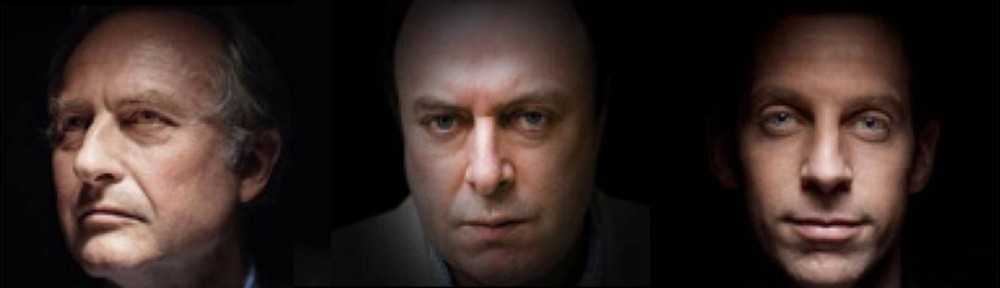
Quote / Christopher Hitchens / On the Independent Mind

Christopher Eric Hitchens (13 April 1949 – 15 December 2011)
English-American, Literary Critic, Journalist, Author,
Essayist, Polemicist, and Outspoken Anti-theist

The essence of the independent mind lies not in what it thinks, but in how it thinks.