SOCIALISM: George Galloway / “Rips UK’s Channel 4 News Presenter Krishnan Guru-Murthy On Fidel Castro”
Reply
LGBT activists all over the country will celebrate the third annual Harvey Milk Day on May 22, a holiday honoring the pioneering San Francisco supervisor who served as the first openly gay elected official in the United States.
A bill authored by California State Asseblyman Mark Leno and signed into law by former Governor Arnold Schwarzenegger created Harvey Milk Day in 2009.
While California is the only state to officially honor the legislator, whose tragic assassination at the hands of fellow Supervisor Dan White was depicted in the Academy Award-winning 2008 film “Milk,” people all over the country also participate. In 2010, groups in 28 other cities followed the Golden State’s lead and held events honoring the legislator.
“Harvey served less than a year in public office before his brutal assassination but his life profoundly changed a city, state, nation and a global community. His courage, passion and sense of justice rocked a country and stirred the very core of a put down and pushed out community, bringing forward new hope and a new vision of freedom”
~ Harvey Milk Foundation.Harvey Milk (May 22, 1930 – November 27, 1978)
After three unsuccessful campaigns, Harvey Milk was elected to the San Francisco County Board of Supervisors. His election was a landmark event. The reason? Harvey Milk was gay, and his election was the first of an openly gay elected official in the United States. To win the election, Milk had to gain the support of all segments of his district.
On election night, Harvey Milk reminded his supporters: “This is not my victory — it’s yours. If a gay man can win, it proves that there is hope for all minorities who are willing to fight.”
[…]
Milk knew that his position as a San Francisco Supervisor advocating gay rights placed him in danger. Hate mail began to pour into his office. With chilling foresight Milk made a tape recording on November 18, 1977, with instructions to have it read only if he died by assassination. In it he says, “If a bullet should enter my brain, let that bullet destroy every closet door.” On November 27, 1978, Supervisor Milk and Mayor Moscone were assassinated by Dan White, a former police officer who had clashed with Milk over gay issues. After shooting the mayor, White entered Milk’s office and shot him five times at his desk.
Can we challenge capitalism and prevail, considering that the top one percent control 50% of the available capital and the top five percent some 70% of the nation’s private funds? Richard Wolff is a closely followed Truthout contributor on economics. Currently, you can obtain his just-released “Occupy the Economy: Challenging Capitalism” directly from Truthout. If you want to know about alternatives to the current destructive course of our economy and how we, as a nation, got to this point, get your copy of “Occupy the Economy” by clicking here.
The following is an interview with Richard Wolff by Truthout staff member Matt Renner.
Matt Renner: In your introduction to the book, you discuss New York City Mayor Michael Bloomberg’s “cleanliness” excuse for clearing the original Occupy Wall Street encampment at Liberty Square. Why do you think so many public officials and right-wing pundits describe the occupiers as “unclean”?
Richard D. Wolff: Their problem has been, and continues to be, that they have no response to Occupy’s basic attack on the inequity and antidemocratic social conditions summarized in the confrontation of, “1 percent against 99 percent.” They know that the vast majority of Americans feel the truth of Occupy’s social criticism, experience it in their lives, and sympathize with protest against and efforts to change a system with such unjust outcomes. So, they can refute little and need instead to distract public opinion from what Occupy focuses on.
One way to do that is to assert the existence of and then condemn some other quality or dimension of Occupy. In Bloomberg’s pathetic example, the best he and his advisers could come up with was a reference to Zuccotti Park as being “unclean” so as to then position the mayor and the police as militant janitors. Everyone who knows even a little about New York City knows that the mayor and the police preside over many filthy subway tunnels, highways, streets, empty lots and abandoned buildings without doing anything to clean them. So, suddenly asserting the importance of cleanliness simply exposed them to the ridicule such a position deserved. I suspect something similar is underway when others, perhaps taking their cue from Bloomberg in New York, decided to follow the cleanliness ploy.
“I don’t waste any emotional or intellectual energy on these elections. All hope is in the street. All hope is through acts of civil disobedience. We may not win, but if we’re going to win that’s the only place we are going to win.”
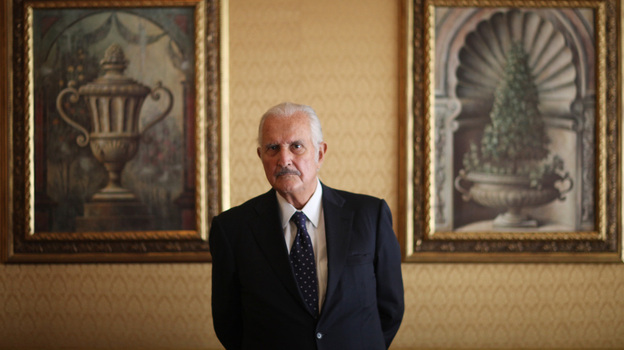 Carlos Fuentes was the son of a Mexican diplomat and spent years living abroad, including in the United States. But Mexico — the country, its people and politics — was central to his writing.
Fuentes, one of the most influential Latin American writers, died Tuesday at a hospital in Mexico City at the age of 83. He was instrumental in bringing Latin American literature to an international audience, and he used his fiction to address what he saw as real-world injustices.
[…]
One of his most famous novels was The Old Gringo, about an American writer who travels to Mexico to die. It was made into a Hollywood movie starring Gregory Peck as the writer and Jimmy Smits as a Mexican general.
The Old Gringo became the first novel by a Latin American writer to make it to The New York Times best-seller list.
Read transcript, and listen to NPR’s Morning Edition AUDIO here . . .
A wonderful scene from the movie can be seen here:
[…]
. . . We have been, like nations on the periphery of empire, colonized. We are controlled by tiny corporate entities that have no loyalty to the nation and indeed in the language of traditional patriotism are traitors. They strip us of our resources, keep us politically passive and enrich themselves at our expense. The mechanisms of control are familiar to those whom the Martinique-born French psychiatrist and writer Frantz Fanon called “the wretched of the earth,” including African-Americans. The colonized are denied job security. Incomes are reduced to subsistence level. The poor are plunged into desperation. Mass movements, such as labor unions, are dismantled. The school system is degraded so only the elites have access to a superior education. Laws are written to legalize corporate plunder and abuse, as well as criminalize dissent. . . .
[…]
The danger the corporate state faces does not come from the poor. The poor, those Karl Marx dismissed as the Lumpenproletariat, do not mount revolutions, although they join them and often become cannon fodder. The real danger to the elite comes from déclassé intellectuals, those educated middle-class men and women who are barred by a calcified system from advancement. Artists without studios or theaters, teachers without classrooms, lawyers without clients, doctors without patients and journalists without newspapers descend economically. They become, as they mingle with the underclass, a bridge between the worlds of the elite and the oppressed. And they are the dynamite that triggers revolt.
This is why the Occupy movement frightens the corporate elite. What fosters revolution is not misery, but the gap between what people expect from their lives and what is offered. This is especially acute among the educated and the talented. They feel, with much justification, that they have been denied what they deserve. They set out to rectify this injustice. And the longer the injustice festers, the more radical they become.
[…]
The power of the Occupy movement is that it expresses the widespread disgust with the elites, and the deep desire for justice and fairness that is essential to all successful revolutionary movements. The Occupy movement will change and mutate, but it will not go away. It may appear to make little headway, but this is less because of the movement’s ineffectiveness and more because decayed systems of power have an amazing ability to perpetuate themselves through habit, routine and inertia. The press and organs of communication, along with the anointed experts and academics, tied by money and ideology to the elites, are useless in dissecting what is happening within these movements. They view reality through the lens of their corporate sponsors. They have no idea what is happening.
[…]
. . . Since September, the mainstream press in the US has systematically ignored and demonized the Occupy movement. The nakedness of the class bias in this case, however, was especially jarring: the size and significance of the protests were downplayed, reports of police brutality were largely ignored, and the movement was portrayed as violent and dangerous. Many of the most prominent US news outlets, such as The New York Times, practically ignored the protests altogether. These shameful distortions by the corporate press display the function of the media as an organ of the rule of “the 1 percent,” and reveal how threatened elites are by organized, direct action and democratic participation.
[…]
The Tea Party, a movement which serves rather than threatens corporate interests, has received front-page coverage in virtually all of the nation’s national newspapers for events that were smaller and less significant than this week’s May Day protests. Yet, a truly substantial social movement with genuine emancipatory potential and a broad base of support among Americans is largely considered un-newsworthy by the corporate press. When the demonstrations were covered, crude caricatures masquerading as objective news ruled the day.
In an interview with GritTV’s Laura Flanders, author and MIT professor Noam Chomsky discussed the potentially bleak future facing both the United States and the European Union. Both, he said, are facing historic crises and are going about trying to resolve them in exactly the wrong ways.
According to Chomsky, we are currently living in a period of “pretty close to global stagnation” but that the world’s great powers are reacting to the lack of growth in exactly the wrong manner. “The United States and Europe are committing suicide in different ways, but both doing it.”
[…]
It’s also a mistake, he said, to treat the Republican Party as a genuine political party rather than the “lock-step” policy arm of the superrich. Of course, the wealthy can’t sell the idea of a plutocracy to the population outright, so they mobilize the socially conservative base by stoking the so-called “culture wars.”
Chomsky has a new book, Occupy, about the Occupy Wall Street movement, what it says about society and humanity’s way forward through this time of economic and social stagnation. He calls OWS “the first major public response to 30 years of class war” and believes that the movement’s greatest success has been the introduction of the inequalities of everyday life into the public dialogue.
The nearly half-hour discussion ranges over a number of topics, but keeps coming back again and again to the importance of individual engagement in society and the political system, and the power of Occupy as a force for social and political change.


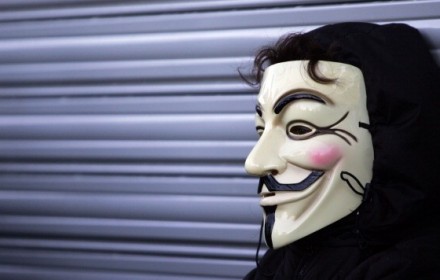

 Always Question Authority