 h/t: truthdig.com
BENIGHTED AMURIKA: “Why Sports are Vital to Democracy” / Signe Wilkinson
1

h/t: truthdig.com
Over the past year I and other plaintiffs including Noam Chomsky and Daniel Ellsberg have pressed a lawsuit in the federal courts to nullify Section 1021(b)(2) of the National Defense Authorization Act (NDAA). This egregious section, which permits the government to use the military to detain U.S. citizens, strip them of due process and hold them indefinitely in military detention centers, could have been easily fixed by Congress. The Senate and House had the opportunity this month to include in the 2013 version of the NDAA an unequivocal statement that all U.S. citizens would be exempt from 1021(b)(2), leaving the section to apply only to foreigners. But restoring due process for citizens was something the Republicans and the Democrats, along with the White House, refused to do. The fate of some of our most basic and important rights—ones enshrined in the Bill of Rights as well as the Fourth and Fifth amendments of the Constitution—will be decided in the next few months in the courts. If the courts fail us, a gulag state will be cemented into place.
[…]
[T]he NDAA is not about protecting us. It is about protecting the state from us.
 h/t: truthdig.com
 h/t: truthdig.com
 h/t: truthdig.com
Green Party
[…]
Nowhere did we find prior research summarizing and detailing religious finances and tax policy, so we decided to investigate it ourselves. This article is the result. It took some digging, but we think we now have a moderately clear understanding of the tax laws regarding religions in the United States. What we found suggests that religious institutions, if they were required to pay taxes the same as for-profit corporations do, would not have nearly as much money or influence as they enjoy in America today. In this article we estimate how much local, state, and federal governments subsidize religions.
[…]
. . . [R]eligions spend a relatively small portion of their revenue on “physical charity”, and while they spend a larger portion of their revenue addressing “spiritual concerns”, most of that qualifies as labor, not charity. What little would qualify as “spiritual charity” would not be replaced by government if discontinued. In short, religions are, by and large, not engaged in charitable work.
[…]
. . . [T]he subsidies to religions in the United States today may not be encouraging the growth of religions, but they may be keeping alive on the equivalent of subsidized life-support many religions that should be dead.
If these subsidies were removed—though we have no basis for believing that they will be anytime soon—we wonder what the damage to religion would be. There is evidence that donations to religions are tied to taxes; as the tax benefit of donating goes up, so do donations and vice versa. In other words, it seems likely that the removal of these subsidies would result in a substantial decrease in the supply of religion in the United States. To what extent it would affect demand for religion is uncertain.
[…]
. . . [I]t seems likely that subsidies are propping up religion in the United States, though to what extent is not clear. Certainly many religions that are near failing would have done so already if not for the subsidies they receive from the government. Another practical result of these subsidies is that religions are more affluent and more influential than they would otherwise be, because they have the resources to fund efforts to change legislation, create widely consumed media, and influence public policy.
[…]
. . . These subsidies should be phased out. But since that is unlikely to happen, we’d accept the following alternative: . . . direct cash transfers to us from the government for trying to convert people to our worldviews while claiming to provide social services[.]
The 2012 election should be about what’s going on in America’s boardrooms, but Republicans would rather it be about America’s bedrooms.
[…]
. . . Republicans have introduced over four hundred bills in state legislatures aimed at limiting women’s reproductive rights — banning abortions, requiring women seeking abortions to have invasive ultra-sound tests beforehand, and limiting the use of contraceptives.
[…]
Our crisis has nothing to do with private morality. It’s a crisis of public morality — of abuses of public trust that undermine the integrity of our economy and democracy and have led millions of Americans to conclude the game is rigged.
What’s truly immoral is not what adults choose to do with other consenting adults. It’s what those with great power have chosen to do to the rest of us.
[…]
Regressive Republicans have no problem intruding on the most personal and most intimate decisions any of us makes while railing against government intrusions on big business.
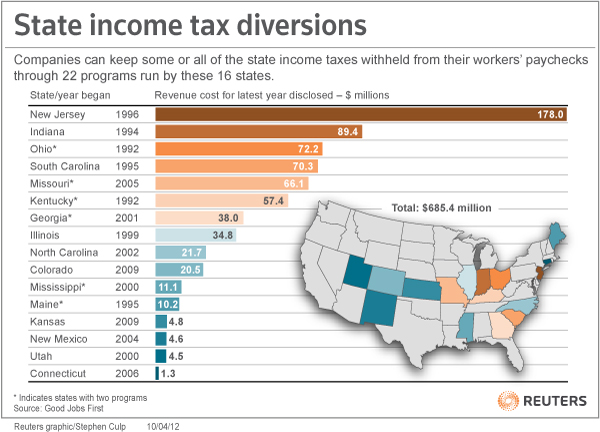
Across the United States more than 2,700 companies are collecting state income taxes from hundreds of thousands of workers – and are keeping the money with the states’ approval, says an eye-opening report published on Thursday.
The report from Good Jobs First, a nonprofit taxpayer watchdog organization funded by Ford, Surdna and other major foundations, identifies 16 states that let companies divert some or all of the state income taxes deducted from workers’ paychecks. None of the states requires notifying the workers, whose withholdings are treated as taxes they paid.
[…]
CORPORATE SOCIALISM
Deals cut with the states over the past two decades diverted $5.5 billion from public purposes to private gain, the report says. Close to $700 million more was diverted last year, Good Jobs First estimates.
[…]
These deals typify corporate socialism, in which business gains are privatized and costs socialized. They also mean government picks winners and losers, interfering with competitive markets. Leaders in both parties embrace these giveaways because they draw campaign donations from corporate interests and votes from people who do not understand that they are subsidizing huge companies.
[…]
The average American would be hard-pressed to see evidence of this “war.” Millions of people meet regularly in houses of worship. What’s more, those institutions are tax exempt. Many denominations participate in taxpayer-funded social service programs. Their clergy regularly speak out on the issues of the day. In the political arena, religious leaders are treated with great respect.
Furthermore, religious organizations often get special breaks that aren’t accorded to their secular counterparts. Houses of worship aren’t required to report their income to the Internal Revenue Service. They don’t have to apply for tax-exempt status; they receive it automatically as soon as they form. Religious entities are routinely exempted from employment laws, anti-discrimination measures and even routine health and safety inspections.
Unlike secular lobbies, religious groups that work with legislators on Capitol Hill don’t have to register with the federal government and are free from the stringent reporting requirements imposed on any group that seeks to influence legislation.
Religion in America would seem to be thriving in this “hands-off” atmosphere, as evidenced by church attendance rates, which in the United States tend to be higher than any other Western nation. So where springs this “war on religion” talk?
[…]
WASHINGTON – American Federation of Government Employees National President John Gage today issued the following statement in response to the 2013 budget plan introduced by House Republicans:
“The House GOP budget, proposed by Rep. Paul Ryan, proposes a staggering $368 billion in additional federal workforce cuts over the next 10 years. Federal employees would have their salaries frozen for another three years and would face massive cuts to the retirement benefits promised when they were hired. In addition, the federal workforce would be cut by 10 percent, jeopardizing the federal programs and services every American relies on.




 Always Question Authority