 h/t: Atheism 411
RELIGION: “The Facts of Religious History” / Steven Pinker ☮
Reply

h/t: Atheism 411
 Atheism is not a modern invention from the western Enlightenment, but actually dates back to the ancient world, according to a new book by a Cambridge academic – which challenges the assumption that humanity is naturally predisposed to believe in gods.
In Battling the Gods, Tim Whitmarsh, professor of Greek culture at Cambridge University, lays out a series of examples showing that atheism existed in polytheistic ancient Greece. It is, according to its author, partly “an attempt to excavate ancient atheism from underneath the rubble heaped on it by millennia of Christian opprobrium”.
Whitmarsh, a fellow of St John’s College, believes that the growing trend towards seeing religion as “hardwired” into humans is deeply worrying. “I am trying to destabilise this notion, which seems to be gaining hold all the time, that there is something fundamental to humanity about [religious] belief,” he told the Guardian.
His book disputes that atheism is “a modern invention, a product of the European Enlightenment” and a mode of thought that “would be inconceivable without the twin ideas of a secular state and of science as a rival to religious truth”.


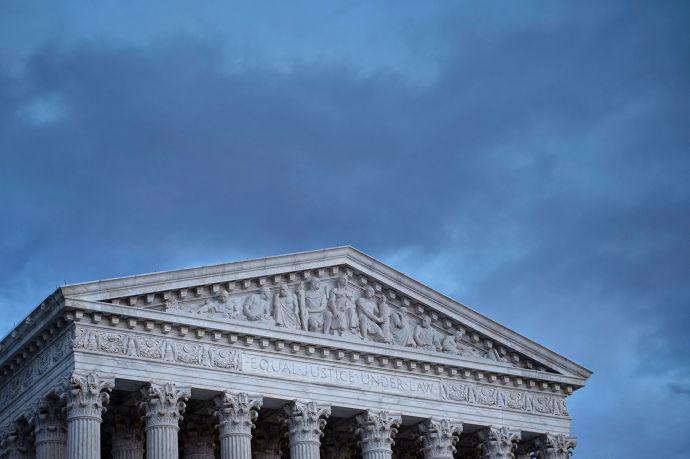 Who should replace Antonin Scalia? On Monday, the Times reported that the Justice himself had weighed in on the question: last June, in his dissenting opinion in the same-sex marriage case Obergefell v. Hodges, Scalia wrote that the Court was “strikingly unrepresentative” of America as a whole and ought to be diversified. He pointed out that four of the Justices are natives of New York City, that none are from the Southwest (or are “genuine” Westerners), and that all of them attended law school at Harvard or Yale. Moreover, Scalia wrote, there is “not a single evangelical Christian (a group that comprises about one quarter of Americans), or even a Protestant of any denomination” on the Court. (All nine Justices are, to varying degrees, Catholic or Jewish.)
Scalia’s remarks imply that an evangelical Christian should be appointed to the Court. That’s a strange idea: surely, the separation of church and state enshrined in the Constitution strongly suggests that court decisions shouldn’t be based on religious preference, or even on religious arguments. The Ten Commandments are reserved for houses of worship; the laws of the land are, or should be, secular. Still, I’m inclined, in my own way, to agree with Scalia’s idea about diversity. My suggestion is that the next Supreme Court Justice be a declared atheist.


 Always Question Authority