ZOMBIE JEBUS DAY: “This is Ishtar” ☮
Reply

 If I donated a kidney, but got it back three days later, that wouldn’t be a sacrifice either, would it?
h/t: Friendly Atheist
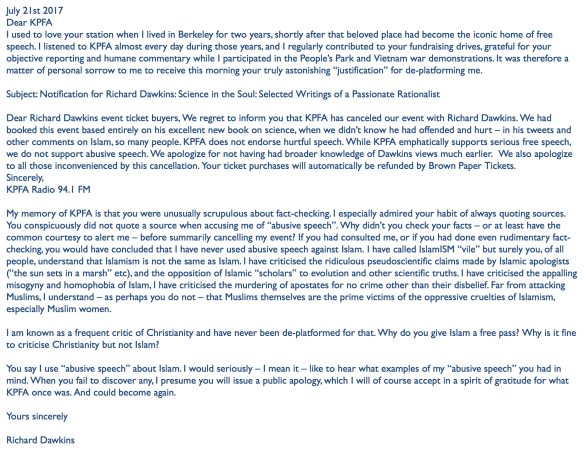
What’s it like to be worshipped by [White Supremacists]? Not good, especially if you’re a passionate rationalist like Richard Dawkins. He was very recently accused of Islamophobia by KPFA radio—which is why some of the [White Supremacists] have flocked toward him—however Dawkins released a statement calling any alleged “abusive speech” by him preposterous, and clarified his views: “I have indeed strongly condemned the misogyny, homophobia, and violence of Islamism, of which Muslims—particularly Muslim women—are the prime victims. I make no apologies for denouncing those oppressive cruelties, and I will continue to do so.” Here he responds to how unpleasant it is to have your rational thoughts and your name hijacked by political extremists, and he expresses his disdain for President Trump’s policies, specifically the ‘Muslim ban’. With that as context, he proceeds to do what he does best: use science to investigate the idea of supernatural gods as the creators of the universe—which is a scientific hypothesis, he states, but one of the failed kind. Dawkins explains that we already have a superb theory of why living things have come into being—Darwinian evolution—and the evils that can come from too much faith. Richard Dawkins’ most recent book is Science in the Soul: Selected Writings of a Passionate Rationalist.
 h/t: Lawrence M. Krauss
If I donated a kidney, but got it back three days later, that wouldn’t be a sacrifice either, would it?
h/t: Friendly Atheist
Neil deGrasse Tyson welcomes ethologist, evolutionary biologist Richard Dawkins at Hayden Planetarium – Sep 2015.

By Bob Fredericks
Stephen Hawking’s decades-old black-hole theory has been confirmed by another scientist — and that may finally land the renowned physicist on the short list for a Nobel Prize.
Hawking — whose life with his former wife and struggle with motor neuron disease were dramatized in the 2014 movie “The Theory of Everything” — calculated back in 1974 that tiny particles should be able to rob black holes of a minuscule fraction of their energy and then escape.
That means that the black holes would slowly evaporate over time, spewing out all the dust, light and passing stars they had swallowed in a trickle of heat.
Conventional wisdom at the time said that black holes were places where gravity pulled so hard that nothing could get out, including light.
The development could open up a bizarre vision of the universe in which black holes can cough themselves into nothingness, Hawking said during recent lectures on the BBC and at Harvard.
“This raises a serious problem that strikes at the heart of our understanding of science,” he said.

 Always Question Authority