Through These Godless Eyes
2

The 18th century was a time of opulence and privilege for some. Europe was dominated by the twin authority of the Church and King – but beneath the surface, new forces were gathering to challenge their absolute rule.
Conservatives and liberals don’t seem to agree about much, and they might not agree about recent studies linking conservatism to low intelligence and “low-effort” thinking.
As The Huffington Post reported in February, a study published in the journal “Psychological Science” showed that children who score low on intelligence tests gravitate toward socially conservative political views in adulthood–perhaps because conservative ideologies stress “structure and order” that make it easier to understand a complicated world.
Ouch.
And now there’s the new study linking conservative ideologies to “low-effort” thinking.
Are racists dumb? Do conservatives tend to be less intelligent than liberals? A provocative new study from Brock University in Ontario suggests the answer to both questions may be a qualified yes.
The study, published in Psychological Science, showed that people who score low on I.Q. tests in childhood are more likely to develop prejudiced beliefs and socially conservative politics in adulthood.
[…]
. . . People of low intelligence gravitate toward socially conservative ideologies, which stress resistance to change and, in turn, prejudice[.]

DR. PETER BOGHOSSIAN is a full-time faculty member in Portland State University’s philosophy department who is well known around campus for directly challenging his student’s faith-based beliefs. He’s also had his fair share of criticism for such recent public lectures as “Jesus, the Easter Bunny, and Other Delusions: Just Say No!” and “Faith as a Cognitive Sickness,” which drew hundreds of attendees.
MERCURY: You often speak out against faith, calling it a delusion and a cognitive sickness. How come?
PETER BOGHOSSIAN: Because enough is enough. A lot of people are sick and tired of being held hostage to the delusions of others, and I’m one of those people. I think that people are hungry for a frank, honest discussion about things—particularly about faith. To profess things you don’t know for certain, and then claim the reason for your justification is faith? That doesn’t contribute to the conversation. That’s the end of the conversation. . . .
. . . That is outside the bounds of reason. The only thing you can say is “go to the children’s table.” Those are the sorts of things that come up when we as a society don’t value critical rationality. . . .
. . . A colleague told me one of my talks offended him. I said, “Your offense means nothing to me.” Nor should it. If you want to provide reasons and evidence then you can sit at the adult table and we can talk about that. But just “I’m offended” carries no legitimacy. . . I think maybe part of the solution to making these cultural changes is to treat faith-based claims like racist claims. To stigmatize those claims. “That’s not cool, we don’t let that into the discussion.” It’s not about a right to believe—believe whatever you want. It’s about the truth or falsity of a belief and about a process that will lead you to the truth or not. Clutch your Bible? Sit at the children’s table.
. . . Not pretending to know things that you don’t know is a virtue.
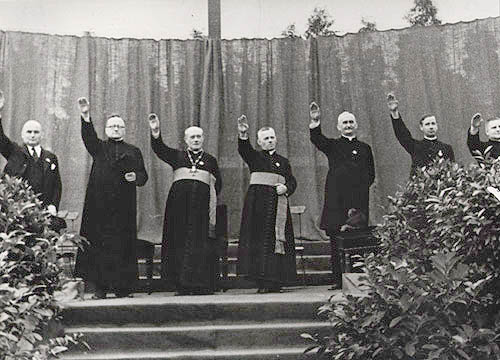
Hitler and the Nazis are often cited as an example of the horrible crimes which atheists have committed in the 20th century. They are only assumed to be atheists, though, because people can’t imagineChristians doing such things; in reality, Hitler explicitly appealed to Christianity on a regular basis and this was part of why he was popular. Not every Christian supported the Nazis, of course, but he was most popular with conservative Christians seeking a restoration of traditional values. . . . .
Christians may not like acknowledging that Nazi actions might have anything to do with Christianity, but Germany saw itself as a fundamentally Christian nation and millions of Christians in Germany enthusiastically endorsed Hitler and the Nazi Party in part because they saw both as embodiments of both German and Christian ideals. Conservative Christians who wanted a return to traditional values either voted for the Nazis or one of the other right-wing nationalist parties which eventually supported and merged with the Nazis.



 Always Question Authority