The United States spends almost as much as the rest of the world combined! Now imagine if we spent this money on hiring better teachers. Or providing cost-free health care. Or expanding our libraries. Or . . .
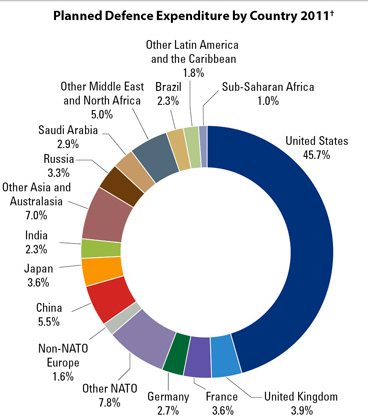
Source: MoveOn.org
Category Archives: Economics
What Are Conservatives [i.e., Reactionaries] Trying to Conserve?
About a month ago, Jonathan Chait published an important article in New York Magazine arguing that demographic changes in the United States will before too long spell doom to the political influence and hegemony of conservatives [i.e., reactionaries], and that conservatives [i.e., reactionaries], well aware of these changes, regard the 2012 elections as their last, best chance to reverse the course America is on. “Conservative America,” Chait writes, “will soon come to be dominated, in a semi-permanent fashion, by an ascendant Democratic coalition hostile to its outlook and interests.” The Republican [i.e., Reactionaries] Party, Chait explains, had over decades found itself increasingly confined to white voters, “especially those lacking a college degree and especially rural whites.” Meanwhile, Democrats have increased their standing among whites with graduate degrees, secular whites and racial minorities. . . .
Brazilians charge Big Oil for spill . . . why didn’t we?
Brazilian police seek charges against US oil company Chevron and drilling contractor Transocean for an oil spill off the coast of Rio de Janeiro. The Brazilians don’t mess around when it comes to oil spills. See what they’re planning to do to their oil barons – that we here in the United States need to copy.
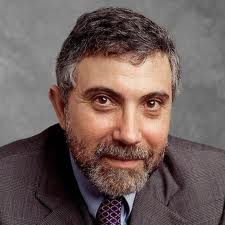
Paul Krugman: Paranoia Strikes Deeper
Stop, hey, what’s that sound? Actually, it’s the noise a great political party makes when it loses what’s left of its mind. And it happened — where else? — on Fox News on Sunday, when Mitt Romney bought fully into the claim that gas prices are high thanks to an Obama administration plot. . . .
. . . [T]he president of the United States doesn’t control gasoline prices, or even have much influence over those prices. Oil prices are set in a world market, and America, which accounts for only about a tenth of world production, can’t move those prices much. Indeed, the recent rise in gas prices has taken place despite rising U.S. oil production and falling imports. . . .
As Richard Hofstadter pointed out in his classic 1964 essay “The Paranoid Style in American Politics,” crazy conspiracy theories have been an American tradition ever since clergymen began warning that Thomas Jefferson was an agent of the Bavarian Illuminati. But it’s one thing to have a paranoid fringe playing a marginal role in a nation’s political life; it’s something quite different when that fringe takes over a whole party, to the point where candidates must share, or pretend to share, that fringe’s paranoia to receive the party’s presidential nod. . . .
How the rich took over airport security
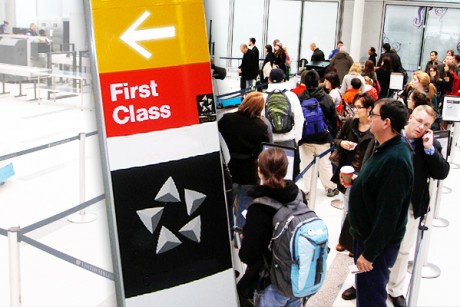
The other day at Bergstrom Airport in Austin, Texas, I witnessed a striking manifestation of the new American plutocracy. Along with getting a photo at the Department of Motor Vehicles and sitting in a jury pool, standing in line at airport security with a mob of other people, miserable though it is, remains one of the few examples of civic equality in our increasingly oligarchic republic. Much airport security, of course, is theater, designed to provide alibis for bureaucrats and politicians in the event of a terrorist attack. But while we can debate what a rational airport security system would look like, no rational system would discriminate among passengers on the basis of ability to pay.
That is what makes the policy of Delta Airlines so shockingly un-American. In Austin, Delta had not one but two lines that fed into the Transportation Security Administration checkpoint area. One line was mixed race, mixed class and mixed age. The other line was usually empty. Now and then a white, middle-aged man would appear in the second line and the first line would be halted as he went directly into the TSA checkpoint.
“Who are those guys?” I asked a TSA officer, when I reached the front of the second-class citizen line.
“Delta has total control over the passenger line all the way up to here,” the officer answered. “They’ve decided to let priority passengers as well as pilots and steward staff go through ahead of others.”
“So that’s the rich white guy line?” I asked.
The TSA officer laughed. “On our side of the line, everybody is equal.”
When They Say Government They Mean You
I’d like to talk about government. The conservative [i.e., reactionary]/corporate propaganda machine has turned “government” into a bad word. Conservatives [i.e., reactionaries] portray our government as some kind of enemy of the public. We have all heard the scare stories about the harm done by meddlesome regulations from intrusive big government programs run by government bureaucrats.
Let’s step back from reacting to the word as we hear it today and think about what the word really means.
This Spring We Rise!
AFGE Responds to House GOP Budget Proposal
WASHINGTON – American Federation of Government Employees National President John Gage today issued the following statement in response to the 2013 budget plan introduced by House Republicans:
“The House GOP budget, proposed by Rep. Paul Ryan, proposes a staggering $368 billion in additional federal workforce cuts over the next 10 years. Federal employees would have their salaries frozen for another three years and would face massive cuts to the retirement benefits promised when they were hired. In addition, the federal workforce would be cut by 10 percent, jeopardizing the federal programs and services every American relies on.
NPR: How Do Racial Attitudes Affect Opinions About The Health Care Overhaul? (AUDIO)
In a new paper published in the American Journal of Political Science, Michael Tesler presents survey and experimental data that suggest that the racial attitudes of ordinary Americans have shaped both how they feel about the health care overhaul, and how intense those feelings are. . . .
The study is part of a broad range of research projects that shows that issues such as race and religion play a powerful role in shaping how people feel about policies related to war, welfare and crime.
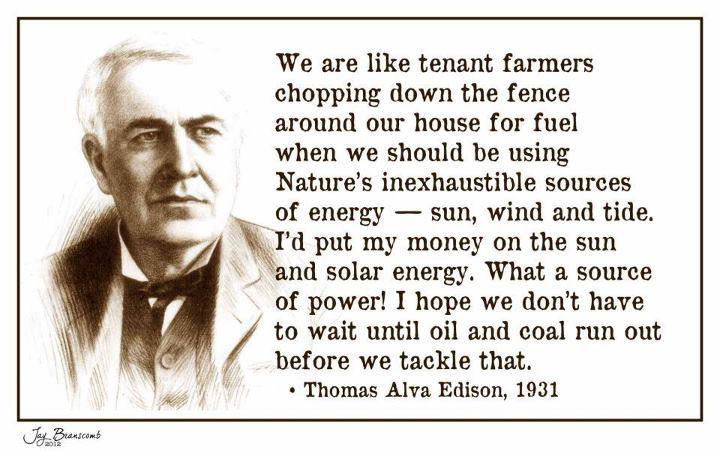
Quote: Thomas Edison
Source: Uncommon Friends: Life with Thomas Edison, Henry Ford, Harvey Firestone, Alexis Carrel & Charles Lindbergh (1987) by James Newton, p. 31.
Via: MoveOn.org