QUOTATION: “On Religion as a By-product of Fear” / Arthur C. Clarke

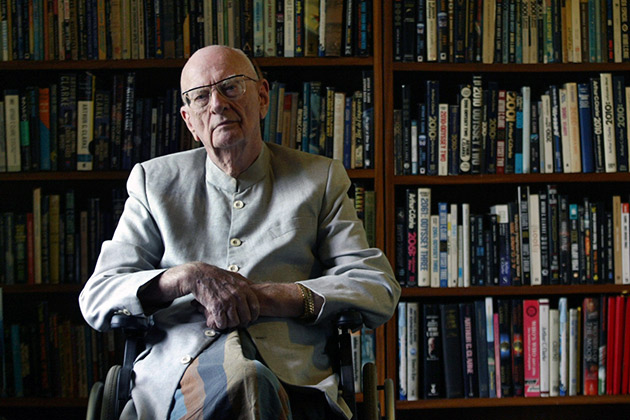
Sir Arthur Charles Clarke (16 December 1917 – 19 March 2008)
British Science Fiction Author, Inventor, Futurist, and Atheist
Author of 2001: A Space Odyssey, (1968)

Religion is a by-product of fear. For much of human history, it may have been a necessary evil, but why was it more evil than necessary? Isn’t killing people in the name of god a pretty good definition of insanity?

QUOTATION: “Science Can Destroy Religion” / Arthur C. Clarke

Sir Arthur Charles Clarke (16 December 1917 – 19 March 2008)
British Science Fiction Author, Inventor, Futurist, and Atheist
Author of 2001: A Space Odyssey, (1968)

Science can destroy religion by ignoring it as well as by disproving its tenets. No one ever demonstrated, so far as I am aware, the nonexistence of Zeus or Thor – but they have few followers now.

The Big Ideas Podcast: Friedrich Nietzsche’s ‘God is dead’

What did Nietzsche mean by the death of God? Benjamen Walker and guests explore the legacy of the German philosopher’s statement.

One of the most frequently quoted – and hotly debated – passages in modern philosophy appears in Section 125 of Friedrich Nietzsche’s The Gay Science. It’s worth quoting in full:

“God is dead. God remains dead. And we have killed him. How shall we comfort ourselves, the murderers of all murderers? What was holiest and mightiest of all that the world has yet owned has bled to death under our knives: who will wipe this blood off us? What water is there for us to clean ourselves? What festivals of atonement, what sacred games shall we have to invent? Is not the greatness of this deed too great for us? Must we ourselves not become gods simply to appear worthy of it?”

But the core statement is as ambiguous as it is catchy: was God an actual being that had ceased to exist, or had we merely stopped believing in him? In Nietzsche’s book, the words are spoken by a madman: did this mean that God was in fact still alive? Many have quipped: Nietzsche doesn’t look that alive these days either.

Listen to podcast here . . . 

Aphorism: On Classic Literature

By Madison S. Hughes (01.14.2012)

What makes classic literature the greatest of literary masterpiece is its ability to transcend time, and place of composition. What makes one able to appreciate it is one’s ability to transcend one’s contemporary time, and place of comprehension.

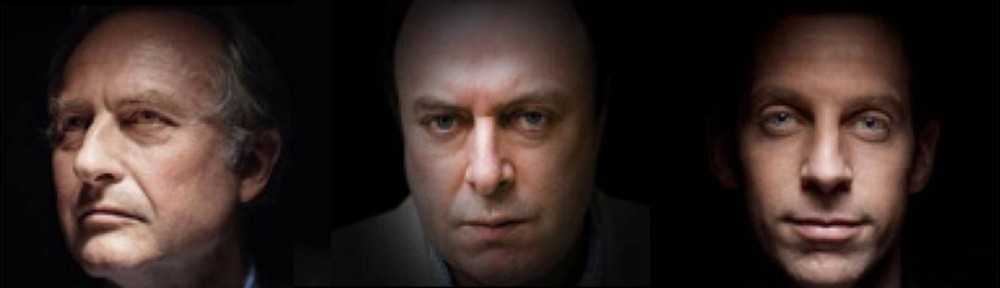
Salman Rushdie: Christopher Hitchens (Vanity Fair, Feb 2012)

Laughter and Hitchens were inseparable companions, and comedy was one of the most powerful weapons in his arsenal. . .

Behind the laughter was what his friend Ian McEwan called “his Rolls-Royce mind,” that organ of improbable erudition and frequently brilliant, though occasionally flawed, perception. The Hitch mind was indeed a sleek and purring machine trimmed with elegant fittings, but his was not a rarefied sensibility. He was an intellectual with the instincts of a street brawler, never happier than when engaged in moral or political fisticuffs. . .

On his sixty-second birthday – his last birthday, a painful phrase to write – I had been with him and Carol and other comrades at the Houston home of his friend Michael Zilkha, and we had been photographed standing on either side of a bust of Voltaire. That photograph is now one of my most treasured possessions; me and the two Voltaires, one of stone and one still very much alive. Now they are both gone, and one can only try to believe, as the philosopher Pangloss insisted to Candide in the elder Voltaire’s masterpiece, that “everything is for the best in this best of all possible worlds.”

It doesn’t feel like that today.

Read more . . . 

Book Review: Democratic Enlightenment: Philosophy, Revolution, and Human Rights, 1750-1790

The great names one learns at school — Voltaire and Rousseau, Newton and Locke, Leibniz and Kant — turn out never to have been willing or able to think themselves through to the new. Israel’s real heroes were hard-nosed atheists, materialists and revolutionaries who brooked no compromise with the status quo.

Israel traces the lineage of this Radical Enlightenment to Baruch Spinoza, the 17th-century philosopher who serves here as the father of all atheists and “one substance” materialists who rejected the suspiciously spiritualist dualism of mind and body. Spinoza was certainly a radical critic of Scripture, who denied miracles and seemed to equate “God” with nature.

Read more . . . 

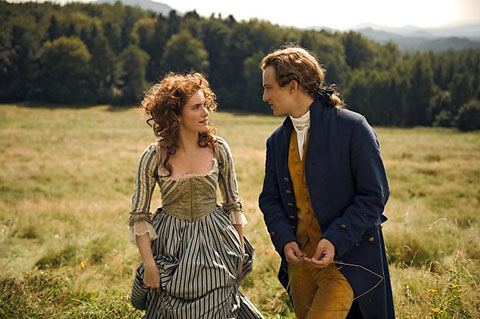
Young Goethe in Love: In fact, just another love story

Johann Wolfgang von Goethe (1749 – 1832), poet, novelist, dramatist, philosopher, naturalist and physicist, was a towering figure in German and world culture. . . 

In the film’s production notes, [German filmmaker Philipp] Stölzl writes: “Goethe is Germany’s most famous and important poet and philosopher, yet there has never been a relevant feature film about this extraordinary personality. There’s a reason for this, too: Goethe could do everything and was everything! He was handsome, came from a wealthy family, wrote successful novels, theater plays and poems, was an accomplished horseback rider and fencer, invented roller skates and discovered the pharyngeal bone, and he was a natural scientist, privy councilor, traveler, artist, minister, lawyer, and much, much more—all in all, a universal genius and thus a completely non-dramatic character for a feature film.”

Read more . . .