 The Most Religious Americans Are Most Likely to Be Creationists
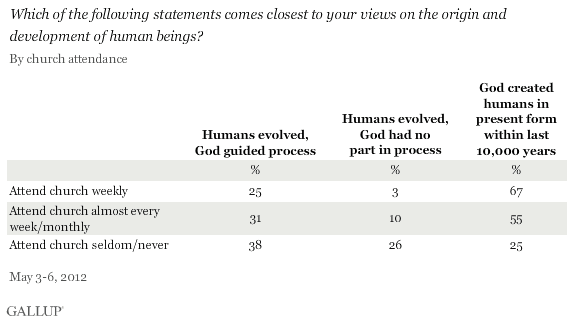 Majority of Republicans Are Creationists
 Those With Postgraduate Education Least Likely to Believe in Creationist Explanation
The Most Religious Americans Are Most Likely to Be Creationists
Majority of Republicans Are Creationists
Those With Postgraduate Education Least Likely to Believe in Creationist Explanation
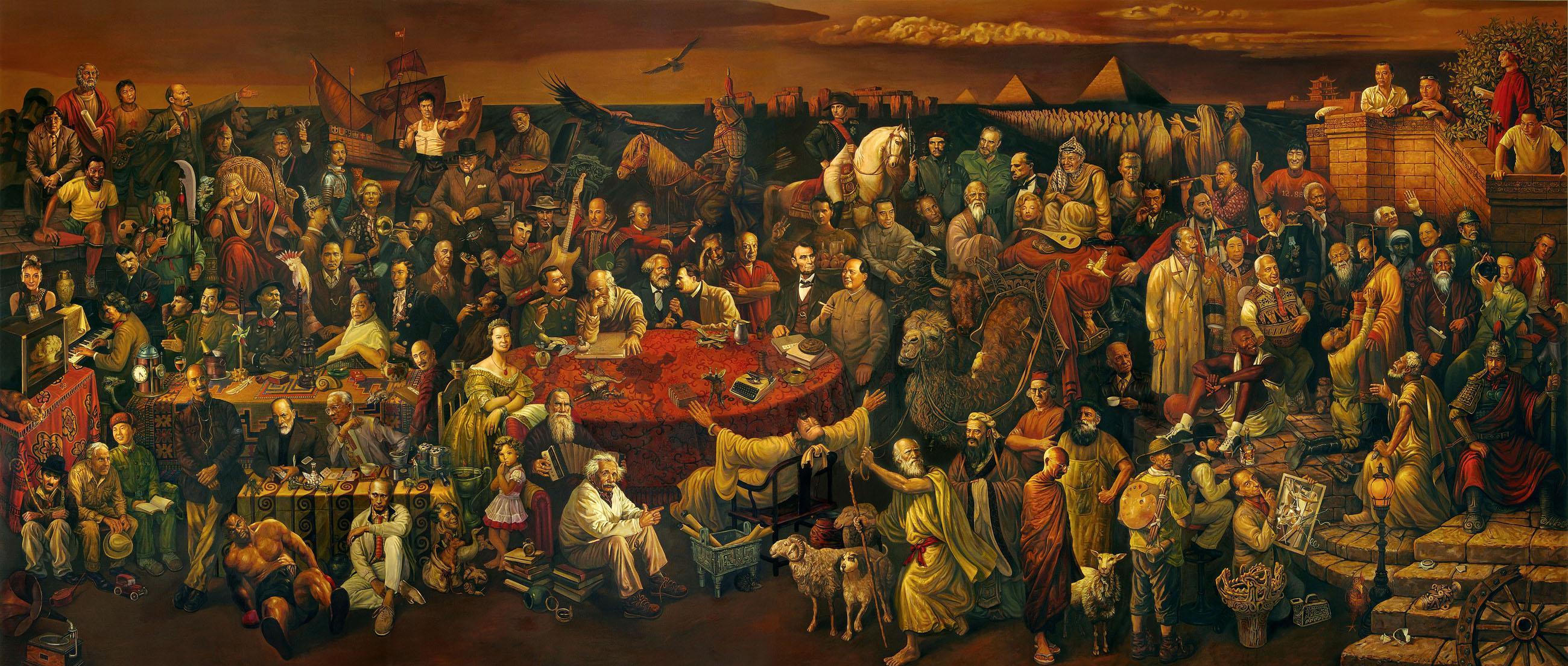
This painting is truly amazing, but more surprising is that it has been “computerized”.
Click on the link below and see a larger version of the picture.
Roll your mouse over the characters and the program tells you who is, each of them.
Click in the body, and you will be re-directed to the Wikipedia life and history of each.
By Madison S. Hughes (05.09.2012)
I cannot say that spontaneous human combustion is my forte; however, judging from the bits and pieces of information concerning such that have entered my realm of thought, I must say that I am not convinced by any evidence that proponents have put forth to support such claims.
Certainly, a “loving” God would not allow such, but somehow I doubt One that engages in world genocide would take issue with a burning here and there. As a matter of fact, His followers have historically proven rather fond to burnings. I wonder if those that spontaneously combust are also of the more intellectual among us.
 Source: MoveOn.org
During most of my years as a liberal Protestant minister, I never saw a contradiction between my Christian faith and the fact of evolution. Like many progressive Christians, I did not understand evolution as a challenge to the doctrine of divine creation ex nihilo; evolution was merely the mechanism that God used for creating life on our planet.
[…]
My indifference towards evolution changed dramatically when I ran across Richard Dawkins’ analogy of natural selection as “climbing Mount Improbable.” In that memorable and vivid metaphor, Dawkins illustrates the truly incremental and gradual nature of the evolutionary process. Opponents of evolution have contended that, while change within species can occur, the leap from one species to a new species is just too improbably great to have happened by purely natural processes. Outside assistance must have been involved. Dawkins addresses that claim by acknowledging that, yes, the leap from one species to the next seems improbably difficult—like scaling the cliff of a mountain to reach the peak. However, if one approaches the peak not from the formidable cliff but instead moves slowly along the slope on the other side of the mountain, reaching the peak of “Mount Improbable” becomes quite possible, although it might take a very long time.
[…]
Which core doctrines of Christianity does evolution challenge? Well, basically all of them. The doctrine of original sin is a prime example. If my rudimentary grasp of the science is accurate, then Darwin’s theory tells us that because new species only emerge extremely gradually, there really is no “first” prototype or model of any species at all—no “first” dog or “first” giraffe and certainly no “first” homo sapiens created instantaneously. The transition from predecessor hominid species was almost imperceptible. So, if there was no “first” human, there was clearly no original couple through whom the contagion of “sin” could be transmitted to the entire human race. The history of our species does not contain a “fall” into sin from a mythical, pristine sinless paradise that never existed.
An overwhelming 83 percent of Americans say that God answers prayers–which begs the question, does prayer work? Is it something that we can even begin to approach scientifically? Unsettling as these questions may be, I [Cara Santa Maria] think it’s important to attempt to get to the bottom of them.
For help, I reached out to two researchers,Tanya Marie Luhrmann, an anthropologist at Stanford and author of the book “When God Talks Back” and Michael Shermer, executive director of the Skeptics Society and author of “The Believing Brain.”
Late last year some fascinating research revealed that people who take a more deliberative approach to problem solving – rather than just going with their instincts – are also less religious. Now some independent research not only confirms those findings, but also extends them to show how there is a progressive link thinking style and decreasing religious beliefs.
[…]
The key results are shown in the figure. People who believe in a personal god are disproportionately likely to have got every question wrong.
Pantheists, who believe in god as an impersonal force, did better. Deists, who believe in an impersonal god who does not intervene in the universe, did better still, and agnostics even better. Atheists were the most likely to give correct answers.
 Source: Bullshit Poisons Everything


 Always Question Authority