ACADEMIC STUDY: Susie Madrak / “Conservatism Is Lack of Complexity In Political Brain”


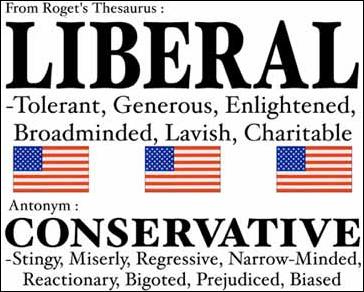
Liberal definitionInteresting studies. Whenever I argue with a conservative, I always end up saying in frustration, “But it’s not that simple!” It appears that for some people, their inability to reason out complex ideas is what makes them conservatives, and not their hatred of the human race (although there may be some overlap there)!

[…]

In the four studies conducted by Scott Eidelman, Christian S. Crandall, Jeffrey A. Goodman, and John C. Blanchar published by the Society for Personality and Social Psychology, Inc, they concluded, “(P)olitical conservatism is promoted when people rely on low-effort thinking.

[…]

We think that compassion and empathy are a fundamental part of liberal values, and we note at times that it takes being in that specific situation for conservatives to grasp why, for example, liberals support universal healthcare for all. There are many studies that address that take on things, but this study is specifically addressing whether or not having low-effort thinking will produce conservative thinking initially, and they showed that it does.

Read more . . .

LITERARY NEUROSCIENCE: Corrie Goldman / “This is your Brain on Jane Austen, and Stanford Researchers are Taking Notes”

In an innovative interdisciplinary study, neurobiological experts, radiologists and humanities scholars are working together to explore the relationship between reading, attention and distraction – by reading Jane Austen.

Surprising preliminary results reveal a dramatic and unexpected increase in blood flow to regions of the brain beyond those responsible for “executive function,” areas which would normally be associated with paying close attention to a task, such as reading, said Natalie Phillips, the literary scholar leading the project.

[…]

Pioneering in a number of respects, her research is “one of the first fMRI experiments to study how our brains respond to literature,” Phillips said, as well as the first to consider “how cognition is shaped not just by what we read, but how we read it.”

Critical reading of humanities-oriented texts is recognized for fostering analytical thought, but if such results hold across subjects, Phillips said it would suggest “it’s not only what we read – but thinking rigorously about it that’s of value, and that literary study provides a truly valuable exercise of people’s brains.”

Read more . . .

EDUCATION: PZ Myers / “Woe is U.S. Academics”

Have you been following Doonesbury for the past few weeks? It’s been all about the progressive destruction of the American university, as the old model is replaced by the for-profit university, a hideous scheme in which state and federal support for higher education gets siphoned off to support lousy schools that grind through massive numbers of students, offering low tuition, flexible hours, and a fast-track to a degree…and with abysmal retention rates, low success, marginally qualified ‘faculty’, and an education that is worth less than you paid for it. These are the colleges you see advertised on cheesy commercials on television, in which some guy proudly testifies about getting his fancy diploma working only a few hours a week at night over two years, and never having to step away from his computer to do it.

Continue reading . . .

SEPARATION OF CHURCH AND STATE: The $71 Billion Break: Why Reforming Religious Subsidies Will Benefit Us All

Now more than ever, the United States needs to change its laws surrounding religious subsidies. Last year, the state of Florida cut over $1.3 billion from the budget meant for public schools as well as $1.1 billion for police and firefighter pensions. If Florida had collected property taxes on religious institutions, the revenue would have been $2.2 Billion, almost enough to cover both of these budgetary expenses. In fact, the debate over religious tax exemptions has recently been distilled down to one number: 71 billion dollars. That’s the total amount that the government forgoes every year in religious subsidies, and clearly, there are places that this money could be put to use.

Continue reading . . .

h/t: Planet Atheism

Bill Moyers: Interview / The Social Consequences of Inequality / Richard Wilkinson (TED Talk VIDEO)

“If Americans want to live the American dream they should go to Denmark.”
~ Richard Wilkinson

Richard Wilkinson is an epidemiologist and a leader in international research of inequality. He is also the co-author of The Spirit Level: Why Greater Equality Makes Societies Stronger with Kate Pickett. Their book has been described by The Sunday Times of London as having “a big idea big enough to change political thinking. In half a page,” the Times says, “it tells you more about the pain of inequality than any play or novel could.”

His TED talk — “How economic inequality harms societies” — has garnered over 1 million views on the TED website since October 2011.

We caught up with him to talk about how inequality can be dangerous to our health.

Read interview, and watch TED talk video here . . .

Research Report: How Secular Humanists (and Everyone Else) Subsidize Religion in the United States

[…]

Nowhere did we find prior research summarizing and detailing religious finances and tax policy, so we decided to investigate it ourselves. This article is the result. It took some digging, but we think we now have a moderately clear understanding of the tax laws regarding religions in the United States. What we found suggests that religious institutions, if they were required to pay taxes the same as for-profit corporations do, would not have nearly as much money or influence as they enjoy in America today. In this article we estimate how much local, state, and federal governments subsidize religions.

[…]

. . . [R]eligions spend a relatively small portion of their revenue on “physical charity”, and while they spend a larger portion of their revenue addressing “spiritual concerns”, most of that qualifies as labor, not charity. What little would qualify as “spiritual charity” would not be replaced by government if discontinued. In short, religions are, by and large, not engaged in charitable work.

[…]

. . . [T]he subsidies to religions in the United States today may not be encouraging the growth of religions, but they may be keeping alive on the equivalent of subsidized life-support many religions that should be dead.

If these subsidies were removed—though we have no basis for believing that they will be anytime soon—we wonder what the damage to religion would be. There is evidence that donations to religions are tied to taxes; as the tax benefit of donating goes up, so do donations and vice versa. In other words, it seems likely that the removal of these subsidies would result in a substantial decrease in the supply of religion in the United States. To what extent it would affect demand for religion is uncertain.

[…]

. . . [I]t seems likely that subsidies are propping up religion in the United States, though to what extent is not clear. Certainly many religions that are near failing would have done so already if not for the subsidies they receive from the government. Another practical result of these subsidies is that religions are more affluent and more influential than they would otherwise be, because they have the resources to fund efforts to change legislation, create widely consumed media, and influence public policy.

[…]

. . . These subsidies should be phased out. But since that is unlikely to happen, we’d accept the following alternative: . . . direct cash transfers to us from the government for trying to convert people to our worldviews while claiming to provide social services[.]

Read more . . .

Book Excerpt: “Occupy the Economy: Challenging Capitalism” / Richard Wolff

For the last half-century, capitalism has been a taboo subject in the United States. . . . Politicians repeated, robot-style, that the “U.S. is the greatest country in the world” and that “capitalism is the greatest economic system in the world.” Those few who have dared to raise questions or criticisms about capitalism have been either ignored or told to go live in North Korea, China or Cuba as if that were the only alternative to pro-capitalism cheerleading.

[…]

Questioning and criticizing capitalism have been taboo, treated by federal authorities, immigration officials, police and most of the public alike as akin to treason. Fear-driven silence has substituted for the necessary, healthy criticism without which all institutions, systems, and traditions harden into dogmas, deteriorate into social rigidities, or worse. Protected from criticism and debate, capitalism in the United States could and has indulged all its darker impulses and tendencies. No public exposure, criticism and movement for change could arise or stand in its way as the system and its effects became ever more unequal, unjust, inefficient and oppressive. Long before the Occupy movement arose to reveal and oppose what U.S. capitalism had become, that capitalism had divided the 1 percent from the 99 percent.

[…]

Across the pages that follow, what emerges is the central importance of how capitalism very particularly organizes production: masses of working people generate corporate profits that others take and use. Tiny boards of directors, selected by and responsible to tiny groups of major shareholders, gather and control corporate profits, thereby shaping and dominating society. That tiny minority (boards and major shareholders) of those associated with and dependent upon corporations make all the basic decisions—how, what, and where to produce and what to do with the profits. The vast majority of workers within and residents surrounding those capitalist corporations must live with the results of corporate decisions. Yet they are systematically excluded from participating in making those decisions. Nothing more glaringly contradicts democracy than how capitalism organizes the corporate enterprises where working people produce the goods and services without which modern life for everyone would be impossible.

From: Occupy the Economy: Challenging Capitalism By Richard Wolff

Read more . . .

Highly Religious People Are Less Motivated by Compassion Than Are Non-Believers

“Love thy neighbor” is preached from many a pulpit. But new research from the University of California, Berkeley, suggests that the highly religious are less motivated by compassion when helping a stranger than are atheists, agnostics and less religious people.

[…]

In the study, the link between compassion and generosity was found to be stronger for those who identified as being non-religious or less religious.

“Overall, we find that for less religious people, the strength of their emotional connection to another person is critical to whether they will help that person or not,” said UC Berkeley social psychologist Robb Willer, a co-author of the study. “The more religious, on the other hand, may ground their generosity less in emotion, and more in other factors such as doctrine, a communal identity, or reputational concerns.”

[…]

“Overall, this research suggests that although less religious people tend to be less trusted in the U.S., when feeling compassionate, they may actually be more inclined to help their fellow citizens than more religious people,” Willer said.

Read more . . .

Losing Your Religion: Analytic Thinking Can Undermine Belief

People who are intuitive thinkers are more likely to be religious, but getting them to think analytically even in subtle ways decreases the strength of their belief, according to a new study in Science.

[…]

Analytic thinking undermines belief because, as cognitive psychologists have shown, it can override intuition. And we know from past research that religious beliefs—such as the idea that objects and events don’t simply exist but have a purpose—are rooted in intuition. “Analytic processing inhibits these intuitions, which in turn discourages religious belief,” [British Columbia psychologist, Ara] Norenzayan explains.

Read more . . . 

Instinctive Thinkers More Likely to Believe in a Personal God – and Less Likely to be Atheists

Late last year some fascinating research revealed that people who take a more deliberative approach to problem solving – rather than just going with their instincts – are also less religious. Now some independent research not only confirms those findings, but also extends them to show how there is a progressive link thinking style and decreasing religious beliefs.

[…]

The key results are shown in the figure. People who believe in a personal god are disproportionately likely to have got every question wrong.

Pantheists, who believe in god as an impersonal force, did better. Deists, who believe in an impersonal god who does not intervene in the universe, did better still, and agnostics even better. Atheists were the most likely to give correct answers.

Read more . . .

via: The Atheism News Magazine