POLITICAL COMMENTARY: “Susan Sarandon on Hillary Clinton’s Foreign Policy” / The Young Turks / Cenk Uygur, Ben Mankiewicz, and John Iadarola ☮

“Speaking with The Young Turks Politics Reporter Jordan Chariton in California, Sarandon made clear that she believed because of the lack of media scrutiny placed on Clinton’s record, she viewed Clinton as actually more dangerous than the blustery strong-man running on the Republican ticket.

“I believe in a way she is more dangerous,” Sarandon suggested without mentioning Trump’s name, after Chariton asked her why Clinton’s foreign policy went largely unchallenged during the Democratic primary.

“She did not learn from Iraq, and she is an interventionist, and she has done horrible things, and very callously, I don’t know if she is overcompensating or what her trip is,” Sarandon said, adding, “I think we’ll be in Iran in two seconds.”

“So I’m curious to see if anyone brings up these things,” she continued.

“But this is what we’re fed. ‘He’s so dangerous. He’s so dangerous,’” Sarandon said, shrugging off Trump’s most controversial rhetoric as too implausible to be considered a serious threat.

“Seriously I am not worried about a wall being built, he is not going to get rid of every Muslim in this country… but seriously, I don’t know what his policy is. I do know what her policies are, I do know who she is taking money from, and I do know that she is no transparent, and I do know that nobody calls her on it”

SOCIAL HISTORY: “The Revolutionary Origins of Memorial Day and its Political Hijacking” / Ben Becker

The way the Civil War became officially remembered — through Memorial Day celebrations— was based on the erasure of the Black veteran and the liberated slave.

A day celebrating Black liberation utilized for white supremacy

What we now know as Memorial Day began as “Decoration Day” in the immediate aftermath of the U.S. Civil War. It was a tradition initiated by former slaves to celebrate emancipation and commemorate those who died for that cause.

These days, Memorial Day is arranged as a day “without politics”—a general patriotic celebration of all soldiers and veterans, regardless of the nature of the wars in which they participated. This is the opposite of how the day emerged, with explicitly partisan motivations, to celebrate those who fought for justice and liberation.

The concept that the population must “remember the sacrifice” of U.S. service members, without a critical reflection on the wars themselves, did not emerge by accident. It came about in the Jim Crow period as the Northern and Southern ruling classes sought to reunite the country around apolitical mourning, which required erasing the “divisive” issues of slavery and Black citizenship. These issues had been at the heart of the struggles of the Civil War and Reconstruction.

To truly honor Memorial Day means putting the politics back in. It means reviving the visions of emancipation and liberation that animated the first Decoration Days. It means celebrating those who have fought for justice, while exposing the cruel manipulation of hundreds of thousands of U.S. service members who have been sent to fight and die in wars for conquest and empire.

Continue reading . . .

INDEPENDENT JOURNALISM: “Bernie and Beautiful at Sanders Portland Headquarters” / TYT Politics / Jordan Chariton ☮

TYT Politics Reporter Jordan Chariton (@JordanChariton) reported from Senator Bernie Sanders Portland, Oregon headquarters on May 15th, 2016.

PLUTOCRACY: “Welcome to 1984” / Chris Hedges ☮

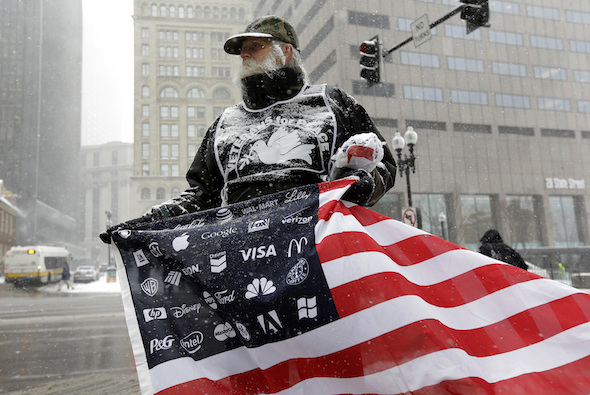
Corporate Flag Protester

The artifice of corporate totalitarianism has been exposed. The citizens, disgusted by the lies and manipulation, have turned on the political establishment. But the game is not over. Corporate power has within its arsenal potent forms of control. It will use them. As the pretense of democracy is unmasked, the naked fist of state repression takes its place. America is about—unless we act quickly—to get ugly.

“Our political system is decaying,” said Ralph Nader when I reached him by phone in Washington, D.C. “It’s on the way to gangrene. It’s reaching a critical mass of citizen revolt.”

This moment in American history is what Antonio Gramsci called the “interregnum”—the period when a discredited regime is collapsing but a new one has yet to take its place. There is no guarantee that what comes next will be better. But this space, which will close soon, offers citizens the final chance to embrace a new vision and a new direction.

Continue reading . . .

US POLITICS: “Thank you, Jimmy Carter, for Waging Peace, Fighting Disease, and Building Hope Around the World” ☮

President Jimmy Carter

To say Jimmy Carter is a great “former” president is a tremendous understatement. This Nobel Peace Prize recipient is one of the greatest presidents in American history.

Under his leadership, we never dropped a bomb, never fired a bullet, and never went to war. No other president since World War II can say this. In 1978, former President Carter facilitated the Camp David Accords, a peace treaty between Israel and Egypt that still exists today. Countless lives have been spared by this remarkable peacemaker, humanitarian, and world leader.

In addition, former President Carter’s astounding nonprofit work via The Carter Center has helped reduce cases of the Guinea Worm Disease from 3.5 million to less than 30. With his wife, Rosalynn Carter, and Habitat For Humanity, former President Carter has been building homes for families in need since 1994. And his contributions with the late Nelson Mandela and The Elders will resonate for centuries. The 39th U.S. President is not only a national treasure—Jimmy Carter is a world treasure.

h/t: Daily Kos

DOCUMENTARY: “Where to Invade Next” / Michael Moore ☮

Filmmaker Michael Moore visits various countries to examine how Europeans view work, education, health care, sex, equality, and other issues. From cafeteria food to sex ed, Moore looks at the benefits of schooling in France, Finland and Slovenia. In Italy, he marvels at how workers enjoy reasonable hours and generous vacation time. In Portugal, Moore notes the effects of the decriminalization of drugs. Through his travels, we discover just how different America is from the rest of the world.