In politics, the concrete usually wins over the abstract [Because thinking is hard!]

. . . [M]ost people value [Christian privilege] as an abstract principle, they don’t make decisions based on abstractions. They tend to look at the concrete manifestations of those abstractions. . . . So while many people will say they support [Christian privilege], they are going to be angry if [women workers] access to their contraceptive services are taken away. The situation is similar to those older Tea [Bagee] supporters who say they support getting government out of health care as an abstract principle but will fight tooth and nail to retain their Medicare.

Read more . . .

Anarchism Is Not What You Think It Is—And There’s a Whole Lot We Can Learn from It

On February 8, 1921 twenty thousand people, braving temperatures so low that musical instruments froze, marched in a funeral procession in the town of Dimitrov, a suburb of Moscow. They came to pay their respects to a man, Petr Kropotkin, and his philosophy, anarchism.

Some 90 years later few know of Kropotkin. And the word anarchism has been so stripped of substance that it has come to be equated with chaos and nihilism.  This is regrettable, for both the man and the philosophy that he did so much to develop have much to teach us in 2012. . . .

The precipitating event that led Kropotkin to embrace anarchism was the publication of Charles Darwin’s Origin of the Species in 1859. . . .

He spent the rest of his life promoting that concept and the theory of social structure known as anarchism. To Americans anarchism is synonymous with a lack of order. But to Kropotkin anarchist societies don’t lack order but the order emerges from rules designed by those who feel their impact, rules that encourage humanly scaled production systems and maximize individual freedom and social cohesion.

Read more . . . 

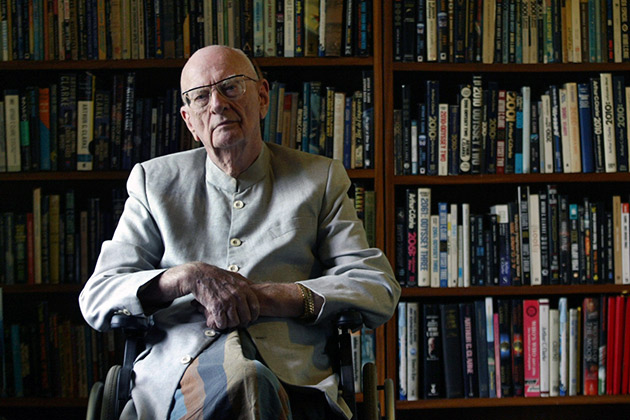
QUOTATION: “On Religion as a By-product of Fear” / Arthur C. Clarke

Sir Arthur Charles Clarke (16 December 1917 – 19 March 2008)
British Science Fiction Author, Inventor, Futurist, and Atheist
Author of 2001: A Space Odyssey, (1968)

Religion is a by-product of fear. For much of human history, it may have been a necessary evil, but why was it more evil than necessary? Isn’t killing people in the name of god a pretty good definition of insanity?

Conservatism [Reactionism] Thrives on Low Intelligence and Poor Information

. . . It feels crude, illiberal to point out that the other side is, on average, more stupid than our own. But this, the study suggests, is not unfounded generalisation but empirical fact.

It is by no means the first such paper. There is plenty of research showing that low general intelligence in childhood predicts greater prejudice towards people of different ethnicity or sexuality in adulthood. Open-mindedness, flexibility, trust in other people: all these require certain cognitive abilities. Understanding and accepting others – particularly “different” others – requires an enhanced capacity for abstract thinking. . .

Those with low cognitive abilities are attracted to “rightwing ideologies that promote coherence and order” and “emphasise the maintenance of the status quo”. Even for someone not yet renowned for liberal reticence, this feels hard to write. . .

. . . [Former Republican ideologue], Mike Lofgren complains that “the crackpot outliers of two decades ago have become the vital centre today“. The Republican party, with its “prevailing anti-intellectualism and hostility to science” is appealing to what he calls the “low-information voter”, or the “misinformation voter”. While most office holders probably don’t believe the “reactionary and paranoid claptrap” they peddle, “they cynically feed the worst instincts of their fearful and angry low-information political base”.

Read more . . . 

QUOTATION: “Science Can Destroy Religion” / Arthur C. Clarke

Sir Arthur Charles Clarke (16 December 1917 – 19 March 2008)
British Science Fiction Author, Inventor, Futurist, and Atheist
Author of 2001: A Space Odyssey, (1968)

Science can destroy religion by ignoring it as well as by disproving its tenets. No one ever demonstrated, so far as I am aware, the nonexistence of Zeus or Thor – but they have few followers now.

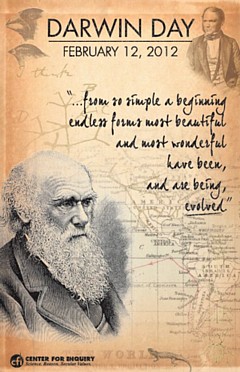
Honoring Darwin Day

On February 12 we’ll commemorate the anniversary of Charles Darwin’s birth, a celebration around the world known as Darwin Day, to appreciate the advancement of human knowledge and the achievements of science and reason. It must also be a day when we push back against the politicization and undermining of science by ideologues and zealots. . .

Unfortunately, too many politicians are gripped by an anti-science fervor. . .

Last year, [Representative Pete Stark (D-CA) California’s 13th district and the only self-described non-theist in Congress] introduced a resolution in the U.S. House of Representatives to designate February 12 as Darwin Day in recognition of Charles Darwin as a worthy symbol of the achievements and importance of reason, science, and the advancement of human knowledge.

Read more . . . 

Just say No,! to the Susan G. Komen Foundation

Source: MoveOn.org

One may enjoy reading the comments associated with this MoveOn.org post, for some of them realize, and speak to, the metaphysical realm of the argument. Of course, many others mix the physical with the metaphysical, while some write purely on an emotional level. Once one realizes the differences between the physical, metaphysical, and emotional levels of argumentation it is quite entertaining to sit back and observe the incoherence of others arguments.

It makes one wonder how is it that many of the sane end up in insane asylums, while the insane aimlessly wonder through life without ever breaching the physiological senses, what’s more, voting for the reactionary ticket, and reproducing like there’s no tomorrow. [MSH]