Nowhere did we find prior research summarizing and detailing religious finances and tax policy, so we decided to investigate it ourselves. This article is the result. It took some digging, but we think we now have a moderately clear understanding of the tax laws regarding religions in the United States. What we found suggests that religious institutions, if they were required to pay taxes the same as for-profit corporations do, would not have nearly as much money or influence as they enjoy in America today. In this article we estimate how much local, state, and federal governments subsidize religions.
[…]
. . . [R]eligions spend a relatively small portion of their revenue on “physical charity”, and while they spend a larger portion of their revenue addressing “spiritual concerns”, most of that qualifies as labor, not charity. What little would qualify as “spiritual charity” would not be replaced by government if discontinued. In short, religions are, by and large, not engaged in charitable work.
[…]
. . . [T]he subsidies to religions in the United States today may not be encouraging the growth of religions, but they may be keeping alive on the equivalent of subsidized life-support many religions that should be dead.
If these subsidies were removed—though we have no basis for believing that they will be anytime soon—we wonder what the damage to religion would be. There is evidence that donations to religions are tied to taxes; as the tax benefit of donating goes up, so do donations and vice versa. In other words, it seems likely that the removal of these subsidies would result in a substantial decrease in the supply of religion in the United States. To what extent it would affect demand for religion is uncertain.
[…]
. . . [I]t seems likely that subsidies are propping up religion in the United States, though to what extent is not clear. Certainly many religions that are near failing would have done so already if not for the subsidies they receive from the government. Another practical result of these subsidies is that religions are more affluent and more influential than they would otherwise be, because they have the resources to fund efforts to change legislation, create widely consumed media, and influence public policy.
[…]
. . . These subsidies should be phased out. But since that is unlikely to happen, we’d accept the following alternative: . . . direct cash transfers to us from the government for trying to convert people to our worldviews while claiming to provide social services[.]
Tag Archives: religion
Conversion on Mount Improbable: How Evolution Challenges Christian Dogma
During most of my years as a liberal Protestant minister, I never saw a contradiction between my Christian faith and the fact of evolution. Like many progressive Christians, I did not understand evolution as a challenge to the doctrine of divine creation ex nihilo; evolution was merely the mechanism that God used for creating life on our planet.
[…]
My indifference towards evolution changed dramatically when I ran across Richard Dawkins’ analogy of natural selection as “climbing Mount Improbable.” In that memorable and vivid metaphor, Dawkins illustrates the truly incremental and gradual nature of the evolutionary process. Opponents of evolution have contended that, while change within species can occur, the leap from one species to a new species is just too improbably great to have happened by purely natural processes. Outside assistance must have been involved. Dawkins addresses that claim by acknowledging that, yes, the leap from one species to the next seems improbably difficult—like scaling the cliff of a mountain to reach the peak. However, if one approaches the peak not from the formidable cliff but instead moves slowly along the slope on the other side of the mountain, reaching the peak of “Mount Improbable” becomes quite possible, although it might take a very long time.
[…]
Which core doctrines of Christianity does evolution challenge? Well, basically all of them. The doctrine of original sin is a prime example. If my rudimentary grasp of the science is accurate, then Darwin’s theory tells us that because new species only emerge extremely gradually, there really is no “first” prototype or model of any species at all—no “first” dog or “first” giraffe and certainly no “first” homo sapiens created instantaneously. The transition from predecessor hominid species was almost imperceptible. So, if there was no “first” human, there was clearly no original couple through whom the contagion of “sin” could be transmitted to the entire human race. The history of our species does not contain a “fall” into sin from a mythical, pristine sinless paradise that never existed.
Aphorism: On Christian Charity
By Madison S. Hughes (05.01.2012)
Churches in general and the Catholic Church in particular, are nothing more than organized tribal cults. They give to their respective tribes, as would any primal tribe; however, these modern-day mendicants mooch off of their secular brethren through tax-exemptions and other Christian privileges purposefully to give back to their primal tribes. They give not out of a sense of compassion to their fellow human beings, but out of a sense of community to their fellow limited and literal-minded tribe members.
Highly Religious People Are Less Motivated by Compassion Than Are Non-Believers
“Love thy neighbor” is preached from many a pulpit. But new research from the University of California, Berkeley, suggests that the highly religious are less motivated by compassion when helping a stranger than are atheists, agnostics and less religious people.
[…]
In the study, the link between compassion and generosity was found to be stronger for those who identified as being non-religious or less religious.
“Overall, we find that for less religious people, the strength of their emotional connection to another person is critical to whether they will help that person or not,” said UC Berkeley social psychologist Robb Willer, a co-author of the study. “The more religious, on the other hand, may ground their generosity less in emotion, and more in other factors such as doctrine, a communal identity, or reputational concerns.”
[…]
“Overall, this research suggests that although less religious people tend to be less trusted in the U.S., when feeling compassionate, they may actually be more inclined to help their fellow citizens than more religious people,” Willer said.
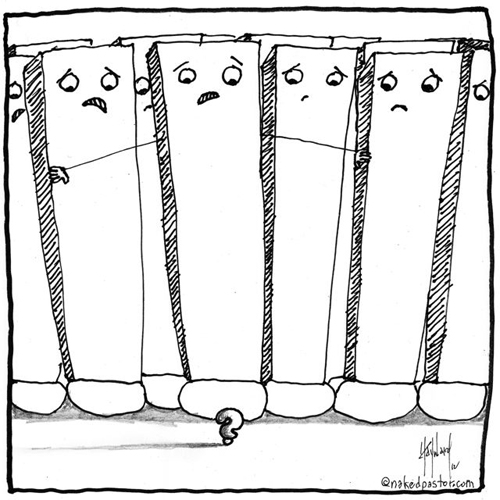
Fear of the Question
For some, even the smallest question can feel threatening. These exclamation marks… towers of certitude… are terrified of this tiny question. They intuitively know that it can completely undermine their dogmatism.
Source: nakedpastor.com
Beautiful Minds: Professor Richard Dawkins
Losing Your Religion: Analytic Thinking Can Undermine Belief
People who are intuitive thinkers are more likely to be religious, but getting them to think analytically even in subtle ways decreases the strength of their belief, according to a new study in Science.
[…]
Analytic thinking undermines belief because, as cognitive psychologists have shown, it can override intuition. And we know from past research that religious beliefs—such as the idea that objects and events don’t simply exist but have a purpose—are rooted in intuition. “Analytic processing inhibits these intuitions, which in turn discourages religious belief,” [British Columbia psychologist, Ara] Norenzayan explains.
Christopher Hitchens: Memorial Service for Vanity Fair Videos
In Part One of the April 20th memorial service for Vanity Fair contributing editor Christopher Hitchens, Graydon Carter welcomed attendees and speakers James Fenton, Lawrence Krauss, Edwin Blue, Patrick Cockburn, Max McGuinness, Aimée Bell, Michael Zilkha, Victor Navasky, and Tom Stoppard.
In Part Two of the April 20th memorial service for Vanity Fair contributing editor Christopher Hitchens, Christopher Buckley read from Hitch-22, followed by speeches from Peter Schneider, Thomas Mallon, James Wood, Leslie Cockburn, and Patrick Cockburn.
In Part Three of the April 20th memorial service for Vanity Fair contributing editor Christopher Hitchens, Sean Penn, Salman Rushdie, Olivia Wilde, Douglas Brinkley, Cary Goldstein spoke.
In Part Four of the April 20th memorial service for Vanity Fair contributing editor Christopher Hitchens, John Auchard, Steve Wasserman, Stephen Fry, Ian McEwen, and Francis Collins spoke.
In Part Five of the April 20th memorial service for Vanity Fair contributing editor Christopher Hitchens, members of his family spoke including Edwin Blue, Alexander Meleagrou-Hitchens, Peter Hitchens, and Carol Blue.
Christopher Hitchens: Remembered by Vanity Fair (VIDEO)
Instinctive Thinkers More Likely to Believe in a Personal God – and Less Likely to be Atheists
Late last year some fascinating research revealed that people who take a more deliberative approach to problem solving – rather than just going with their instincts – are also less religious. Now some independent research not only confirms those findings, but also extends them to show how there is a progressive link thinking style and decreasing religious beliefs.
[…]
The key results are shown in the figure. People who believe in a personal god are disproportionately likely to have got every question wrong.
Pantheists, who believe in god as an impersonal force, did better. Deists, who believe in an impersonal god who does not intervene in the universe, did better still, and agnostics even better. Atheists were the most likely to give correct answers.