CHRISTIAN MISOGYNISTIC MALEVOLENCE: “Arithmetic for Anti-Choicers”
Reply

 h/t: Being Liberal
 h/t: Being Liberal
 h/t: Being Liberal
 h/t: WeAllSupport.com
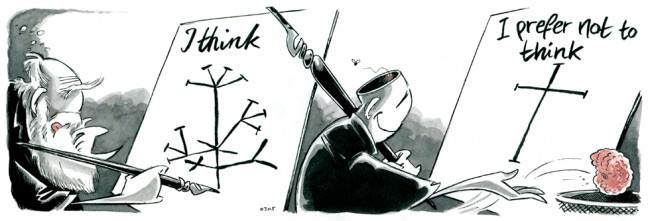
As it turns out, the reason most Christians are so difficult to budge from their religious views is because they know so little about their religion. This may seem counter-intuitive, but this is the essence of the Dunning-Kruger Effect, discovered and described by psychologists David Dunning and Justin Kruger, both then of Cornell University, in a 1999 paper titled: “Unskilled and Unaware of It: How Difficulties in Recognizing One’s Own Incompetence Lead to Inflated Self-Assessments.”
The D-K Effect was frequently suggested historically, notably by Charles Darwin –
“Ignorance more frequently begets confidence than does knowledge”
– and Bertrand Russell –
“One of the painful things about our time is that those who feel certainty are stupid, and those with any imagination and understanding are filled with doubt and indecision.”
In a series of studies, Dunning and Kruger found this pattern across many skills, including reading comprehension, operating a motor vehicle, and playing chess or tennis. Apparently, those displaying the D-K Effect are so lacking in competence that they are even unaware of their incompetence, thus they tend to overestimate their level of skill and fail to recognize skill in others. Conversely, people with high levels of skill or knowledge tend to underestimate their standing relative to others. It seems that the more one knows, the more he realizes how little he knows.
Interestingly, but not surprisingly, Dunning and Kruger also found the Effect operative in broad tests of logical reasoning skills.
The D-K Effect goes a long way toward explaining why those with the least competence in their religion are the most sure they are right about it. Similarly, those who know the least about science are the most certain that it has nothing important to say about how the world works. And, in general, those who are the least adept at critical thinking are the most confident they have the answers.
 The focus of this book is on the growing economic, political and cultural gap that has emerged in the United States between political leaders elected to govern and the citizenry whom they represent. It is also about the pernicious gap between ruling financial and corporate elites and the rest of society and how it has intensified the growth of a political and cultural landscape that is as anti-intellectual and devoid of a culture of questioning as it is authoritarian. I argue in this book that the deepening political, economic and moral deficit in America is inextricably connected to an education deficit, which is currently impacting young people most of all by starving them of both the economic resources and the formative educational experiences required to help them develop into knowledgeable and engaged citizens. The book begins with the premise that the crisis of schooling cannot be disconnected from the economic crisis – fueled by endless wars, a bloated military-industrial complex, and vast disparities in wealth and income. I argue throughout the book that as the United States proceeds headlong on a reckless course of civic illiteracy, which serves to legitimate and bolster a malignant gap in income, wealth and power, the end point is sure to entail the destruction of current and future possibilities for developing the educational institutions and formative culture that advance the imperatives of justice and democracy.
The book takes up the theme of the educational deficit by analyzing how recent attacks on youth can be linked to systemic attempts by a corporate and financial elite, conservative think tanks, and other right-wing forces to dismantle the social state and undermine opportunities for critical education, civic courage, and actions that make a world more just and democratic. These attacks range from the militarization of schools and the reduction in social services to the ongoing criminalization of a wide range of youth and adult behaviors and an increasing disinvestment in policies that would provide jobs, health care, and a future for young people.
Examining the regressive educational apparatuses, conservative politics, and cultures of cynicism that have dominated the United States in recent years,America’s Education Deficit and the War on Youth describes and analyzes how American society is increasingly infused by real and symbolic forms of violence promoted by a range of intersecting forces, including neoliberal policymaking, militarization, religious fanaticism, corporate elitism, the violation of civil liberties, unconstitutional forms of surveillance, the disinvestment in public and higher education, and persistent racism. Despite widespread calls for electoral reform, the nation has arrived at such a crisis in governance that it cannot possibly begin to redress prevailing issues through political reform alone. Education must be taken seriously as a matter of primary importance among anyone who believes in the promise of US democracy.
In addition to documenting the authoritarian and morally malicious policies and actions of a government beholden to corporate, religious and military interests, America’s Education Deficit and the War on Youth invites the reader to consider the possibilities for democratic renewal embodied by the ongoing actions of various modes of resistance that are emerging among young people, workers, feminists, and other individual and social movements that are demonstrating the importance of critical education, hope, and peaceful resistance against a creeping authoritarianism. All but abandoned by the adult generation, youth, with others are beginning to take matters into their own hands and are teaching themselves the power of democratic expression in a society that has all but relinquished its claim to democracy.




 Always Question Authority