ANTITHEISM: Richard Dawkins / Christopher Hitchens Tribute
Reply
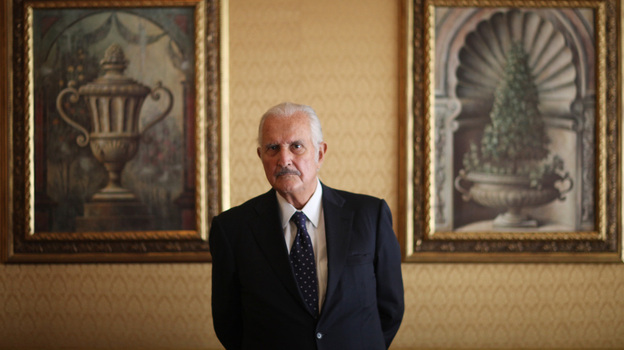 Carlos Fuentes was the son of a Mexican diplomat and spent years living abroad, including in the United States. But Mexico — the country, its people and politics — was central to his writing.
Fuentes, one of the most influential Latin American writers, died Tuesday at a hospital in Mexico City at the age of 83. He was instrumental in bringing Latin American literature to an international audience, and he used his fiction to address what he saw as real-world injustices.
[…]
One of his most famous novels was The Old Gringo, about an American writer who travels to Mexico to die. It was made into a Hollywood movie starring Gregory Peck as the writer and Jimmy Smits as a Mexican general.
The Old Gringo became the first novel by a Latin American writer to make it to The New York Times best-seller list.
Read transcript, and listen to NPR’s Morning Edition AUDIO here . . .
A wonderful scene from the movie can be seen here:
[…]
The first thing you have to do when confronting Shakespeare is break down the wall of resistance that has been constructed between you and him by a cultural atmosphere fraught with willful misunderstanding. For instance, how many times have you heard someone say that Shakespeare wrote in Old English or Middle English? That right there might be enough to put you off. But both of those claims are patently false.
[…]
Shakespeare wrote in Modern English, the same language that we speak today. [. . .] Your problem with understanding Shakespeare is due to his language being poetic. Most of your everyday discourse has become so pedestrian that your ears have become unable to tune in to language that aspires to greater heights. This may or may not be your fault. We all are aware that the state of education in this country is woefully bleak. But why submit to the prevailing philistine attitude without a fight?
If you cannot understand my argument, and declare ‘It’s Greek to me’,
you are quoting Shakespeare;
if you claim to be more sinned against than sinning,
you are quoting Shakespeare;
if you recall your salad days,
you are quoting Shakespeare;
if you act more in sorrow than in anger,
if your wish is father to the thought,
if your lost property has vanished into thin air,
you are quoting Shakespeare;
if you have ever refused to budge an inch or suffered from green-eyed jealousy,
if you have played fast and loose,
if you have been tongue-tied,
a tower of strength,
hoodwinked or in a pickle,
if you have knitted your brows,
made a virtue of necessity,
insisted on fair play,
slept not one wink,
stood on ceremony,
danced attendance (on your lord and master),
laughed yourself into stitches,
had short shrift, cold comfort or too much of a good thing,
if you have seen better days or lived in a fool’s paradise —
why, be that as it may, the more fool you, for it is a foregone conclusion that you are (as good luck would have it) quoting Shakespeare;
if you think it is early days and clear out bag and baggage,
if you think it is high time and that that is the long and short of it,
if you believe that the game is up and that truth will out even if it involves your own flesh and blood,
if you lie low till the crack of doom because you suspect foul play,
if you have your teeth set on edge (at one fell swoop) without rhyme or reason,
then — to give the devil his due — if the truth were known (for surely you have a tongue in your head) you are quoting Shakespeare;
even if you bid me good riddance and send me packing,
if you wish I was dead as a doornail,
if you think I am an eyesore,
a laughing stock,
the devil incarnate,
a stony-hearted villain,
bloody-minded or a blinking idiot,
then — by Jove!
O Lord!
Tut, tut!
For goodness’ sake!
What the dickens!
But me no buts —
it is all one to me, for you are quoting Shakespeare.
Charles Dickens — one of the most beloved storytellers in the English language — was born 200 years ago Tuesday [02.07.2012]. He was a comic genius and a social reformer whose novels made him famous in his own time, and continue as classics in ours.
[…]
Dickens began his literary career with almost no formal education. He was born in Landport, on Feb. 7, 1812, the second of eight children. When he was 12, his father was sent to debtor’s prison. Dickens was forced to quit school and work in a London blacking factory, sealing pots of shoe polish and pasting labels on them. He would rework that hellish experience into his fiction for the rest of his life.
“He was a social reformer who knew whereof he spoke,” says actor Simon Callow, author of a new biography called Charles Dickens and the Great Theatre of the World. “He knew what poverty was. He knew what it was to be rejected, to be cast aside, to live in squalor.”
The 18th century was a time of opulence and privilege for some. Europe was dominated by the twin authority of the Church and King – but beneath the surface, new forces were gathering to challenge their absolute rule.
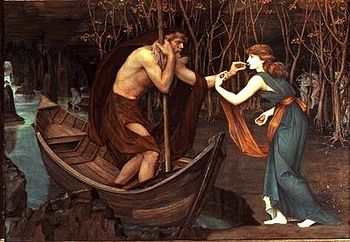
Charon and Psyche (1883), a pre-Raphaelite interpretation of the myth by John Roddam Spencer Stanhope
Charon’s obol is an allusive term for the coin placed in or on the mouth of a dead person before burial. According to Greek and Latin literary sources, the coin was a payment or bribe for the ferryman who conveyed souls across the river that divided the world of the living from the world of the dead.

 Always Question Authority