QUOTATION: Daniel Dennett / “Life of Folly”
2

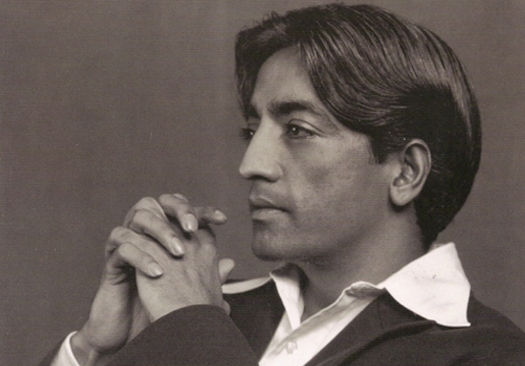 Jiddu Krishnamurti (May 11, 1895 – February 17, 1986)
Indian born speaker and writer on philosophical and spiritual subjects
We have all, I am sure, tried to subdue anger but somehow that does not seem to dissolve it. Is there a different approach to dissipate anger? Anger may spring from physical or psychological causes. One is angry, perhaps, because one is thwarted, one’s defensive reactions are being broken down, or one’s security which has been carefully built up is being threatened, and so on. We are all familiar with anger. How is one to understand and dissolve anger? If you consider that your beliefs, concepts, opinions, are of the greatest importance, then you are bound to react violently when questioned. Instead of clinging to beliefs, opinions, if you begin to question whether they are essential to one’s comprehension of life, then through the understanding of its causes there is the cessation of anger. Thus one begins to dissolve one’s own resistances which cause conflict and pain. This again requires earnestness. We are used to controlling ourselves for sociological or religious reasons or for convenience, but to uproot anger requires deep awareness. You say you are angry when you hear of injustice. Is it because you love humanity, because you are compassionate? Do compassion and anger dwell together? Can there be justice when there is anger, hatred? You are perhaps angry at the thought of general injustice, cruelty, but your anger does not alter injustice or cruelty; it can only do harm. To bring about order, you yourself have to be thoughtful, compassionate. Action born of hatred can only create further hatred. There can be no righteousness where there is anger. Righteousness and anger cannot dwell together.
~ J. Krishnamurti Online

In an innovative interdisciplinary study, neurobiological experts, radiologists and humanities scholars are working together to explore the relationship between reading, attention and distraction – by reading Jane Austen.
Surprising preliminary results reveal a dramatic and unexpected increase in blood flow to regions of the brain beyond those responsible for “executive function,” areas which would normally be associated with paying close attention to a task, such as reading, said Natalie Phillips, the literary scholar leading the project.
[…]
Pioneering in a number of respects, her research is “one of the first fMRI experiments to study how our brains respond to literature,” Phillips said, as well as the first to consider “how cognition is shaped not just by what we read, but how we read it.”
Critical reading of humanities-oriented texts is recognized for fostering analytical thought, but if such results hold across subjects, Phillips said it would suggest “it’s not only what we read – but thinking rigorously about it that’s of value, and that literary study provides a truly valuable exercise of people’s brains.”
[…]
Southerners love trashing the rest of the country (when did you last hear a kind Rebel word for New York, Detroit or San Francisco?), but when their blood is really up the go-to move down South is to dismiss their fellow citizens as un-American.
[…]
Until enough Southerners are able to examine their society honestly—until they can begin to withstand external criticism without collapsing into blind hysteria—nothing will change.
[…]
The majority of Southerners are not uneducated rednecks flying Confederate flags from the backs of their pickups.
I never claimed they were, in the book or elsewhere.
[…]
However good and polite they may be, what the majority of Southerners are, and have always been, is willing to allow the most angry and “patriotic” firebrands among them to remain in control of their society’s most powerful and influential positions, be they in the realms of politics, business, education, religion or media.
[…]
As far back as 1941, Southern journalist W.J. Cash was remarking on “the ancient incapacity of the great body of Southerners to examine and analyze a case realistically even when their own fate hinged upon it, the tendency to take the easiest answer as explaining all their ills.”
Related articles

The following is an excerpt from “Hello Goodbye Hello” [Simon & Schuster,26.95]:
J.D. Salinger seeks out Ernest Hemingway The Ritz Hotel, 15 place Vendôme, Paris Late August 1944.
The twenty-five-year-old Jerry Salinger is experiencing a terrible war. Of the 3,080 men of the 12th US Infantry who disembarked with him at Normandy on D-Day, only a third are still alive.
His regiment is the first to enter Paris. They are mobbed by happy crowds. Salinger’s job as an officer in the Counter-Intelligence Corps entails weeding out and interrogating Nazi collaborators. As they go through Paris, he and a fellow officer arrest a collaborator, but a crowd wrests their prisoner away and beats him to death.
Salinger has heard that Ernest Hemingway is in town. A writer himself, with a growing reputation for his short stories, he is determined to seek out America’s most famous living novelist. He feels sure he will find him at the Ritz, so he drives the jeep there. Sure enough, Hemingway is installed in the small bar, already bragging that he alone liberated Paris in general and the Ritz in particular.
 Cartoon credit: Mr Fish
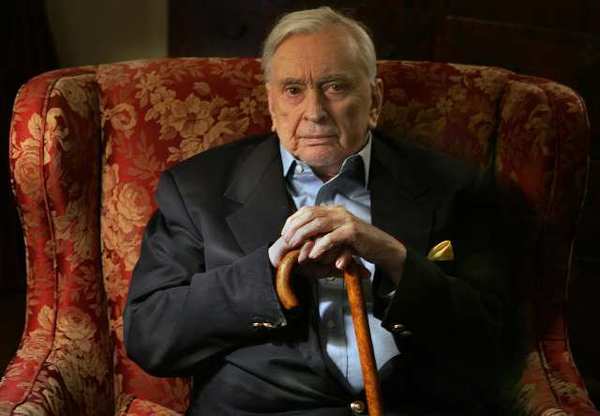
Gore Vidal came from a generation of novelists whose fiction gave them a political platform. Norman Mailer ran for mayor of New York City; Kurt Vonnegut became an anti-war spokesman. And Vidal was an all-around critic. His novels sometimes infuriated readers with unflattering portraits of American history.
He also wrote essays and screenplays, and his play The Best Man currently has a revival on Broadway.
Vidal died Tuesday at his home in the Hollywood Hills, from complications of pneumonia. He was 86 years old.
 h/t:
h/t: 

 Always Question Authority