APHORISM: “On Presidential Prerequisites” / Madison S. Hughes

By Madison S. Hughes (05.22.2012)

Reality Check! During a press conference at the 2012 Chicago NATO Summit President Obama has finally spoken truth to the long-standing myth that executive business experience brings added value to the Presidency as he said, “when you’re president, as opposed to the head of a private equity firm, then your job is not simply to maximize profits. Your job is to figure out how everybody in the country has a fair shot.” Do not for one New York second believe that he, or any other political puppet of the corporate state, is not on the former sides of the conditionals in the post title. He also blew a whole in the myth of military experience being a significant factor in execution of Commander-in-chief duties (puns intended). Do not for one New York second believe that he, or any other political puppet of the corporate state, is not on the sides of the military industrial complex either. Need we discuss the industrial police state . . . neither did I.

HEALTH CARE: Socialized Medicine: Why Everyone Should Share the Costs / Al Stefanelli

“A society will be judged by how it cares for it’s weakest members.”

Understand, I do not begrudge anyone from earning a profit, nor do I have anything personally against the entrepreneurial spirit. We should all do what we can to better ourselves. However, I am of the position that health care is not a privilege, but a right. As well, I reason that we are all morally obligated to ensure that each of us has access to it. That the United States does not have a national health care program is a major moral failure, and what we have in place is little more than a venue for unethical profiteers within the pharmaceutical and insurance industries.

[…]

The United States needs a tax-payer funded (single-payer) national health care system. Totally and completely socialized and incurring no costs to anyone beyond what their taxes pay. Those who cannot pay due to disability, unemployment or other circumstances beyond their control should have the same access as those who do.

In my opinion, putting a dollar ahead of the health and welfare of a human being is immoral. National or Socialized medicine should be a no-brainer.

[…]

There should never be any individual who’s life is less important than a number on a profit and loss ledger.

Read more . . .

EDUCATION: Op-Ed / Open letter to High School Grads

Dear graduating senior,

I am begging your pardon for a somber reflection amid the joy of accomplishment: not to be a wet rag on the festivities of graduation, but a bright light on the realities of post-secondary education.

[…]

If you haven’t posted a good academic performance in high school, don’t believe a university, its leadership, advertisements or admissions officers who co-sign your promissory note with no responsibility for its payment obligation. They need paying students.

Stoking a deceitful dream on life support — an underappreciated, overfinanced, media-hyped charade — is the real deception, and the weight falls on your back, not theirs.

A shameful, elaborate sham, when one out of two college graduates this year are unemployable in their chosen field.

Look carefully at the costs and benefits of a university education. University officials may not tell you the truth: Enrollments could drop. Bankers will not tell you the truth: Interest income will fall off. Elected officials will not tell you the truth: Elections will be lost. Listen to those really concerned for you carefully.

Read more . . .

QUOTE: Epicurus

Portrait of Epicurus, founder of the Epicurean...

Epicurus (341 BCE – 270 BCE)
Ancient Greek philosopher as well as the founder
of the school of philosophy called Epicureanism

Why should I fear death? If I am, death is not. If death is, I am not. Why should I fear that which can only exist when I do not?

PHILOSOPHY: The Atheist and Death

Whether you die from a long, painful illness or quietly in your sleep or from violence or misadventure, the final moment for every single person is the same: UNconsciousness. That transition will either be quick and sharp, or slow, like falling asleep. Regardless, ONE second afterwards, you’re not there to experience anything. As Wittgenstein put it “Death is not an event in life: we do not live to experience death. If we take eternity to mean not infinite temporal duration but timelessness, then eternal life belongs to those who live in the present.” There is nothing to fear in the experience of death for, to the last second, we are alive and not dead; and then once dead, we experience nothing at all.

Read more . . .

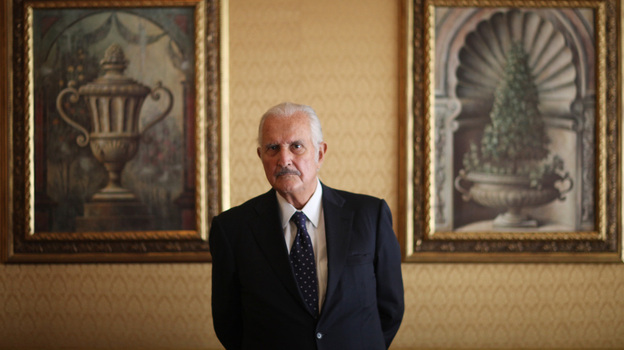
LITERATURE: In Writing, Fuentes Shed Light On Poverty, Inequality / (NPR’s Morning Edition AUDIO)

Carlos Fuentes was the son of a Mexican diplomat and spent years living abroad, including in the United States. But Mexico — the country, its people and politics — was central to his writing.

Fuentes, one of the most influential Latin American writers, died Tuesday at a hospital in Mexico City at the age of 83. He was instrumental in bringing Latin American literature to an international audience, and he used his fiction to address what he saw as real-world injustices.

[…]

One of his most famous novels was The Old Gringo, about an American writer who travels to Mexico to die. It was made into a Hollywood movie starring Gregory Peck as the writer and Jimmy Smits as a Mexican general.

The Old Gringo became the first novel by a Latin American writer to make it to The New York Times best-seller list.

Read transcript, and listen to NPR’s Morning Edition AUDIO here . . . 

A wonderful scene from the movie can be seen here:

Book Excerpt: “Occupy the Economy: Challenging Capitalism” / Richard Wolff

For the last half-century, capitalism has been a taboo subject in the United States. . . . Politicians repeated, robot-style, that the “U.S. is the greatest country in the world” and that “capitalism is the greatest economic system in the world.” Those few who have dared to raise questions or criticisms about capitalism have been either ignored or told to go live in North Korea, China or Cuba as if that were the only alternative to pro-capitalism cheerleading.

[…]

Questioning and criticizing capitalism have been taboo, treated by federal authorities, immigration officials, police and most of the public alike as akin to treason. Fear-driven silence has substituted for the necessary, healthy criticism without which all institutions, systems, and traditions harden into dogmas, deteriorate into social rigidities, or worse. Protected from criticism and debate, capitalism in the United States could and has indulged all its darker impulses and tendencies. No public exposure, criticism and movement for change could arise or stand in its way as the system and its effects became ever more unequal, unjust, inefficient and oppressive. Long before the Occupy movement arose to reveal and oppose what U.S. capitalism had become, that capitalism had divided the 1 percent from the 99 percent.

[…]

Across the pages that follow, what emerges is the central importance of how capitalism very particularly organizes production: masses of working people generate corporate profits that others take and use. Tiny boards of directors, selected by and responsible to tiny groups of major shareholders, gather and control corporate profits, thereby shaping and dominating society. That tiny minority (boards and major shareholders) of those associated with and dependent upon corporations make all the basic decisions—how, what, and where to produce and what to do with the profits. The vast majority of workers within and residents surrounding those capitalist corporations must live with the results of corporate decisions. Yet they are systematically excluded from participating in making those decisions. Nothing more glaringly contradicts democracy than how capitalism organizes the corporate enterprises where working people produce the goods and services without which modern life for everyone would be impossible.

From: Occupy the Economy: Challenging Capitalism By Richard Wolff

Read more . . .

Aphorism: On Spontaneous Human Combustion

By Madison S. Hughes (05.09.2012)

I cannot say that spontaneous human combustion is my forte; however, judging from the bits and pieces of information concerning such that have entered my realm of thought, I must say that I am not convinced by any evidence that proponents have put forth to support such claims.

Certainly, a “loving” God would not allow such, but somehow I doubt One that engages in world genocide would take issue with a burning here and there. As a matter of fact, His followers have historically proven rather fond to burnings. I wonder if those that spontaneously combust are also of the more intellectual among us.

Conversion on Mount Improbable: How Evolution Challenges Christian Dogma

During most of my years as a liberal Protestant minister, I never saw a contradiction between my Christian faith and the fact of evolution. Like many progressive Christians, I did not understand evolution as a challenge to the doctrine of divine creation ex nihilo; evolution was merely the mechanism that God used for creating life on our planet.

[…]

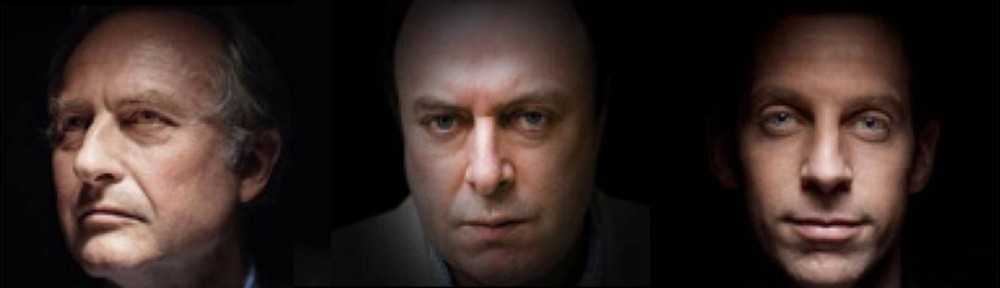
My indifference towards evolution changed dramatically when I ran across Richard Dawkins’ analogy of natural selection as “climbing Mount Improbable.” In that memorable and vivid metaphor, Dawkins illustrates the truly incremental and gradual nature of the evolutionary process. Opponents of evolution have contended that, while change within species can occur, the leap from one species to a new species is just too improbably great to have happened by purely natural processes. Outside assistance must have been involved. Dawkins addresses that claim by acknowledging that, yes, the leap from one species to the next seems improbably difficult—like scaling the cliff of a mountain to reach the peak. However, if one approaches the peak not from the formidable cliff but instead moves slowly along the slope on the other side of the mountain, reaching the peak of “Mount Improbable” becomes quite possible, although it might take a very long time.

[…]

Which core doctrines of Christianity does evolution challenge? Well, basically all of them. The doctrine of original sin is a prime example. If my rudimentary grasp of the science is accurate, then Darwin’s theory tells us that because new species only emerge extremely gradually, there really is no “first” prototype or model of any species at all—no “first” dog or “first” giraffe and certainly no “first” homo sapiens created instantaneously. The transition from predecessor hominid species was almost imperceptible. So, if there was no “first” human, there was clearly no original couple through whom the contagion of “sin” could be transmitted to the entire human race. The history of our species does not contain a “fall” into sin from a mythical, pristine sinless paradise that never existed.

Read more . . .