By Madison S. Hughes (07.21.2012)
Optimism is a refuge reserved for the delusional and the willfully ignorant. It serves as a shallow subterfuge for ignoramuses to protect them from the depressive realism of toilful thought.
By Madison S. Hughes (07.21.2012)
Optimism is a refuge reserved for the delusional and the willfully ignorant. It serves as a shallow subterfuge for ignoramuses to protect them from the depressive realism of toilful thought.
As soon as I opened the door and saw the two men standing there, each with a backpack, one holding a book and the other a magazine, I knew I should have ignored the knock. But it was a slow afternoon, so I thought I’d play along.
Of course, based on their age, their clothing, and their general demeanor, I could tell immediately who they were. Who else but scientists would be in their 60s, wear lab coats on a beautiful spring day, and crack nary a smile? I slightly raised my eyebrows, letting them know I was open to their pitch but warning them that my patience was limited.
“Good afternoon, sir,” said one of the men, without smiling. “We’d like to talk to you about something that’s important to all of us – especially these days.”
“And what might that be?” I said, not moving from the doorway.
“The value of science, of rationality, and of the pursuit of truth. The absolutely essential quality of asking questions wherever the answers might lead. And the resistance to supernatural dogma.”
“I see,” I said. “And why is this important to me?”
h/t: Planet Atheism
h/t: Mike Daniels
Bill talks with and invites readings by renowned poet, novelist, and editor Philip Appleman, whose creativity spans a long life filled with verse, fiction, philosophy, and religion. The author of nine books of poetry, three novels, and six volumes of non-fiction, Appleman’s most acclaimed work includes explorations of the life and theories of Charles Darwin. A scholar of Darwin, Appleman edited the critical anthology Darwin, and wrote the poetry books Darwin’s Ark and Darwin’s Bestiary, earning him praise for illuminating the “overwhelming sanity” of Darwin’s thought with clarity and wit. Appleman’s latest poetry collection is Perfidious Proverbs.
In this web-exclusive Bill Moyers Essay, Bill professes his lifelong love for libraries and their strong cultural value, and points to a crisis in public library funding across the country. But he also shares a unique and controversial community effort in Troy, Michigan that kept its library from becoming a political casualty, and serves as “a reminder of what can happen when we act together.”
Watch the full video below that explains how the Tea Party put the library in jeopardy, and how the town — with the help ad agency Leo Burnett — successfully fought back.
[…]
[R]egressives have no interest in preserving or protecting our system of government. To the contrary, they show every sign of wanting to be rid of it.
In fact, regressives in Congress have substituted partisanship for patriotism, placing party loyalty above loyalty to America.
The GOP’s highest-ranking member of Congress has said his “number one aim” is to unseat President Obama. For more than three years congressional Republicans have marched in lockstep, determined to do just that. They have brooked no compromise.
They couldn’t care less if they mangle our government in pursuit of their partisan aims. Senate Republicans have used the filibuster more frequently in this Congress than in any congress in history.
[…]
So when regressives talk about “preserving and protecting” the nation, be warned: They mean securing our borders, not securing our society.
One complaint made about some atheist activists is that they are in fact anti-religious and anti-theistic bigots who are just expressing their personal bigotry, not arguing on behalf of atheists’ rights and liberty. There is a legitimate point to be made here, in that generalizing about an entire class of people for the actions of only some members is technically incorrect. What’s missing, though, is an appreciation for how the “silent” majority perpetuate and benefit from injustice.
I don’t think it’s a coincidence that this particular disagreement is not in the least bit new. Liberation and civil rights movements in the past have recognized that there is always a “silent” majority in privileged classes who do not actively oppress or discriminate, but at the same time help perpetuate and benefit from injustice precisely through their silence and inaction. They may not intend this and they may not even be conscious it, but this does not alter their complicity and it is because of this complicity that generalizations are made.
[…]
Generalizations made by a despised and discriminated-against minority cannot harm a privileged and powerful class — this is true whether it’s atheists generalizing about Christians, feminists generalizing about men, gays generalizing about straights, blacks generalizing about whites, etc. Those members of a privileged class who are supposedly giving the rest a bad name are, however, causing real harm to others. Some of that harm is even due to their generalizations about despised and excluded minorities which are made precisely to ensure that the marginalized remain powerless.
When other members of a privileged class — the ones who insist that they “aren’t like that” — expend more resources and worry over the former than the latter, then they are tacitly abetting and complicit in the harm being caused. Atheist generalizations about Christians or religious theists do not lead to any religious believers being excluded from power, being denied equality, or being forced into a second-class status.
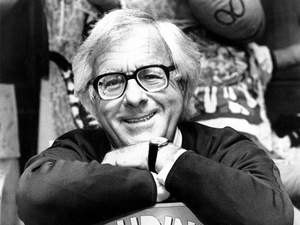
Ray Bradbury, author of The Martian Chroniclesand Fahrenheit 451, died Tuesday. He was 91. Bradbury was known for his futuristic tales — but he never used a computer, or even drove a car.
Bradbury was born in Waukegan, Ill., in 1920 and grew up during the Great Depression. He said it was a time when people couldn’t imagine the future, and his active imagination made him stand out. He once told Fresh Air‘s Terry Gross about exaggerating basic childhood fears, like monsters at the top of the stairs.
“As soon as I looked up, there it was, and it was horrible,” Bradbury remembers. “And I would scream and fall back down the stairs, and my mother and father would get up and sigh and say, ‘Oh, my gosh, here we go again.’ “
Bradbury dove into books as a child. Wild tales from authors Jules Verne and H.G. Wells captivated Bradbury — and made him dream of becoming a great author. So he started writing, churning out a short story every week during his teens. After his family moved to Southern California, he would escape to the basement of the UCLA library. There, he’d focus on his craft.
 Eric Hoffer a.k.a. “Longshoreman Philosopher” (July 25, 1902 – May 21, 1983)
American Social Writer, Author, Awarded the Presidential Medal of Freedom
The blindness of the fanatic is a source of strength (he sees no obstacles), but it is the cause of intellectual sterility and emotional monotony. The fanatic is also mentally cocky, and hence barren of new beginnings. At the root of his cockiness is the conviction that life and the universe conform to a simple formula – his formula. His is thus without the fruitful intervals of groping [uncertainty], when the mind is as it were in solution – ready for all manner of new reactions, new combinations and new beginnings. (Between the Devil and the Dragon. New York: Harper & Row Publishers, 1982, p. 287)
 Oscar Wilde (16 October 1854 – 30 November 1900)
Irish Writer, Poet, Classicist, Spokesman for Aestheticism, and Atheist.
Known for his biting wit, flamboyant dress, and glittering conversation.
Disobedience, in the eyes of anyone who has read history, is man’s original virtue. It is through disobedience and rebellion that progress has been made.