EDUCATION: How the Conservative Worldview Quashes Critical Thinking

[…]

. . . High-stakes testing is an artifact of the conservative belief that education is about acquiring a required body of knowledge that’s been determined by experts. If it’s not in the book, you don’t need to know it. And the ultimate outcome — the purpose of this whole process — is to graduate with a credential that will certify your acceptability to the established hierarchies of the economic world.

In the conservative model, critical thinking is horrifically dangerous, because it teaches kids to reject the assessment of external authorities in favor of their own judgment — a habit of mind that invites opposition and rebellion.

[…]

Given this reality, the college-as-job-training model the conservatives are promoting looks patently insane. Subjects like logic and philosophy, anthropology and rhetoric, foreign languages and history provide the mental flexibility, deep perspective, and sharp critical thinking skills that allow one to make one’s own way on unfamiliar landscapes, a skill that’s useful when the world keeps changing around you. People with rich liberal arts backgrounds are also far better prepared for leadership roles, and better positioned to recognize and seize on whatever opportunities fate throws their way.

[…]

It’s obvious that stripping these mind-expanding fripperies out of the curriculum — as conservatives are proposing, often with no push-back at all from liberals — serves the narrow, functional conservative view of education and citizenship very well.

[…]

The conservatives are not wrong: for 150 years, the schools have been the leading promoter and disseminator of progressive values. It’s precisely because they understand the power of education to preserve democracy that they’re now doing their best to dismantle that system, and replace it with one that produces followers, subjects and serfs.

Read more . . .

CAPITALISM: Interview / Richard Wolff on Challenging Capitalism in His New Book, “Occupy the Economy”

Can we challenge capitalism and prevail, considering that the top one percent control 50% of the available capital and the top five percent some 70% of the nation’s private funds?  Richard Wolff is a closely followed Truthout contributor on economics.  Currently, you can obtain his just-released “Occupy the Economy: Challenging Capitalism” directly from Truthout.  If you want to know about alternatives to the current destructive course of our economy and how we, as a nation, got to this point, get your copy of “Occupy the Economy” by clicking here.

The following is an interview with Richard Wolff by Truthout staff member Matt Renner.

Matt Renner: In your introduction to the book, you discuss New York City Mayor Michael Bloomberg’s “cleanliness” excuse for clearing the original Occupy Wall Street encampment at Liberty Square. Why do you think so many public officials and right-wing pundits describe the occupiers as “unclean”?

Richard D. Wolff: Their problem has been, and continues to be, that they have no response to Occupy’s basic attack on the inequity and antidemocratic social conditions summarized in the confrontation of, “1 percent against 99 percent.” They know that the vast majority of Americans feel the truth of Occupy’s social criticism, experience it in their lives, and sympathize with protest against and efforts to change a system with such unjust outcomes. So, they can refute little and need instead to distract public opinion from what Occupy focuses on.

One way to do that is to assert the existence of and then condemn some other quality or dimension of Occupy. In Bloomberg’s pathetic example, the best he and his advisers could come up with was a reference to Zuccotti Park as being “unclean” so as to then position the mayor and the police as militant janitors. Everyone who knows even a little about New York City knows that the mayor and the police preside over many filthy subway tunnels, highways, streets, empty lots and abandoned buildings without doing anything to clean them. So, suddenly asserting the importance of cleanliness simply exposed them to the ridicule such a position deserved. I suspect something similar is underway when others, perhaps taking their cue from Bloomberg in New York, decided to follow the cleanliness ploy.

Continue reading . . .

SOCIAL ACTIVISM: Chris Hedges / Why OWS Frightens the Corporate Elite


“I don’t waste any emotional or intellectual energy on these elections. All hope is in the street. All hope is through acts of civil disobedience. We may not win, but if we’re going to win that’s the only place we are going to win.”

LITERATURE: In Writing, Fuentes Shed Light On Poverty, Inequality / (NPR’s Morning Edition AUDIO)

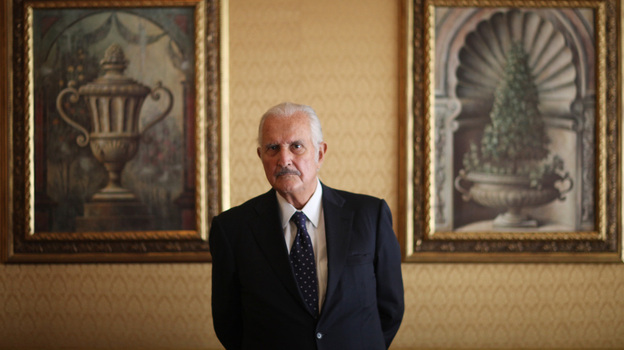
Carlos Fuentes was the son of a Mexican diplomat and spent years living abroad, including in the United States. But Mexico — the country, its people and politics — was central to his writing.

Fuentes, one of the most influential Latin American writers, died Tuesday at a hospital in Mexico City at the age of 83. He was instrumental in bringing Latin American literature to an international audience, and he used his fiction to address what he saw as real-world injustices.

[…]

One of his most famous novels was The Old Gringo, about an American writer who travels to Mexico to die. It was made into a Hollywood movie starring Gregory Peck as the writer and Jimmy Smits as a Mexican general.

The Old Gringo became the first novel by a Latin American writer to make it to The New York Times best-seller list.

Read transcript, and listen to NPR’s Morning Edition AUDIO here . . . 

A wonderful scene from the movie can be seen here:

Research Report: How Secular Humanists (and Everyone Else) Subsidize Religion in the United States

[…]

Nowhere did we find prior research summarizing and detailing religious finances and tax policy, so we decided to investigate it ourselves. This article is the result. It took some digging, but we think we now have a moderately clear understanding of the tax laws regarding religions in the United States. What we found suggests that religious institutions, if they were required to pay taxes the same as for-profit corporations do, would not have nearly as much money or influence as they enjoy in America today. In this article we estimate how much local, state, and federal governments subsidize religions.

[…]

. . . [R]eligions spend a relatively small portion of their revenue on “physical charity”, and while they spend a larger portion of their revenue addressing “spiritual concerns”, most of that qualifies as labor, not charity. What little would qualify as “spiritual charity” would not be replaced by government if discontinued. In short, religions are, by and large, not engaged in charitable work.

[…]

. . . [T]he subsidies to religions in the United States today may not be encouraging the growth of religions, but they may be keeping alive on the equivalent of subsidized life-support many religions that should be dead.

If these subsidies were removed—though we have no basis for believing that they will be anytime soon—we wonder what the damage to religion would be. There is evidence that donations to religions are tied to taxes; as the tax benefit of donating goes up, so do donations and vice versa. In other words, it seems likely that the removal of these subsidies would result in a substantial decrease in the supply of religion in the United States. To what extent it would affect demand for religion is uncertain.

[…]

. . . [I]t seems likely that subsidies are propping up religion in the United States, though to what extent is not clear. Certainly many religions that are near failing would have done so already if not for the subsidies they receive from the government. Another practical result of these subsidies is that religions are more affluent and more influential than they would otherwise be, because they have the resources to fund efforts to change legislation, create widely consumed media, and influence public policy.

[…]

. . . These subsidies should be phased out. But since that is unlikely to happen, we’d accept the following alternative: . . . direct cash transfers to us from the government for trying to convert people to our worldviews while claiming to provide social services[.]

Read more . . .

Book Excerpt: “Occupy the Economy: Challenging Capitalism” / Richard Wolff

For the last half-century, capitalism has been a taboo subject in the United States. . . . Politicians repeated, robot-style, that the “U.S. is the greatest country in the world” and that “capitalism is the greatest economic system in the world.” Those few who have dared to raise questions or criticisms about capitalism have been either ignored or told to go live in North Korea, China or Cuba as if that were the only alternative to pro-capitalism cheerleading.

[…]

Questioning and criticizing capitalism have been taboo, treated by federal authorities, immigration officials, police and most of the public alike as akin to treason. Fear-driven silence has substituted for the necessary, healthy criticism without which all institutions, systems, and traditions harden into dogmas, deteriorate into social rigidities, or worse. Protected from criticism and debate, capitalism in the United States could and has indulged all its darker impulses and tendencies. No public exposure, criticism and movement for change could arise or stand in its way as the system and its effects became ever more unequal, unjust, inefficient and oppressive. Long before the Occupy movement arose to reveal and oppose what U.S. capitalism had become, that capitalism had divided the 1 percent from the 99 percent.

[…]

Across the pages that follow, what emerges is the central importance of how capitalism very particularly organizes production: masses of working people generate corporate profits that others take and use. Tiny boards of directors, selected by and responsible to tiny groups of major shareholders, gather and control corporate profits, thereby shaping and dominating society. That tiny minority (boards and major shareholders) of those associated with and dependent upon corporations make all the basic decisions—how, what, and where to produce and what to do with the profits. The vast majority of workers within and residents surrounding those capitalist corporations must live with the results of corporate decisions. Yet they are systematically excluded from participating in making those decisions. Nothing more glaringly contradicts democracy than how capitalism organizes the corporate enterprises where working people produce the goods and services without which modern life for everyone would be impossible.

From: Occupy the Economy: Challenging Capitalism By Richard Wolff

Read more . . .

The Wretchedness of the U.S.’s Educated Workforce

[…]

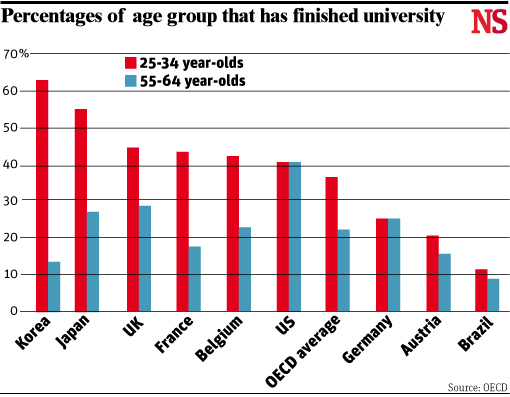
In the 1970s and 1980s, the US led the world on college enrollment. In fact, since the passing of the GI bill in 1944, America had been forging a path. That bill led to 2.2 million American infantrymen attending university in the 12 years in was in effect.

But a generation later, the US hasn’t changed at all, while the rest of the developed world has more or less caught up with it – and some of its key competitors have overtaken it.

The country could once boast the best educated workforce in the world. No longer.

Read more . . .

Chris Hedges: Colonized by Corporations

[…]

. . . We have been, like nations on the periphery of empire, colonized. We are controlled by tiny corporate entities that have no loyalty to the nation and indeed in the language of traditional patriotism are traitors. They strip us of our resources, keep us politically passive and enrich themselves at our expense. The mechanisms of control are familiar to those whom the Martinique-born French psychiatrist and writer Frantz Fanon called “the wretched of the earth,” including African-Americans. The colonized are denied job security. Incomes are reduced to subsistence level. The poor are plunged into desperation. Mass movements, such as labor unions, are dismantled. The school system is degraded so only the elites have access to a superior education. Laws are written to legalize corporate plunder and abuse, as well as criminalize dissent. . . .

[…]

The danger the corporate state faces does not come from the poor. The poor, those Karl Marx dismissed as the Lumpenproletariat, do not mount revolutions, although they join them and often become cannon fodder. The real danger to the elite comes from déclassé intellectuals, those educated middle-class men and women who are barred by a calcified system from advancement. Artists without studios or theaters, teachers without classrooms, lawyers without clients, doctors without patients and journalists without newspapers descend economically. They become, as they mingle with the underclass, a bridge between the worlds of the elite and the oppressed. And they are the dynamite that triggers revolt.

This is why the Occupy movement frightens the corporate elite. What fosters revolution is not misery, but the gap between what people expect from their lives and what is offered. This is especially acute among the educated and the talented. They feel, with much justification, that they have been denied what they deserve. They set out to rectify this injustice. And the longer the injustice festers, the more radical they become.

[…]

The power of the Occupy movement is that it expresses the widespread disgust with the elites, and the deep desire for justice and fairness that is essential to all successful revolutionary movements. The Occupy movement will change and mutate, but it will not go away. It may appear to make little headway, but this is less because of the movement’s ineffectiveness and more because decayed systems of power have an amazing ability to perpetuate themselves through habit, routine and inertia. The press and organs of communication, along with the anointed experts and academics, tied by money and ideology to the elites, are useless in dissecting what is happening within these movements. They view reality through the lens of their corporate sponsors. They have no idea what is happening.

Read more . . .

Zinnia Jones: Why Bristol Palin is Wrong on Marriage


“If there are good reasons for a tradition these reasons can stand on their own merits with no need to appeal to longevity. Using the past to veto the future is often the hallmark of those who just don’t have a better argument.”

The Radical History of Mother’s Day

There’s a good number of us who question holidays like Mother’s Day in which you spend more time feeding money into a system that exploits our love for our mothers than actually celebrating them.  It’s not unlike any other holiday in America in that its complete commercialization has stripped away so much of its genuine meaning, as well its history.  Mother’s Day is unique in its completely radical and totally feminist history, as much as it has been forgotten.

Mother’s Day began in America in 1870 when Julia Ward Howe wrote the Mother’s Day Proclamation. Written in response to the American Civil War and the Franco-Prussian War, her proclamation called on women to use their position as mothers to influence society in fighting for an end to all wars. She called for women to stand up against the unjust violence of war through their roles as wife and mother, to protest the futility of their sons killing other mothers’ sons.

Howe wrote:

Arise, then, women of this day!

Arise, all women who have hearts, Whether our baptism be of water or of tears!

Say firmly: “We will not have great questions decided by irrelevant agencies, Our husbands will not come to us, reeking with carnage, for caresses and applause. Our sons shall not be taken from us to unlearn All that we have been able to teach them of charity, mercy and patience. We, the women of one country, will be too tender of those of another country To allow our sons to be trained to injure theirs.”

[Read the remainder of Howe’s quote here]

The holiday caught on years later when a West Virginia women’s group led by Anna Reeves Jarvis began promoting it as a way to reunite families after the Civil War.  After Jarvis’ death, her daughter began a campaign for the creation of an official Mother’s Day in honor of peace. Devoting much of her life to the cause, it wasn’t until 1914 when Woodrow Wilson signed it into national observance in 1914.

The holiday flourished, along with the flower industry.  The business journal, the Florists Review, actually admitted to its desire to exploit the holiday. Jarvis was strongly opposed to every aspect of the holiday’s commercialization, arrested for protesting the sale of flowers, and petitioning to stop the creation of a Mother’s Day postage stamp.

Today we are in multiple wars that continue to claim the lives of thousands of sons and daughters.  We are also experiencing a still-rising commercialization of nearly every aspect of life; the exploitation of every possible human event and emotion at the benefit of corporations.

Let’s take this Mother’s Day to excuse ourselves from the pressure to consume and remember its radical roots – that mothers, or rather all women, in fact, all people, have a stake in war and a responsibility as American citizens to protest the incredible violence that so many fellow citizens, here and abroad, must suffer through.

Read more . . .