WESTERN PHILOSOPHY: “Why We Need Greek Words for Love” / The School of Life / Alain de Botton ☮
Reply
Venting my frustration about the ignorance and gross oversimplification of the realities of adoption in recent antinatalism facebook group posts.
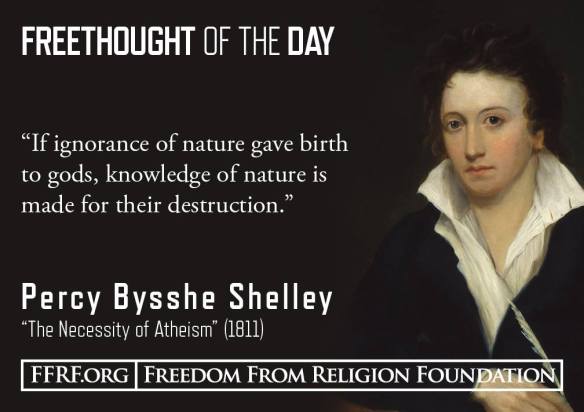 On this date in 1792, Percy Bysshe Shelley, one of atheism’s most passionate advocates, was born in Field Place, Sussex, England. As an 18-year-old, Shelley was expelled from Oxford University College for writing The Necessity of Atheism (1811), a pamphlet which opens: “There is no God.” Shelley vigorously protested the imprisonment of an elderly publisher for distributing Thomas Paine‘s Age of Reason in another pamphlet, “A Letter to Lord Ellenborough.” Shelley’s Declaration of Rights further championed freedom of thought and press. Shelley’s long, atheistic poem, “Queen Mab,” was published in 1813, in which he wrote of religion that it had “taintest all thou look’st upon!” In A Refutation of Deism (1814), Shelley averred: “It is among men of genius and science that atheism alone is found.” Freethought permeated his other writings, including Hymn to Intellectual Beauty (1816), The Revolt of Islam (1817), Peter Bell the Third (1819) and Ode to Liberty (1820). When Shelley eloped with 16-year-old Harriet Westbrook, the daughter of a barkeeper, his father disinherited him. The pair briefly went on a political speaking tour in Ireland. They had two children, but the marriage was unsuccessful, despite Shelley’s increasing recognition as a poet. New scandal followed Shelley when he ran off with 16-year-old Mary Wollstonecraft Godwin, the daughter of atheist writer William Godwin and of Mary Wollstonecraft. The young couple fled to the continent, traveling for a time with Lord Byron. During a writing race between the trio, Mary produced her famous classic, Frankenstein. When Shelley’s first wife committed suicide, Shelley was denied custody of their two sons because of his infidel views. Mary Godwin and Percy wed in 1816, and had a son, William. He obtained financial security when his grandfather bequeathed him money. The young couple moved to Italy, where Shelley penned Prometheus Unbound, a lyrical drama. Shelley, at Byron‘s invitation, sailed to Pisa to consult over a new magazine. Shelley drowned, tragically young at 29, along with two others, on the return trip when their yacht capsized in a storm. D. 1822.

Facts don’t convince people. It’s better to appeal to people’s sense of tribal unity.
Brave New Films with Social Good Now
Eleven Shocking Illustrations Reveal How Animals Feel By Switching Them With Humans.
Arthur Schopenhauer was deeply influenced by Buddhist thought and is in many ways the West’s answer to it: he too tells us to reign in our desires and adopt a consolingly pessimistic attitude to our struggles.

Sociologist Tony Campolo has been known, when speaking to Christian audiences, to begin by saying something like this:
I have three things I’d like to say today. First, while you were sleeping last night, 30,000 kids died of starvation or diseases related to malnutrition. Second, most of you don’t give a shit. What’s worse is that you’re more upset with the fact I just said “shit” than you are that 30,000 kids died last night.
When citing this, I have had people prove his very point by responding something to the effect of, “Yeah, I get it, but I still wish he would make his point some other way…” Ummm, that is his point. His point, in my opinion, isn’t really about the children (although it is, obviously); his point is that we (Christians) get upset over the wrong things. Our moral sense of outrage is often misdirected.
The fact that we notice the language, our being offended, before we really register the fact that children are dying, tells us all we need to know. Any focus on a crude term and not on his greater point that children are dying of starvation or malnutrition and that we might be complicit proves his very point. If there was a tiny gasp from the crowd at that word or an awkward silence—such reactions were misdirected. These people were upset about the wrong thing.
The legalistic, simplistic, and shallow world of fundamentalism (and even many aspects of evangelicalism) breeds some rather odd triggers for what it is we are supposed to get upset about. Here are just a few:

 Always Question Authority