 h/t: Atheism 411
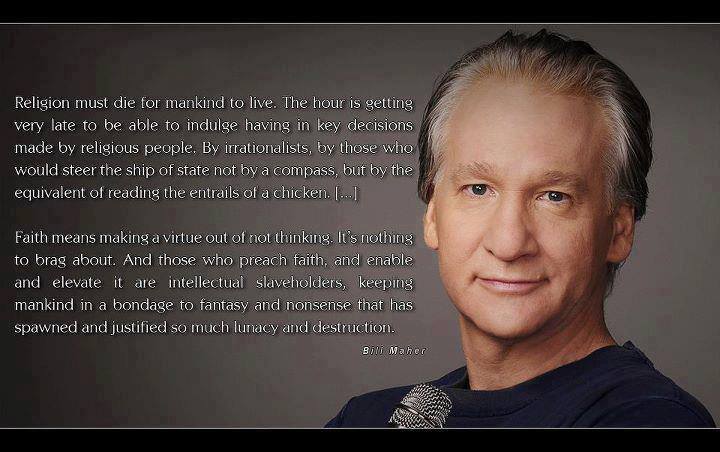
IRRATIONALITY: “Faith means making a virtue out of not thinking.” / Bill Maher
Reply

h/t: Atheism 411
Erich Seligmann Fromm
(March 23, 1900 – March 18, 1980)
German social psychologist, psychoanalyst, sociologist, humanistic philosopher, and democratic socialist
“Perhaps the greatest enjoyment is not so much in owning material things but in owning living beings. In a patriarchal society even the most miserable of men in the poorest of classes can be an owner of property—in his relationship to his wife, his children, his animals, over whom he can feel he is absolute master. At least for the man in a patriarchal society, having many children is the only way to own persons without needing to work to attain ownership, and without capital investment. Considering that the whole burden of childbearing is the woman’s, it can hardly be denied that the production of children in a patriarchal society is a matter of crude exploitation of women. In turn, however, the mothers have their own form of ownership, that of children when they are small. The circle is endless and vicious: the husband exploits the wife, she exploits the small children, and the adolescent males soon join the elder men in exploiting the women, and so on” (Fromm 70).
Fromm, Erich. To Have Or To Be?. New York: Harper & Row, 1976 Print.
 “A MAN WITH A CONVICTION is a hard man to change. Tell him you disagree and he turns away. Show him facts or figures and he questions your sources. Appeal to logic and he fails to see your point.” So wrote the celebrated Stanford University psychologist Leon Festinger (PDF), in a passage that might have been referring to climate change denial—the persistent rejection, on the part of so many Americans today, of what we know about global warming and its human causes. But it was too early for that—this was the 1950s—and Festinger was actually describing a famous case study in psychology.
[…]
The theory of motivated reasoning builds on a key insight of modern neuroscience (PDF): Reasoning is actually suffused with emotion (or what researchers often call “affect”). Not only are the two inseparable, but our positive or negative feelings about people, things, and ideas arise much more rapidly than our conscious thoughts, in a matter of milliseconds—fast enough to detect with an EEG device, but long before we’re aware of it. That shouldn’t be surprising: Evolution required us to react very quickly to stimuli in our environment. It’s a “basic human survival skill,” explains political scientist Arthur Lupia of the University of Michigan. We push threatening information away; we pull friendly information close. We apply fight-or-flight reflexes not only to predators, but to data itself.
We’re not driven only by emotions, of course—we also reason, deliberate. But reasoning comes later, works slower—and even then, it doesn’t take place in an emotional vacuum. Rather, our quick-fire emotions can set us on a course of thinking that’s highly biased, especially on topics we care a great deal about.
[…]
In Kahan’s research (PDF), individuals are classified, based on their cultural values, as either “individualists” or “communitarians,” and as either “hierarchical” or “egalitarian” in outlook. (Somewhat oversimplifying, you can think of hierarchical individualists as akin to conservative Republicans, and egalitarian communitarians as liberal Democrats.)
h/t: Planet Atheism
 h/t: Current
Society—especially capitalist societies, but also some earlier types such as feudalism—is divided by class, with a minority constituting a ruling class that lives by exploiting the direct producers. Thus, the majority is exploited and hence oppressed.
[…]
. . . [O]ne of capitalists’ favorite ideological ploys: individualism. We are the masters of our own fate, not society and its culture. If we fail, it is our own fault. We simply did not try hard enough or follow the right path. Individualism favors self-blame and a refusal even to look for social causes.
[…]
Enforced subordination calls forth coping reactions and leads to identities grounded in how well we manage to cope.
Examples of this kind of coping include what can be called “the good soldier” and “the sexy woman.” In the former, a person prides him or herself on the ability to demonstrate undying loyalty to a superior. In the latter, a woman prides herself on her ability to manipulate men in a world where men are dominant.
Related articles
Each religion has what can be called an immune system, a set of teachings and practices that guard against other beliefs or loss of belief. Cognitive dissonance theory and confirmation bias help us to understand how beliefs can remain unchanged in the face of devastating failures of prophecy or moral failings of leaders.
By Madison S. Hughes (07.21.2012)
Optimism is a refuge reserved for the delusional and the willfully ignorant. It serves as a shallow subterfuge for ignoramuses to protect them from the depressive realism of toilful thought.



 Always Question Authority