I am begging your pardon for a somber reflection amid the joy of accomplishment: not to be a wet rag on the festivities of graduation, but a bright light on the realities of post-secondary education.
[…]
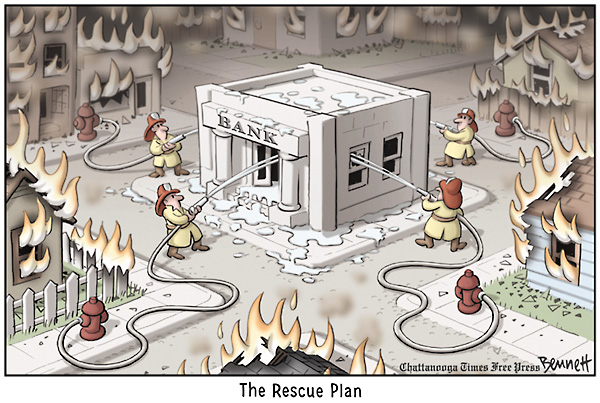
If you haven’t posted a good academic performance in high school, don’t believe a university, its leadership, advertisements or admissions officers who co-sign your promissory note with no responsibility for its payment obligation. They need paying students.
Stoking a deceitful dream on life support — an underappreciated, overfinanced, media-hyped charade — is the real deception, and the weight falls on your back, not theirs.
A shameful, elaborate sham, when one out of two college graduates this year are unemployable in their chosen field.
Look carefully at the costs and benefits of a university education. University officials may not tell you the truth: Enrollments could drop. Bankers will not tell you the truth: Interest income will fall off. Elected officials will not tell you the truth: Elections will be lost. Listen to those really concerned for you carefully.
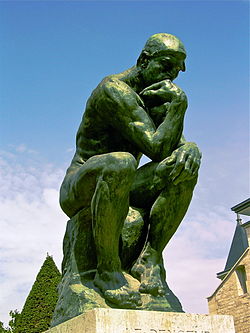
QUOTE: Epicurus
Epicurus (341 BCE – 270 BCE)
Ancient Greek philosopher as well as the founder
of the school of philosophy called Epicureanism
Why should I fear death? If I am, death is not. If death is, I am not. Why should I fear that which can only exist when I do not?
PHILOSOPHY: The Atheist and Death
Whether you die from a long, painful illness or quietly in your sleep or from violence or misadventure, the final moment for every single person is the same: UNconsciousness. That transition will either be quick and sharp, or slow, like falling asleep. Regardless, ONE second afterwards, you’re not there to experience anything. As Wittgenstein put it “Death is not an event in life: we do not live to experience death. If we take eternity to mean not infinite temporal duration but timelessness, then eternal life belongs to those who live in the present.” There is nothing to fear in the experience of death for, to the last second, we are alive and not dead; and then once dead, we experience nothing at all.
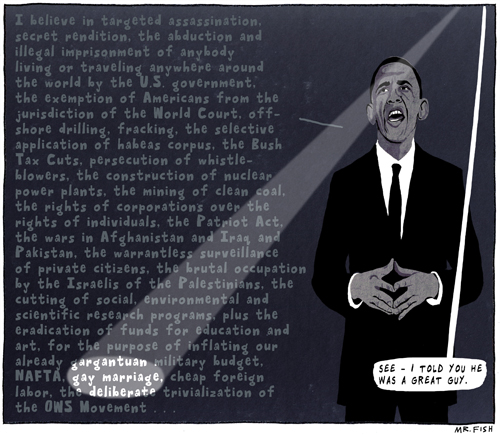
POLITICAL SATIRE: I Believe
Source: truthdig.org
EDUCATION: How the Conservative Worldview Quashes Critical Thinking
. . . High-stakes testing is an artifact of the conservative belief that education is about acquiring a required body of knowledge that’s been determined by experts. If it’s not in the book, you don’t need to know it. And the ultimate outcome — the purpose of this whole process — is to graduate with a credential that will certify your acceptability to the established hierarchies of the economic world.
In the conservative model, critical thinking is horrifically dangerous, because it teaches kids to reject the assessment of external authorities in favor of their own judgment — a habit of mind that invites opposition and rebellion.
[…]
Given this reality, the college-as-job-training model the conservatives are promoting looks patently insane. Subjects like logic and philosophy, anthropology and rhetoric, foreign languages and history provide the mental flexibility, deep perspective, and sharp critical thinking skills that allow one to make one’s own way on unfamiliar landscapes, a skill that’s useful when the world keeps changing around you. People with rich liberal arts backgrounds are also far better prepared for leadership roles, and better positioned to recognize and seize on whatever opportunities fate throws their way.
[…]
It’s obvious that stripping these mind-expanding fripperies out of the curriculum — as conservatives are proposing, often with no push-back at all from liberals — serves the narrow, functional conservative view of education and citizenship very well.
[…]
The conservatives are not wrong: for 150 years, the schools have been the leading promoter and disseminator of progressive values. It’s precisely because they understand the power of education to preserve democracy that they’re now doing their best to dismantle that system, and replace it with one that produces followers, subjects and serfs.
HUMOR: Eve’s First Prayer
“Lord, I have a problem.”
“What’s the problem, Eve?”
“I’m bored. I know that you provided me with this beautiful garden, and all of these wonderful animals, as well as that hilarious comedic snake, but I’m just not happy.”
“And why is that Eve?”
“Lord, I think I’m lonely, and I’m sick to death of apples.”
“Well, Eve, in that case, I shall create a man for you.”
“What’s a man, Lord?”
“A flawed creature, to be sure. He will have many bad traits: he’ll lie, cheat and be vain; all in all, he’ll give you a hard time. And he’ll be bigger, faster. But he will will like to hunt and kill things for you to eat along with the veggies I’ve provided. And I’ll create him in such a way that he will satisfy your physical needs – sometimes. He will be witless and will revel in childish things like fighting and kicking and throwing balls about – sometimes using sticks. He won’t be as smart as you, so he will also need your advice to think properly.”
“Sounds OK, I guess” says Eve, with ironically raised eyebrows.
“Well, you can have one then, but only on one condition.”
“And what’s that Lord?”
“As I said, he’ll be proud, arrogant and self-admiring . . . so you’ll have to let him believe that I made him before you. And that will have to stay our little secret — woman to woman.”
Source: The Atheism News Magazine
CAPITALISM: Interview / Richard Wolff on Challenging Capitalism in His New Book, “Occupy the Economy”
Can we challenge capitalism and prevail, considering that the top one percent control 50% of the available capital and the top five percent some 70% of the nation’s private funds? Richard Wolff is a closely followed Truthout contributor on economics. Currently, you can obtain his just-released “Occupy the Economy: Challenging Capitalism” directly from Truthout. If you want to know about alternatives to the current destructive course of our economy and how we, as a nation, got to this point, get your copy of “Occupy the Economy” by clicking here.
The following is an interview with Richard Wolff by Truthout staff member Matt Renner.
Matt Renner: In your introduction to the book, you discuss New York City Mayor Michael Bloomberg’s “cleanliness” excuse for clearing the original Occupy Wall Street encampment at Liberty Square. Why do you think so many public officials and right-wing pundits describe the occupiers as “unclean”?
Richard D. Wolff: Their problem has been, and continues to be, that they have no response to Occupy’s basic attack on the inequity and antidemocratic social conditions summarized in the confrontation of, “1 percent against 99 percent.” They know that the vast majority of Americans feel the truth of Occupy’s social criticism, experience it in their lives, and sympathize with protest against and efforts to change a system with such unjust outcomes. So, they can refute little and need instead to distract public opinion from what Occupy focuses on.
One way to do that is to assert the existence of and then condemn some other quality or dimension of Occupy. In Bloomberg’s pathetic example, the best he and his advisers could come up with was a reference to Zuccotti Park as being “unclean” so as to then position the mayor and the police as militant janitors. Everyone who knows even a little about New York City knows that the mayor and the police preside over many filthy subway tunnels, highways, streets, empty lots and abandoned buildings without doing anything to clean them. So, suddenly asserting the importance of cleanliness simply exposed them to the ridicule such a position deserved. I suspect something similar is underway when others, perhaps taking their cue from Bloomberg in New York, decided to follow the cleanliness ploy.
CORPORATE MEDIA: Thom Hartmann / Why is Fox so-called News Supporting the Christian Taliban?
SOCIAL ACTIVISM: Chris Hedges / Why OWS Frightens the Corporate Elite
“I don’t waste any emotional or intellectual energy on these elections. All hope is in the street. All hope is through acts of civil disobedience. We may not win, but if we’re going to win that’s the only place we are going to win.”