LOGIC: Is Homosexuality Unnatural?
Reply

 […]
[…]
It’s no surprise that so many influential thinkers and creative types have come from the ranks of these intellectual revolutionaries. Organized religion tends to reward people not for thinking creatively or critically, but for reciting and defending the dogmas of the previous generation. Throughout human history, it has consistently been true that hidebound theocracies have been mired in poverty, backwardness and intellectual stagnation, whereas the most dramatic advances have come about in times and places where people had the freedom to think for themselves, to freely question and debate. The lives of the men and women recounted here bear testimony to this.
1. Albert Einstein . . .
2. Robert Ingersoll . . .
3. W.E.B. DuBois . . .
4. Zora Neale Hurston . . .
5. Elizabeth Cady Stanton . . .
6. Asa Philip Randolph . . .
7. Robert Frost . . .
8. Emma Lazarus . . .
9. Yip Harburg . . .
[…]
. . . [I]t is hard to believe that morality is nothing more than ruling-class ideology. Most people become socialists [underline added] because they think that some things should be opposed not just because they threaten their own material interests, but because they think they are wrong in and of themselves—racism and sexism, imperialist wars that kill hundreds of thousands of people, a system that destroys people’s lives in order to make a tiny number of people fantastically rich.
[…]
IN HIS Economic and Philosophical Manuscripts of 1844 and elsewhere, Marx starts with a very different understanding of human nature. In this conception, we are not naturally competitive, rather, we are social creatures who cannot survive without cooperating with each other. Modern science confirms this view. Humans did not evolve as a collection of atomized individuals constantly at war with one another, but in social groups that depended on mutual support.
[…]
Warfare became a feature of human society only as a consequence of specific historical developments—crucially the establishment of permanent settlements with accumulated wealth, and the emergence of “social hierarchy, an elite, perhaps with its own interests and rivalries.” Rather than war being the expression of some general human propensity towards violence, it reflects the interests of those at the top of society who are most likely to benefit from it.
Evidence of this kind supports the view that human beings are not naturally violent, selfish, competitive, greedy, or xenophobic, it is not natural for human societies to be organized hierarchically or for women to have lower social status than men, and capitalism does not exist because it uniquely reflects human nature, as its defenders often claim.

Epicurus (341 BCE – 270 BCE)
Ancient Greek philosopher as well as the founder
of the school of philosophy called Epicureanism
Why should I fear death? If I am, death is not. If death is, I am not. Why should I fear that which can only exist when I do not?
. . . High-stakes testing is an artifact of the conservative belief that education is about acquiring a required body of knowledge that’s been determined by experts. If it’s not in the book, you don’t need to know it. And the ultimate outcome — the purpose of this whole process — is to graduate with a credential that will certify your acceptability to the established hierarchies of the economic world.
In the conservative model, critical thinking is horrifically dangerous, because it teaches kids to reject the assessment of external authorities in favor of their own judgment — a habit of mind that invites opposition and rebellion.
[…]
Given this reality, the college-as-job-training model the conservatives are promoting looks patently insane. Subjects like logic and philosophy, anthropology and rhetoric, foreign languages and history provide the mental flexibility, deep perspective, and sharp critical thinking skills that allow one to make one’s own way on unfamiliar landscapes, a skill that’s useful when the world keeps changing around you. People with rich liberal arts backgrounds are also far better prepared for leadership roles, and better positioned to recognize and seize on whatever opportunities fate throws their way.
[…]
It’s obvious that stripping these mind-expanding fripperies out of the curriculum — as conservatives are proposing, often with no push-back at all from liberals — serves the narrow, functional conservative view of education and citizenship very well.
[…]
The conservatives are not wrong: for 150 years, the schools have been the leading promoter and disseminator of progressive values. It’s precisely because they understand the power of education to preserve democracy that they’re now doing their best to dismantle that system, and replace it with one that produces followers, subjects and serfs.
“If there are good reasons for a tradition these reasons can stand on their own merits with no need to appeal to longevity. Using the past to veto the future is often the hallmark of those who just don’t have a better argument.”
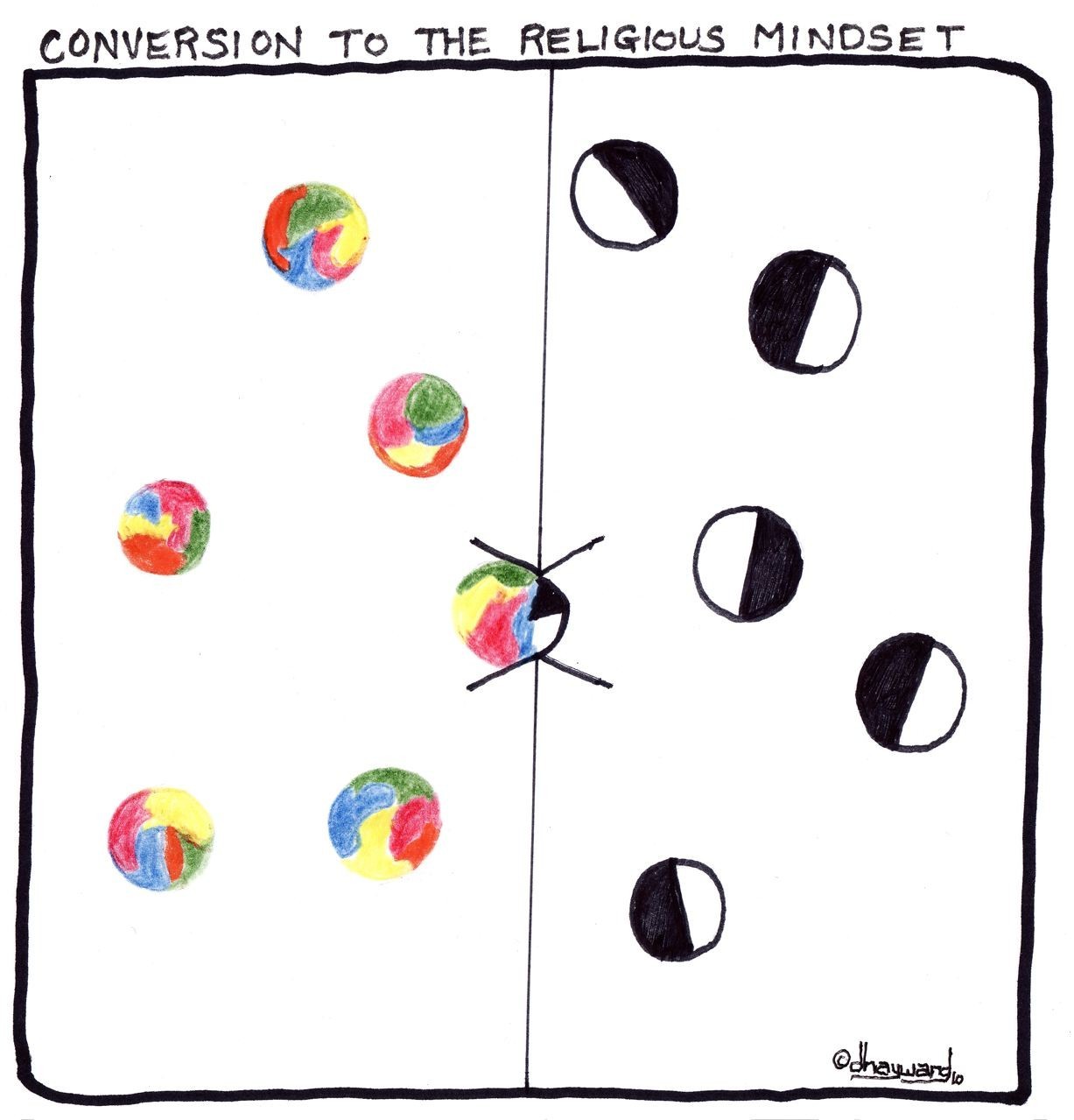 Religion has a way of dulling the mind and removing color from one’s life. Not true religion necessarily. Often the religious mindset causes a fundamentalist mindset. Colorful diversity becomes black and white homogeneity.
Source: nakedpastor.com