NOISE: “I’m Thinking. Please. Be Quiet.” / George Prochnik

Arthur Schopenhauer

I have long held the opinion that the amount of noise that anyone can bear undisturbed stands in inverse proportion to his mental capacity and may therefore be regarded as a pretty fair measure of it.
~ Arthur Schopenhauer, The World as Will and Representation, 1819

SLAMMING doors, banging walls, bellowing strangers and whistling neighbors were the bane of the philosopher Arthur Schopenhauer’s existence. But it was only in later middle age, after he had moved with his beloved poodle to the commercial hub of Frankfurt, that his sense of being tortured by loud, often superfluous blasts of sound ripened into a philosophical diatribe. Then, around 1850, Schopenhauer pronounced noise to be the supreme archenemy of any serious thinker.

His argument against noise was simple: A great mind can have great thoughts only if all its powers of concentration are brought to bear on one subject, in the same way that a concave mirror focuses light on one point. Just as a mighty army becomes useless if its soldiers are scattered helter-skelter, a great mind becomes ordinary the moment its energies are dispersed.

And nothing disrupts thought the way noise does, Schopenhauer declared, adding that even people who are not philosophers lose whatever ideas their brains can carry in consequence of brutish jolts of sound.

Continue reading . . .

CRITICAL THINKING: “Ignorance Begets Confidence: The Dunning-Kruger Effect”

Dunning-Kruger EffectAs it turns out, the reason most Christians are so difficult to budge from their religious views is because they know so little about their religion. This may seem counter-intuitive, but this is the essence of the Dunning-Kruger Effect, discovered and described by psychologists David Dunning and Justin Kruger, both then of Cornell University, in a 1999 paper titled: “Unskilled and Unaware of It: How Difficulties in Recognizing One’s Own Incompetence Lead to Inflated Self-Assessments.”

The D-K Effect was frequently suggested historically, notably by Charles Darwin –

“Ignorance more frequently begets confidence than does knowledge”

– and Bertrand Russell

“One of the painful things about our time is that those who feel certainty are stupid, and those with any imagination and understanding are filled with doubt and indecision.”

In a series of studies, Dunning and Kruger found this pattern across many skills, including reading comprehension, operating a motor vehicle, and playing chess or tennis. Apparently, those displaying the D-K Effect are so lacking in competence that they are even unaware of their incompetence, thus they tend to overestimate their level of skill and fail to recognize skill in others. Conversely, people with high levels of skill or knowledge tend to underestimate their standing relative to others. It seems that the more one knows, the more he realizes how little he knows.

Interestingly, but not surprisingly, Dunning and Kruger also found the Effect operative in broad tests of logical reasoning skills.

The D-K Effect goes a long way toward explaining why those with the least competence in their religion are the most sure they are right about it. Similarly, those who know the least about science are the most certain that it has nothing important to say about how the world works. And, in general, those who are the least adept at critical thinking are the most confident they have the answers.

Continue reading . . .

QUOTATION: Krishnamurti / “We submit to authority because all of us have this inward demand to be safe.”

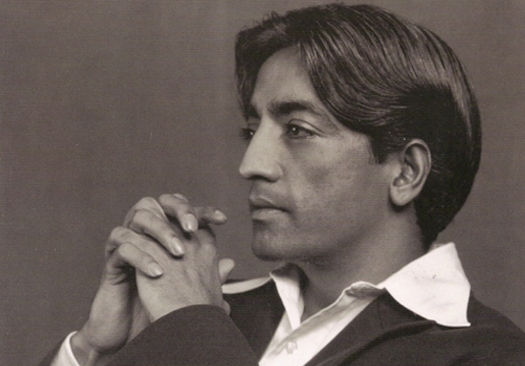
Jiddu Krishnamurti (May 11, 1895 – February 17, 1986)
Indian born speaker and writer on philosophical and spiritual subjects

One is afraid to think apart from what has been said by the leaders because one might lose one’s job, be ostracized, excommunicated, or put into a concentration camp. We submit to authority because all of us have this inward demand to be safe, this urge to be secure. So long as we want to be secure in our possessions, in our power, in our thoughts we must have authority, we must be followers; and in that lies the seed of evil, for it invariably leads to the exploitation of man by man. He who would really find out what truth is, what God is, can have no authority, whether of the book, of the government, of the image, or of the priest; he must be totally free of all that. This is very difficult for most of us because it means being insecure, standing completely alone, searching, groping, never being satisfied, never seeking success. But if we seriously experiment with it, then I think we shall find that there is no longer any question of creating or following authority because something else begins to operate which is not a mere verbal statement but an actual fact. The man who is ceaselessly questioning, who has no authority, who does not follow any tradition, any book or teacher, becomes a light unto himself. – Hamburg 1956,Talk 2

 ~ J. Krishnamurti Online

QUOTATION: Krishnamurti / “All conflict is this battle between the observer and the observed.”

Jiddu Krishnamurti (May 11, 1895 – February 17, 1986)
Indian born speaker and writer on philosophical and spiritual subjects

The division in our lives is the structure of thought, which is the action of the observer who thinks himself separate. He further thinks of himself as the thinker, as something different from his thought. But there can be no thought without the thinker and no thinker without the thought. So the two are really one. He is also the experiencer and, again, he separates himself from the thing he experiences. The observer, the thinker, the experiencer, are not different from the observed, the thought, the experienced. This is not a verbal conclusion. If it is a conclusion then it is another thought which again makes the division between the conclusion and the action which is supposed to follow that conclusion. When the mind sees the reality of this, the division can no longer exist. This is the whole point of what we are saying. All conflict is this battle between the observer and the observed. This is the greatest thing to understand.

 ~ J. Krishnamurti Online

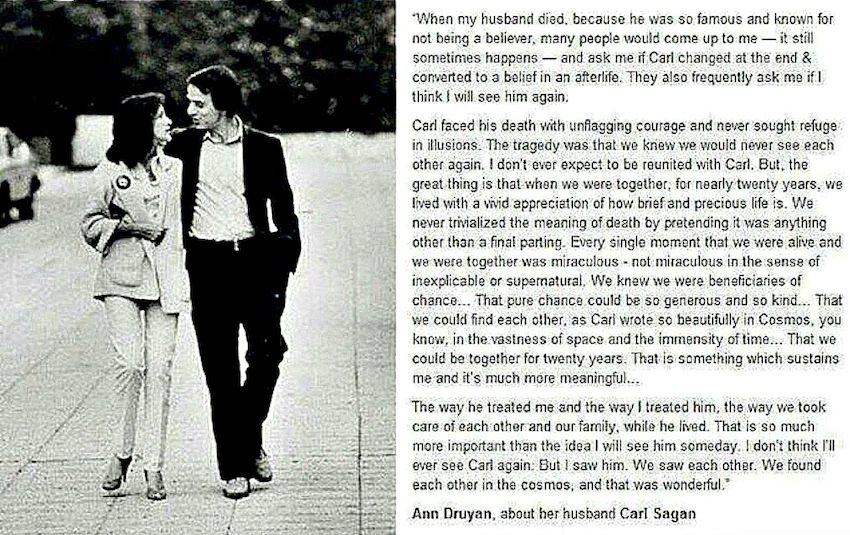
ATHEISM: “Ann Druyan About Her Husband Carl Sagan” / MUST READ!

Ann Druyan About Her Husband Carl Sagan h/t: Richard Dawkins Foundation Facebook

QUOTATION: Krishnamurti / “Fear is one of the greatest problems in life.”

Jiddu Krishnamurti (May 11, 1895 – February 17, 1986)
Indian born speaker and writer on philosophical and spiritual subjects

Fear is one of the greatest problems in life. A mind that is caught in fear lives in confusion, in conflict, and therefore must be violent, distorted and aggressive. It dare not move away from its own patterns of thinking, and this breeds hypocrisy. Until we are free from fear, climb the highest mountain, invent every kind of God, we will always remain in darkness. – Freedom from the Known,40

 ~ J. Krishnamurti Online

QUOTATION: Krishnamurti / “A Particular Corner of the Vast Field of Life”

Jiddu Krishnamurti (May 11, 1895 – February 17, 1986)
Indian born speaker and writer on philosophical and spiritual subjects

And what is yourself, the individual you? I think there is a difference between the human being and the individual. The individual is a local entity, living in a particular country, belonging to a particular culture, particular society, particular religion. The human being is not a local entity. He is everywhere. If the individual merely acts in a particular corner of the vast field of life, then his action is totally unrelated to the whole. So one has to bear in mind that we are talking of the whole not the part, because in the greater the lesser is, but in the lesser the greater is not. The individual is the little conditioned, miserable, frustrated entity, satisfied with his little gods and his little traditions, whereas a human being is concerned with the total welfare, the total misery and total confusion of the world. – Freedom from the Known,13

 ~ J. Krishnamurti Online

POETRY: “From Sage to Philistine”

 By Madison S. Hughes (04.11.2009)

Chomsky, Vidal, Vonnegut and Zinn
Sages of generations past.
How will their prodigious wits last?

With Philistines of today
As far as the eye can see.
Oh sad, how sad, can this truly be?