LITERARY NEUROSCIENCE: Corrie Goldman / “This is your Brain on Jane Austen, and Stanford Researchers are Taking Notes”

In an innovative interdisciplinary study, neurobiological experts, radiologists and humanities scholars are working together to explore the relationship between reading, attention and distraction – by reading Jane Austen.

Surprising preliminary results reveal a dramatic and unexpected increase in blood flow to regions of the brain beyond those responsible for “executive function,” areas which would normally be associated with paying close attention to a task, such as reading, said Natalie Phillips, the literary scholar leading the project.

[…]

Pioneering in a number of respects, her research is “one of the first fMRI experiments to study how our brains respond to literature,” Phillips said, as well as the first to consider “how cognition is shaped not just by what we read, but how we read it.”

Critical reading of humanities-oriented texts is recognized for fostering analytical thought, but if such results hold across subjects, Phillips said it would suggest “it’s not only what we read – but thinking rigorously about it that’s of value, and that literary study provides a truly valuable exercise of people’s brains.”

Read more . . .

EXPOSITORY ESSAY: John Kelly / “Robert Ingersoll, the ‘Great Agnostic’”

Photo credit: LIBRARY OF CONGRESS
Robert G. Ingersoll, shown between 1865 and 1880.

What was Robert Ingersoll’s address? Answer Man is confident many readers are wondering, “Who the heck was Robert Ingersoll?

Well, he is the most famous American you never heard of.

Col. Ingersoll — he fought for the Union in the Civil War after raising a cavalry regiment from Illinois — was a lawyer who counted the wealthy and powerful among his clients. He was a committed Republican who stumped for GOP candidates. He was a silver-tongued orator whose lectures drew thousands — and earned him thousands of dollars a pop. He was also, by all accounts, a really nice guy.

And Ingersoll accomplished all of this without believing in God.

Ingersoll’s disbelief was the quality that most fascinated the 19th-century audiences that packed theaters to hear him speak. He was known as the Great Agnostic. Some called him blasphemer or infidel.

Continue reading . . .

h/t: The Atheism News Magazine

BOOK EXCERPT: Craig Brown / “J.D. Salinger’s Letter To Ernest Hemingway”

The following is an excerpt from “Hello Goodbye Hello” [Simon & Schuster,26.95]:

J.D. Salinger seeks out Ernest Hemingway The Ritz Hotel, 15 place Vendôme, Paris Late August 1944.

The twenty-five-year-old Jerry Salinger is experiencing a terrible war. Of the 3,080 men of the 12th US Infantry who disembarked with him at Normandy on D-Day, only a third are still alive.

His regiment is the first to enter Paris. They are mobbed by happy crowds. Salinger’s job as an officer in the Counter-Intelligence Corps entails weeding out and interrogating Nazi collaborators. As they go through Paris, he and a fellow officer arrest a collaborator, but a crowd wrests their prisoner away and beats him to death.

Salinger has heard that Ernest Hemingway is in town. A writer himself, with a growing reputation for his short stories, he is determined to seek out America’s most famous living novelist. He feels sure he will find him at the Ritz, so he drives the jeep there. Sure enough, Hemingway is installed in the small bar, already bragging that he alone liberated Paris in general and the Ritz in particular.

Continue reading . . .

IN MEMORIAM: Mr Fish / “Rest in Peace, Dear Gore”

Cartoon credit: Mr Fish

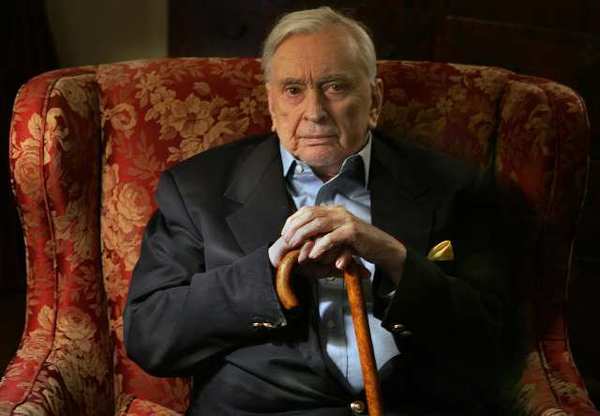
IN MEMORIAM: Gore Vidal / “Gore Vidal, American Writer And Cultural Critic, Dies” / (AUDIO)

Gore Vidal came from a generation of novelists whose fiction gave them a political platform. Norman Mailer ran for mayor of New York City; Kurt Vonnegut became an anti-war spokesman. And Vidal was an all-around critic. His novels sometimes infuriated readers with unflattering portraits of American history.

He also wrote essays and screenplays, and his play The Best Man currently has a revival on Broadway.

Vidal died Tuesday at his home in the Hollywood Hills, from complications of pneumonia. He was 86 years old.

Continue reading . . .

POETRY: “From Sage to Philistine”

 By Madison S. Hughes (04.11.2009)

Chomsky, Vidal, Vonnegut and Zinn
Sages of generations past.
How will their prodigious wits last?

With Philistines of today
As far as the eye can see.
Oh sad, how sad, can this truly be?

RELIGIOUS SATIRICAL POETRY: Bill Moyers / “The Poetry of Philip Appleman” / VIDEO

Bill talks with and invites readings by renowned poet, novelist, and editor Philip Appleman, whose creativity spans a long life filled with verse, fiction, philosophy, and religion. The author of nine books of poetry, three novels, and six volumes of non-fiction, Appleman’s most acclaimed work includes explorations of the life and theories of Charles Darwin. A scholar of Darwin, Appleman edited the critical anthology Darwin, and wrote the poetry books Darwin’s Ark and Darwin’s Bestiary, earning him praise for illuminating the “overwhelming sanity” of Darwin’s thought with clarity and wit. Appleman’s latest poetry collection is Perfidious Proverbs.

Watch video here . . .

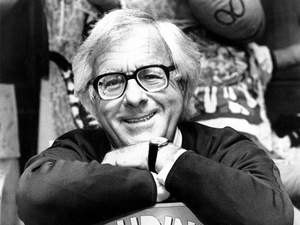
IN MEMORIAM: Ray Bradbury / “‘Fahrenheit 451’ Author Ray Bradbury Dies At 91” / (AUDIO)

Ray Bradbury, author of The Martian Chroniclesand Fahrenheit 451died Tuesday. He was 91. Bradbury was known for his futuristic tales — but he never used a computer, or even drove a car.

Bradbury was born in Waukegan, Ill., in 1920 and grew up during the Great Depression. He said it was a time when people couldn’t imagine the future, and his active imagination made him stand out. He once told Fresh Air‘s Terry Gross about exaggerating basic childhood fears, like monsters at the top of the stairs.

“As soon as I looked up, there it was, and it was horrible,” Bradbury remembers. “And I would scream and fall back down the stairs, and my mother and father would get up and sigh and say, ‘Oh, my gosh, here we go again.’ “

Bradbury dove into books as a child. Wild tales from authors Jules Verne and H.G. Wells captivated Bradbury — and made him dream of becoming a great author. So he started writing, churning out a short story every week during his teens. After his family moved to Southern California, he would escape to the basement of the UCLA library. There, he’d focus on his craft.

Read transcripts, and listen to audio here . . .

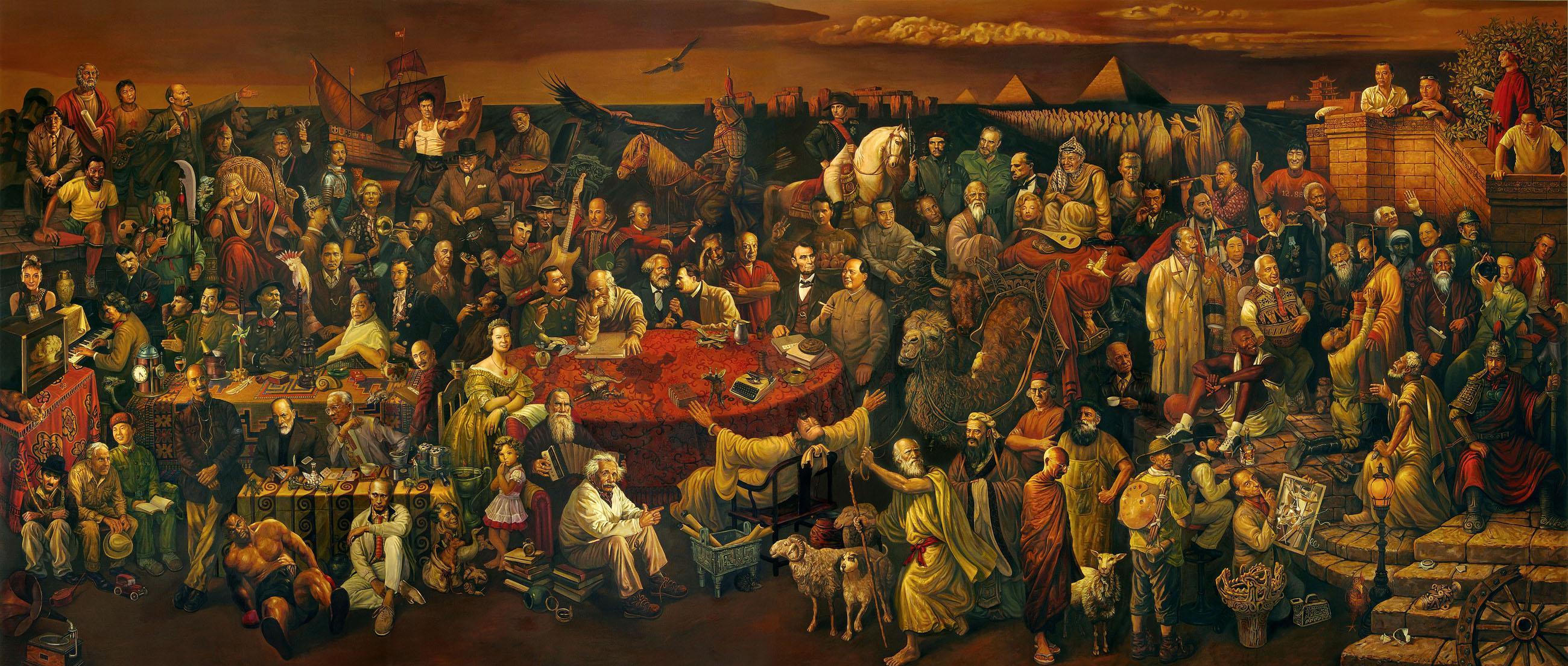
ART: Famous People Painting

This painting is truly amazing, but more surprising is that it has been “computerized”.

Click on the link below and see a larger version of the picture.

Roll your mouse over the characters and the program tells you who is, each of them.

Click in the body, and you will be re-directed to the Wikipedia life and history of each.

Click here . . .