 h/t: Monk’s Catacomb
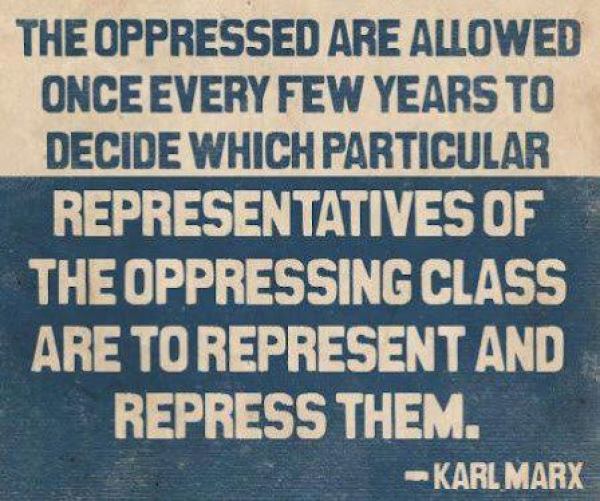
CLASS REPRESSION: Karl Marx / “The Oppressed Class”
Reply
h/t: Monk’s Catacomb
A Roman Catholic bishop was found guilty on Thursday of failing to report suspected child abuse, becoming the first American bishop in the decades-long sexual abuse scandal to be convicted of shielding a pedophile priest.
In a hastily announced bench trial that lasted a little over an hour, a judge found the bishop, Robert W. Finn, guilty on one misdemeanor charge and not guilty on a second charge, for failing to report a priest who had taken hundreds of pornographic pictures of young girls. The counts each carried a maximum penalty of one year in jail and a $1,000 fine, but Bishop Finn was sentenced to two years of court-supervised probation.
The verdict is a watershed moment in the priest sexual abuse scandal that has plagued the church since the 1980s. Bishops have been eager to turn the page on this era and have put in place extensive abuse prevention policies, which include reporting suspected abusers to law enforcement authorities. But the Kansas City case has served as a wake-up call to Catholics that the policies cannot be effective if the bishops do not follow them.
It seems like this election season “religious liberty” is a hot topic. Rumors of its demise are all around, as are politicians who want to make sure that you know they will never do anything to intrude upon it.
[…]
Quick Questions.” Just pick “A” or “B” for each question.
1. My religious liberty is at risk because:
A) I am not allowed to go to a religious service of my own choosing.
B) Others are allowed to go to religious services of their own choosing.2. My religious liberty is at risk because:
A) I am not allowed to marry the person I love legally, even though my religious community blesses my marriage.
B) Some states refuse to enforce my own particular religious beliefs on marriage on those two guys in line down at the courthouse.3. My religious liberty is at risk because:
A) I am being forced to use birth control.
B) I am unable to force others to not use birth control.[…]
10. My religious liberty is at risk because:
A) I am not allowed to teach my children the creation stories of our faith at home.
B) Public school science classes are teaching science.
Even though the no’s were again as loud if not louder than the aye’s on the third vote, Villagairosa said he had determined that two-thirds of those present had voted in favor. Boos filled the arena in response.
If a drinking game had been made out of Republicans calling America “exceptional” at the RNC, the hospitals would have been full of people with alcohol poisoning this week. Unfortunately, and a bit embarrassingly, what these exceptional Americans don’t seem to realize is that the term “American exceptionalism” actually comes from an insult to America, not a compliment.
Six years ago, Glenn Schellenberg decided to do an experiment.
Schellenberg works at the University of Toronto, where he studies the psychology of music. The idea behind his experiment couldn’t have been more straightforward: He simply wanted to play music for people and get them to rate how happy or sad that music made them feel.
These two emotions — happy and sad — are relatively easy to identify in music, and though there are different ways for music to convey emotion (through lyrics or what kind of instruments are used), Schellenberg says the tempo of a song and whether it’s in a major or minor key often strongly influences which emotion the song conveys.
“Happy-sounding songs typically tend to be in a major key, and they tend to be fast, [with] more beats per minute,” he says. “Conversely, sad-sounding songs tend to be slow in tempo, and they also tend to be in a minor key.”
So Schellenberg sat down with a grad student and told him to find both happy-sounding fast music in a major key and sad-sounding slow music in a minor key. Essentially, they were looking for emotionally clear music that they could play for their future research subjects.
But while the grad student had no trouble finding fast, happy-sounding music in a major key when he looked at older musical eras — from the classical period up through the 1960s — it got a lot harder when it came to contemporary pop music.