By Madison S. Hughes (04.11.2009)
Chomsky, Vidal, Vonnegut and Zinn
Sages of generations past.
How will their prodigious wits last?With Philistines of today
As far as the eye can see.
Oh sad, how sad, can this truly be?
By Madison S. Hughes (04.11.2009)
Chomsky, Vidal, Vonnegut and Zinn
Sages of generations past.
How will their prodigious wits last?With Philistines of today
As far as the eye can see.
Oh sad, how sad, can this truly be?
Bill talks with and invites readings by renowned poet, novelist, and editor Philip Appleman, whose creativity spans a long life filled with verse, fiction, philosophy, and religion. The author of nine books of poetry, three novels, and six volumes of non-fiction, Appleman’s most acclaimed work includes explorations of the life and theories of Charles Darwin. A scholar of Darwin, Appleman edited the critical anthology Darwin, and wrote the poetry books Darwin’s Ark and Darwin’s Bestiary, earning him praise for illuminating the “overwhelming sanity” of Darwin’s thought with clarity and wit. Appleman’s latest poetry collection is Perfidious Proverbs.
In this web-exclusive Bill Moyers Essay, Bill professes his lifelong love for libraries and their strong cultural value, and points to a crisis in public library funding across the country. But he also shares a unique and controversial community effort in Troy, Michigan that kept its library from becoming a political casualty, and serves as “a reminder of what can happen when we act together.”
Watch the full video below that explains how the Tea Party put the library in jeopardy, and how the town — with the help ad agency Leo Burnett — successfully fought back.
 Eric Hoffer a.k.a. “Longshoreman Philosopher” (July 25, 1902 – May 21, 1983)
American Social Writer, Author, Awarded the Presidential Medal of Freedom
The blindness of the fanatic is a source of strength (he sees no obstacles), but it is the cause of intellectual sterility and emotional monotony. The fanatic is also mentally cocky, and hence barren of new beginnings. At the root of his cockiness is the conviction that life and the universe conform to a simple formula – his formula. His is thus without the fruitful intervals of groping [uncertainty], when the mind is as it were in solution – ready for all manner of new reactions, new combinations and new beginnings. (Between the Devil and the Dragon. New York: Harper & Row Publishers, 1982, p. 287)
 Carlos Fuentes was the son of a Mexican diplomat and spent years living abroad, including in the United States. But Mexico — the country, its people and politics — was central to his writing.
Fuentes, one of the most influential Latin American writers, died Tuesday at a hospital in Mexico City at the age of 83. He was instrumental in bringing Latin American literature to an international audience, and he used his fiction to address what he saw as real-world injustices.
[…]
One of his most famous novels was The Old Gringo, about an American writer who travels to Mexico to die. It was made into a Hollywood movie starring Gregory Peck as the writer and Jimmy Smits as a Mexican general.
The Old Gringo became the first novel by a Latin American writer to make it to The New York Times best-seller list.
Read transcript, and listen to NPR’s Morning Edition AUDIO here . . .
A wonderful scene from the movie can be seen here:
For the last half-century, capitalism has been a taboo subject in the United States. . . . Politicians repeated, robot-style, that the “U.S. is the greatest country in the world” and that “capitalism is the greatest economic system in the world.” Those few who have dared to raise questions or criticisms about capitalism have been either ignored or told to go live in North Korea, China or Cuba as if that were the only alternative to pro-capitalism cheerleading.
[…]
Questioning and criticizing capitalism have been taboo, treated by federal authorities, immigration officials, police and most of the public alike as akin to treason. Fear-driven silence has substituted for the necessary, healthy criticism without which all institutions, systems, and traditions harden into dogmas, deteriorate into social rigidities, or worse. Protected from criticism and debate, capitalism in the United States could and has indulged all its darker impulses and tendencies. No public exposure, criticism and movement for change could arise or stand in its way as the system and its effects became ever more unequal, unjust, inefficient and oppressive. Long before the Occupy movement arose to reveal and oppose what U.S. capitalism had become, that capitalism had divided the 1 percent from the 99 percent.
[…]
Across the pages that follow, what emerges is the central importance of how capitalism very particularly organizes production: masses of working people generate corporate profits that others take and use. Tiny boards of directors, selected by and responsible to tiny groups of major shareholders, gather and control corporate profits, thereby shaping and dominating society. That tiny minority (boards and major shareholders) of those associated with and dependent upon corporations make all the basic decisions—how, what, and where to produce and what to do with the profits. The vast majority of workers within and residents surrounding those capitalist corporations must live with the results of corporate decisions. Yet they are systematically excluded from participating in making those decisions. Nothing more glaringly contradicts democracy than how capitalism organizes the corporate enterprises where working people produce the goods and services without which modern life for everyone would be impossible.
From: Occupy the Economy: Challenging Capitalism By Richard Wolff
During most of my years as a liberal Protestant minister, I never saw a contradiction between my Christian faith and the fact of evolution. Like many progressive Christians, I did not understand evolution as a challenge to the doctrine of divine creation ex nihilo; evolution was merely the mechanism that God used for creating life on our planet.
[…]
My indifference towards evolution changed dramatically when I ran across Richard Dawkins’ analogy of natural selection as “climbing Mount Improbable.” In that memorable and vivid metaphor, Dawkins illustrates the truly incremental and gradual nature of the evolutionary process. Opponents of evolution have contended that, while change within species can occur, the leap from one species to a new species is just too improbably great to have happened by purely natural processes. Outside assistance must have been involved. Dawkins addresses that claim by acknowledging that, yes, the leap from one species to the next seems improbably difficult—like scaling the cliff of a mountain to reach the peak. However, if one approaches the peak not from the formidable cliff but instead moves slowly along the slope on the other side of the mountain, reaching the peak of “Mount Improbable” becomes quite possible, although it might take a very long time.
[…]
Which core doctrines of Christianity does evolution challenge? Well, basically all of them. The doctrine of original sin is a prime example. If my rudimentary grasp of the science is accurate, then Darwin’s theory tells us that because new species only emerge extremely gradually, there really is no “first” prototype or model of any species at all—no “first” dog or “first” giraffe and certainly no “first” homo sapiens created instantaneously. The transition from predecessor hominid species was almost imperceptible. So, if there was no “first” human, there was clearly no original couple through whom the contagion of “sin” could be transmitted to the entire human race. The history of our species does not contain a “fall” into sin from a mythical, pristine sinless paradise that never existed.
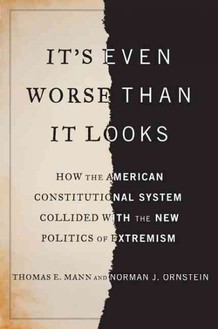
Congressional scholars Thomas Mann and Norman Ornstein are no strangers to D.C. politics. The two of them have been in Washington for more than 40 years — and they’re renowned for their carefully nonpartisan positions.
But now, they say, Congress is more dysfunctional than it has been since the Civil War, and they aren’t hesitating to point a finger at who they think is to blame.
“One of the two major parties, the Republican Party, has become an insurgent outlier — ideologically extreme; contemptuous of the inherited social and economic policy regime; scornful of compromise; unpersuaded by conventional understanding of facts, evidence and science; and dismissive of the legitimacy of its political opposition,” they write in their new book, It’s Even Worse Than It Looks.
Mann, a senior fellow at the Brookings Institution, and Ornstein, a resident scholar at the American Enterprise Institute, join Morning Edition host Steve Inskeep to talk about the book, which [came out 05.01.2012].
Zuccotti Park Press, a project of Adelante Alliance, a Brooklyn-based immigrant advocacy group, is releasing Occupy, a new book by Noam Chomsky, on May Day.
People seem to know about May Day everywhere except where it began, here in the United States of America. That’s because those in power have done everything they can to erase its real meaning. For example, Ronald Reagan designated what he called “Law Day” — a day of jingoist fanaticism, like an extra twist of the knife in the labor movement. Today, there is a renewed awareness, energized by the Occupy movement’s organizing, around May Day, and its relevance for reform and perhaps eventual revolution.



 Always Question Authority