
h/t: Planet Atheism
h/t: Planet Atheism
There is unrest in the forest
There is trouble with the trees
For the Maples want more sunlight
And the Oaks ignore their pleas
The trouble with the maples
And they’re quite convinced they’re right
They say the oaks are just too lofty
And they grab up all the light
But the oaks can’t help their feelings
If they like the way they’re made
And they wonder why the maples
Can’t be happy in their shade
There is trouble in the forest
And the creatures all have fled
As the maples scream ‘Oppression!’
And the oaks, just shake their heads
So the maples formed a union
And demanded equal rights
‘The oaks are just too greedy
We will make them give us light’
Now there’s no more oak oppression
For they passed a noble law
And the trees are all kept equal
By hatchet,
Axe,
And saw

SCHOOLS run along faith guidelines have hit the jackpot big time following Louisiana’s decision to siphon tens of millions of tax dollars out public schools and into religious institutions where only creationism will be taught.
In what is described here as “the nation’s boldest experiment in privatizing public education”, the state will pay private industry, businesses owners and church pastors to educate children.
Starting this fall, thousands of poor and middle-class kids will get vouchers covering the full cost of tuition at more than 120 private schools across Louisiana, including small, Bible-based church schools.
Said Governor Bobby Jindal, a Republican who muscled the plan through the legislature this spring over fierce objections from Democrats and teachers unions:
“We are changing the way we deliver education. We are letting [some of the most notoriously uneducated] parents [in the country] decide what’s best for their children, not government.”
Jindal is a [converted] devout Catholic, and this is what he believes:
“As Christians, we’re secure in the knowledge that in the Book of Life, our God wins. He gets off that cross. He beats Satan. We’re not called to be despondent. We are called to be salt and light and to be planting the seeds of the gospel.”
One complaint made about some atheist activists is that they are in fact anti-religious and anti-theistic bigots who are just expressing their personal bigotry, not arguing on behalf of atheists’ rights and liberty. There is a legitimate point to be made here, in that generalizing about an entire class of people for the actions of only some members is technically incorrect. What’s missing, though, is an appreciation for how the “silent” majority perpetuate and benefit from injustice.
I don’t think it’s a coincidence that this particular disagreement is not in the least bit new. Liberation and civil rights movements in the past have recognized that there is always a “silent” majority in privileged classes who do not actively oppress or discriminate, but at the same time help perpetuate and benefit from injustice precisely through their silence and inaction. They may not intend this and they may not even be conscious it, but this does not alter their complicity and it is because of this complicity that generalizations are made.
[…]
Generalizations made by a despised and discriminated-against minority cannot harm a privileged and powerful class — this is true whether it’s atheists generalizing about Christians, feminists generalizing about men, gays generalizing about straights, blacks generalizing about whites, etc. Those members of a privileged class who are supposedly giving the rest a bad name are, however, causing real harm to others. Some of that harm is even due to their generalizations about despised and excluded minorities which are made precisely to ensure that the marginalized remain powerless.
When other members of a privileged class — the ones who insist that they “aren’t like that” — expend more resources and worry over the former than the latter, then they are tacitly abetting and complicit in the harm being caused. Atheist generalizations about Christians or religious theists do not lead to any religious believers being excluded from power, being denied equality, or being forced into a second-class status.
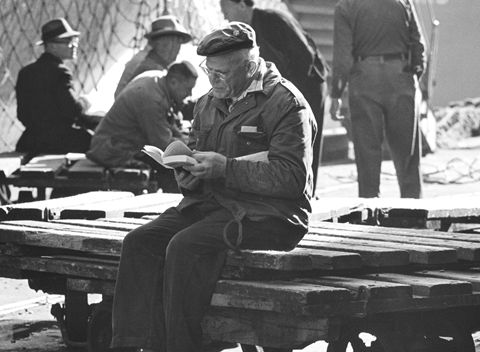 Eric Hoffer a.k.a. “Longshoreman Philosopher” (July 25, 1902 – May 21, 1983)
American Social Writer, Author, Awarded the Presidential Medal of Freedom
The blindness of the fanatic is a source of strength (he sees no obstacles), but it is the cause of intellectual sterility and emotional monotony. The fanatic is also mentally cocky, and hence barren of new beginnings. At the root of his cockiness is the conviction that life and the universe conform to a simple formula – his formula. His is thus without the fruitful intervals of groping [uncertainty], when the mind is as it were in solution – ready for all manner of new reactions, new combinations and new beginnings. (Between the Devil and the Dragon. New York: Harper & Row Publishers, 1982, p. 287)
[…]
. . . [I]t is hard to believe that morality is nothing more than ruling-class ideology. Most people become socialists [underline added] because they think that some things should be opposed not just because they threaten their own material interests, but because they think they are wrong in and of themselves—racism and sexism, imperialist wars that kill hundreds of thousands of people, a system that destroys people’s lives in order to make a tiny number of people fantastically rich.
[…]
IN HIS Economic and Philosophical Manuscripts of 1844 and elsewhere, Marx starts with a very different understanding of human nature. In this conception, we are not naturally competitive, rather, we are social creatures who cannot survive without cooperating with each other. Modern science confirms this view. Humans did not evolve as a collection of atomized individuals constantly at war with one another, but in social groups that depended on mutual support.
[…]
Warfare became a feature of human society only as a consequence of specific historical developments—crucially the establishment of permanent settlements with accumulated wealth, and the emergence of “social hierarchy, an elite, perhaps with its own interests and rivalries.” Rather than war being the expression of some general human propensity towards violence, it reflects the interests of those at the top of society who are most likely to benefit from it.
Evidence of this kind supports the view that human beings are not naturally violent, selfish, competitive, greedy, or xenophobic, it is not natural for human societies to be organized hierarchically or for women to have lower social status than men, and capitalism does not exist because it uniquely reflects human nature, as its defenders often claim.

Epicurus (341 BCE – 270 BCE)
Ancient Greek philosopher as well as the founder
of the school of philosophy called Epicureanism
Why should I fear death? If I am, death is not. If death is, I am not. Why should I fear that which can only exist when I do not?
Whether you die from a long, painful illness or quietly in your sleep or from violence or misadventure, the final moment for every single person is the same: UNconsciousness. That transition will either be quick and sharp, or slow, like falling asleep. Regardless, ONE second afterwards, you’re not there to experience anything. As Wittgenstein put it “Death is not an event in life: we do not live to experience death. If we take eternity to mean not infinite temporal duration but timelessness, then eternal life belongs to those who live in the present.” There is nothing to fear in the experience of death for, to the last second, we are alive and not dead; and then once dead, we experience nothing at all.
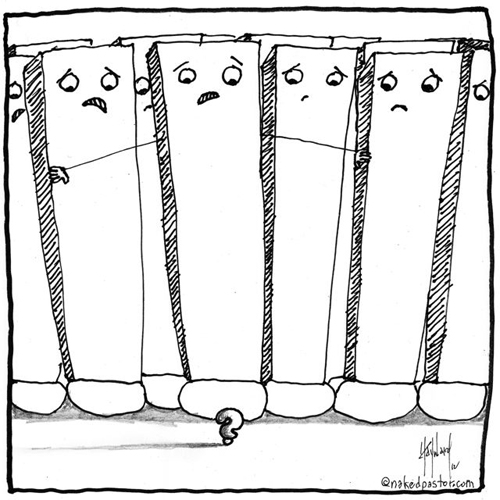 For some, even the smallest question can feel threatening. These exclamation marks… towers of certitude… are terrified of this tiny question. They intuitively know that it can completely undermine their dogmatism.
Source: nakedpastor.com

[…]
Analytic thinking undermines belief because, as cognitive psychologists have shown, it can override intuition. And we know from past research that religious beliefs—such as the idea that objects and events don’t simply exist but have a purpose—are rooted in intuition. “Analytic processing inhibits these intuitions, which in turn discourages religious belief,” [British Columbia psychologist, Ara] Norenzayan explains.

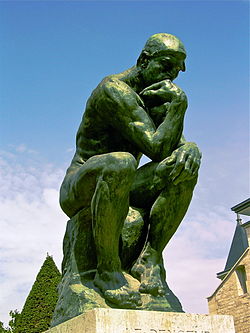

 Always Question Authority